Getting paid: pay apps, retainage, lien waivers and stop payment notices
Money moves down the contract chain from owner to general contractor to subs and suppliers, and paperwork moves up it. Here is where each document sits in time, from the first preliminary notice to the last retainage check, and what to do when payment stops.
How getting paid works
Each month a contractor bills for the work done with a pay application, usually on the AIA G702 summary and G703 continuation sheet. The owner pays it less retainage, and each tier passes payment down. Lien waivers travel the other way as proof that each payment arrived. If money stops, the lower tiers have statutory tools: a notice of nonpayment, a stop payment notice, a mechanics lien or, on bonded and public work, a payment bond claim. Most of those tools only work if a preliminary notice went out at the start.
The rules are state law. Names, deadlines and forms differ from state to state and between public and private jobs. The examples below name the state they come from.
The pay app: what you bill each month
A pay application is the contractor’s monthly request for payment for work completed and materials stored, measured against the schedule of values. On AIA-based contracts it has two parts: the G703 lists every line with its scheduled value, work completed this period and to date, stored materials, percent complete and balance to finish; the G702 rolls those up into the amount due and carries the certifications. The architect (or owner’s rep) reviews and certifies it, and the owner pays the certified amount by the date the contract sets.
Subcontractors bill the GC the same way, usually a few days earlier, so the GC can build its own application from theirs. A sub’s pay app late or wrong holds up the whole job’s billing.
Worked example (illustrative)
A drywall sub’s fourth pay app on an $850,000 subcontract, with 10 percent retainage. These numbers are made up to show the G702 arithmetic:
| Contract sum to date (with approved changes) | $850,000 |
|---|---|
| Work completed to date | $340,000 |
| Materials presently stored | $20,000 |
| Total completed and stored to date | $360,000 |
| Retainage (10% of $360,000) | −$36,000 |
| Total earned less retainage | $324,000 |
| Less previous certificates for payment | −$243,000 |
| Current payment due | $81,000 |
| Balance to finish, including retainage | $526,000 |
The sub sends a conditional progress waiver for $81,000 with this pay app. When the $81,000 clears, it sends an unconditional progress waiver for the same amount and through-date. The $36,000 of retainage is still owed and is not waived by either one. Build your own with the free pay application builder, and see each G702 line explained in Anatomy of a pay app.
Retainage: the money held back until the end
Retainage (retention in the UK, holdback in Canada) is a percentage of each payment the owner keeps until the work is finished, as security for completion and for paying the lower tiers. The contract sets the rate; 5 and 10 percent are common. Many states cap retainage on public work and some on private work, and some require it to be reduced once the job is half complete or released within a set time after completion.
Retainage flows down: the GC holds back from its subs at least what the owner holds from the GC, so a sub that finishes early can wait months for its last 10 percent. The GC carries retainage receivable from the owner and retainage payable to subs, and a retainage release usually needs final waivers, closeout documents and often the surety’s consent. Run the numbers with the retainage calculator. If you also work in Ontario, read holdback vs retainage: the Canadian version is statutory, not contractual.
The four lien waiver types
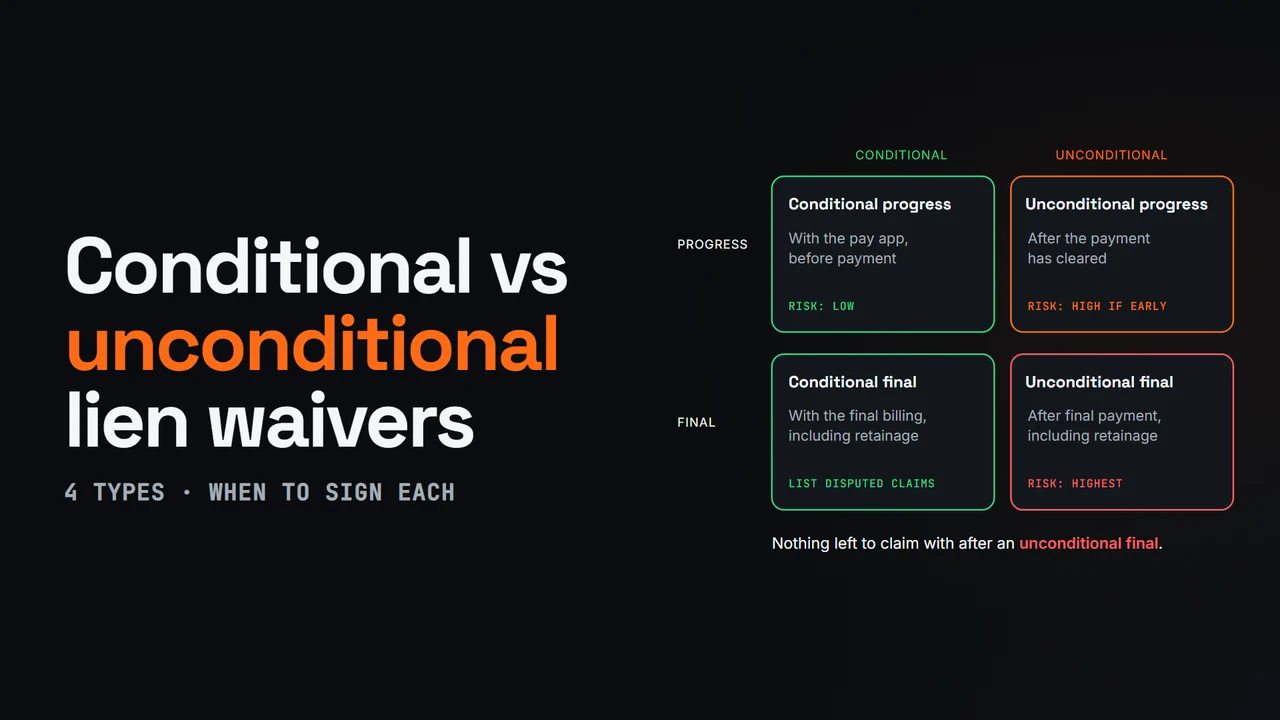
A lien waiver, also called a lien release, is a signed statement that gives up lien rights (and in California, stop payment notice and payment bond rights too) for a stated amount or period. Two questions pick the type: has the payment already been received, and is it a progress payment or the final one? The rule that keeps you safe: trade a conditional waiver for a payment, and sign an unconditional waiver only after the money has cleared.
| Waiver | When to sign it | What it gives up | Risk to the signer | California form |
|---|---|---|---|---|
| Conditional progress | With a progress pay app or invoice, before payment | Rights for work through the stated date, only once the stated amount is paid | Low: void if the payment never arrives | Civ. Code § 8132 |
| Unconditional progress | After the progress payment has actually cleared | Rights for work through the stated date, immediately on signing | High if signed early: rights are gone even if the check bounces | Civ. Code § 8134 |
| Conditional final | With the final billing, including retainage | All rights for the job, once the final amount is paid | Low, but list any disputed claims you are keeping | Civ. Code § 8136 |
| Unconditional final | After final payment, including retainage, has cleared | All remaining rights on the job, immediately | Highest: nothing left to claim with afterwards | Civ. Code § 8138 |
California, Texas, Georgia and several other states prescribe the wording, and a waiver that doesn’t follow the statutory form may not be enforceable; in Florida the statutory form is available but optional. Elsewhere the parties negotiate the wording, and broad waivers can release more than the payment, such as claims for pending change orders. Read every waiver for its amount, through-date and exceptions before signing it, and collect waivers from lower-tier suppliers, not just the subs you pay directly. The deeper version is in the lien waiver glossary entry.
Watch the explainer · 1:59
Conditional vs unconditional lien waivers
- 0:00Two questions pick the waiver
- 0:16Conditional vs unconditional
- 0:38Progress vs final
- 0:57One payment, two waivers
- 1:21State forms and exceptions
- 1:42Waivers in accounts payable
Read the transcript
A lien waiver, or lien release, is a signed document that gives up lien rights for a stated amount or period, usually in exchange for payment. Two questions pick the type: has the payment already been received, and is it a progress payment or the final one?
A conditional waiver takes effect only once the stated payment is actually received. If the money never arrives, it's void. An unconditional waiver takes effect the moment it's signed, even if the check later bounces. So the rule is: trade a conditional waiver for a payment, and sign the unconditional only after the money has cleared.
Progress waivers cover work through a stated date, one billing period at a time. Final waivers cover the whole job, including retainage, and go in with the final billing. The unconditional final is the riskiest to sign early: once it's signed, there's nothing left to claim with.
Here's an illustrative month. A sub bills ninety thousand dollars for March, less ten percent retainage, so eighty-one thousand is due. With its pay app, it sends a conditional progress waiver for eighty-one thousand through March thirty-first. When that payment clears, it sends the unconditional for the same amount and date. The nine thousand of retainage is still owed, and it's listed as an exception on both.
California, Texas, Georgia and several other states prescribe the wording, and a waiver that doesn't follow the statutory form may not be enforceable. Elsewhere, a broad waiver can release retainage or pending change orders, so read the exceptions before you sign. General information, not legal advice.
In the os.construction Accounting module, Accounts Payable records all four waiver types, holds a bill when a required waiver is missing, and lets vendors upload waivers through their portal.
Video page with chaptersMore in Construction concepts explained
The notices, side by side
Five documents get confused because they sound alike. Each has a different sender, recipient, timing and effect.
| Document | Who sends it | To whom | When | What it does |
|---|---|---|---|---|
| Preliminary notice | Sub or supplier | Owner, GC, lender | Early: in California within 20 days of first furnishing | Preserves the right to lien, stop notice or bond claim later |
| Notice of commencement | Owner | Recorded publicly, posted on site | Before work starts, in states that use it (e.g. Florida) | Tells lien claimants who to notify, and sets priority |
| Notice of nonpayment | Unpaid sub or supplier | GC and surety, sometimes owner | After nonpayment, by a statutory deadline where required | Warns, or keeps a bond claim alive (e.g. Florida, 90 days) |
| Stop payment notice | Unpaid sub, supplier or laborer | Owner, construction lender or public agency | Before the lien or notice deadline runs out | Freezes undisbursed construction funds for the claim |
| Mechanics lien | Unpaid contractor, sub or supplier | Recorded against the property | Within the recording window after completion or last work | Clouds title; can be foreclosed to force payment |
Preliminary notice. Sent at the start of a sub’s or supplier’s work to tell the owner (and usually the GC and lender) who is on the job. In California it is a prerequisite: a claimant must give it before recording a lien, giving a stop payment notice or claiming on a payment bond (Civ. Code § 8200), and it reaches back only 20 days before it is served (§ 8204). Florida’s version is the notice to owner; Texas uses monthly notices of unpaid claims instead.
Notice of commencement. In states that use one, such as Florida, the owner records a notice of commencement before work starts, naming the owner, contractor, lender and surety. Lower tiers use it to know whom to notify. Its bookend is the notice of completion, which in California shortens the window to record a lien.
Notice of nonpayment and stop payment notice
What is a notice of nonpayment? A notice of nonpayment (notice of non-payment) is a written notice from an unpaid sub or supplier to the GC and surety, and sometimes the owner, that it hasn’t been paid. In some states it is a required step with a deadline: on a payment-bonded private job in Florida, a claimant not in direct contract with the contractor generally must serve it within 90 days after its final furnishing (Fla. Stat. § 713.23). In Texas the equivalent is a monthly notice of the unpaid claim to the owner and original contractor, due by the 15th day of the third month after the month the work was done (second month on residential jobs) (Tex. Prop. Code § 53.056). Elsewhere it is an informal warning letter before a lien or bond claim.
What is a stop payment notice? A stop payment notice is a claim served on the owner, the construction lender or a public agency that requires it to withhold enough of the remaining project funds to cover the claim. It traps the money, not the property. In California, a claimant on a private job can give a lender a bonded notice with a bond of 125 percent of the claim (§ 8532); anyone who wants the frozen funds released can post a release bond of 125 percent of the amount claimed (§ 8510); and the claimant must sue to enforce the notice no sooner than 10 days after giving it and no later than 90 days after the time to give it expires, or the notice stops being effective (§ 8550). Public works follow a parallel set of sections starting at § 9350.
Mechanics lien. A lien is recorded against the property and can ultimately be foreclosed. In California, a direct contractor generally must record within 90 days after completion, or 60 days after the owner records a notice of completion; subs and suppliers within 90 days after completion, or 30 days after a notice of completion (§§ 8412, 8414), and the lien must be enforced by a lawsuit within 90 days after recording (§ 8460). Public property generally can’t be liened, so on public work the payment bond takes its place; see construction bonds explained.
For a GC, any of these means money that went to the job didn’t reach the bottom of the chain. Find out who wasn’t paid and why, then pay through a joint check in exchange for releases, dispute the claim, or bond around it. We walk through the three side by side in notice of non-payment vs stop payment notice vs mechanics lien.
A clean billing month, step by step
Most payment disputes start as a missing document. This is the order that keeps a GC’s pay app moving and its lower tiers protected.
- Set up notices at the start. Log the notice of commencement and every preliminary notice you receive. Each one names a party whose waiver you may need later.
- Collect sub pay apps by the cutoff. Check each against its subcontract SOV, approved changes, stored materials and retainage.
- Collect conditional waivers for this period from each sub, for the amount it is billing, and unconditional waivers for last period’s payments.
- Build and certify your G702/G703. Approved change orders only; stored materials with backup; retainage at the contract rate.
- Submit with your own conditional waiver and the lower-tier waivers the owner or lender requires.
- Pay down promptly when paid. Many states and contracts set a deadline for passing payment to subs. Hold a sub’s payment if its own suppliers’ waivers are missing.
- Answer any notice the same week. A notice of nonpayment or stop notice is cheaper to resolve before the next draw than after it.
In os.construction, payment applications build the G702/G703 from the contract’s schedule of values and executed change orders, with retainage calculated per line on work and stored materials. In the Accounting module, Accounts Receivable tracks retainage receivable and refuses a release until the closeout documents you require are on file, and Accounts Payable records conditional and unconditional, progress and final waivers, holds a bill when a waiver is missing or a stop pay is on the vendor, and supports joint checks. Generating waiver requirements on the pay app checklist is planned (lien waiver tracking). os.construction does not file statutory notices or liens for you.
Glossary
- Pay Application (Pay App)
- AIA G702
- AIA G703
- Schedule of Values (SOV)
- Stored Materials
- Retainage
- Retainage Release
- Retainage payable
- Retainage receivable
- Lien Waiver
- Conditional Lien Waiver
- Unconditional Lien Waiver
- Preliminary Notice
- Notice of Commencement (NOC)
- Notice of Nonpayment
- Stop Payment Notice
- Mechanics Lien
- Notice of Completion
- Joint Check
- Pay-When-Paid
- Payment Bond
Common questions
What is a stop payment notice?
A stop payment notice (often just “stop notice”) is a written claim that an unpaid subcontractor, supplier or laborer serves on the owner, the construction lender or, on public work, the public agency. It requires the recipient to hold back enough of the money still owed on the project to cover the claim. It attaches to the construction funds, not the property. California is the best-known example; other states have similar fund-trapping notices under different names.
What is a notice of nonpayment?
A notice of nonpayment (also written notice of non-payment) is a written notice from an unpaid sub or supplier to the general contractor, the surety or the owner saying it has not been paid. In some states it is a statutory step with a deadline. In Florida, for example, a claimant on a bonded private job who is not in direct contract with the contractor generally must serve it within 90 days after its final furnishing of labor, services or materials to keep a payment bond claim.
What is the difference between a conditional and an unconditional lien waiver?
A conditional waiver gives up lien rights only if and when the stated payment is actually received. An unconditional waiver gives them up as soon as it is signed, whether or not the money arrives. The safe pattern is to exchange a conditional waiver for a payment, and sign the unconditional only after the funds have cleared.
What is a lien release in construction?
In everyday use, lien release means the same as lien waiver: a signed document in which a contractor, sub or supplier gives up its lien rights for a stated amount or period, usually in exchange for payment. It is also used for a document that removes a lien that has already been recorded against the property. Check which one a request is asking for.
When is retainage released?
When the contract says. Many contracts release most retainage at substantial completion and the rest at final completion, after the punch list, closeout documents, final lien waivers and often the surety’s consent are in. Some contracts reduce retainage once the work is half complete. State law caps or times retainage on many public projects and some private ones.
Do subcontractors need to send a preliminary notice?
Often, yes, depending on the state. In California, a sub or supplier generally must give the 20-day preliminary notice to the owner, the direct contractor and any construction lender before it can record a lien, give a stop payment notice or claim on a payment bond (Civil Code §§ 8200, 8204). Other states have their own notice-to-owner or notice-to-contractor rules, and some have none for certain tiers.
Keep going
Sources and further reading
- California Civil Code, works of improvement: § 8200 (preliminary notice), §§ 8132–8138 (statutory waiver and release forms), § 8510 (release bond), § 8550 (enforcing a stop payment notice).
- Florida Statutes § 713.23: payment bonds and the notice of nonpayment.
- Texas Property Code chapter 53: mechanic’s, contractor’s or materialman’s liens, including § 53.056 notices.
- AIA Contract Documents: G702 and G703, A201 general conditions (payments and retainage).
- Associated General Contractors of America (AGC).
General information only, not legal advice. Rules vary by state, by public or private project and by contract, and they change.
Keep exploring
Related across os.construction
- BlogRetainage, lien waivers and pay apps on one recordA pay app, the retainage it withholds and the lien waivers that release it are one transaction. Most contractors track them in three places. Here's how each piece works and why they belong together.
- GlossaryStop Payment NoticeA claim served on an owner or construction lender that requires them to withhold enough undisbursed project funds to cover an unpaid sub or supplier.
- GlossaryMechanics LienA legal claim against a property filed by an unpaid contractor, subcontractor or supplier who improved it.
- BlogNotice of non-payment vs stop payment notice vs mechanics lienA notice of non-payment warns people, a stop payment notice freezes the money and a mechanics lien attaches to the property. What each one does, who sends it, the deadlines in California, Florida and Texas, and what a GC should do when one lands.
- DocsPay apps, SOV and retainageHow progress billing works with a schedule of values, AIA G702/G703 and retainage, worked through Pay App
- Free toolMechanics lien deadlines by statePreliminary notice, lien filing and enforcement deadlines for 50 states and DC, with statutes.
Want this on live job data?
os.construction builds G702/G703 pay apps from the contract, tracks retainage both ways, and holds AP payments when a lien waiver is missing.
14-day free trial. Pricing for paid plans isn't set yet. Talk to us. Already have an account? Sign in →
General information, not legal advice. Lien, notice, waiver and retainage rules are set by each state (and province), change often and have strict deadlines. Read the statute and your contract, and talk to a construction attorney about a specific situation.