A lien waiver, also called a lien release, is a signed document in which a contractor, subcontractor or supplier gives up its right to file a mechanics lien for a stated amount or period, usually in exchange for payment. Owners and lenders collect waivers from every tier as proof that money paid into the job reached the people who did the work.
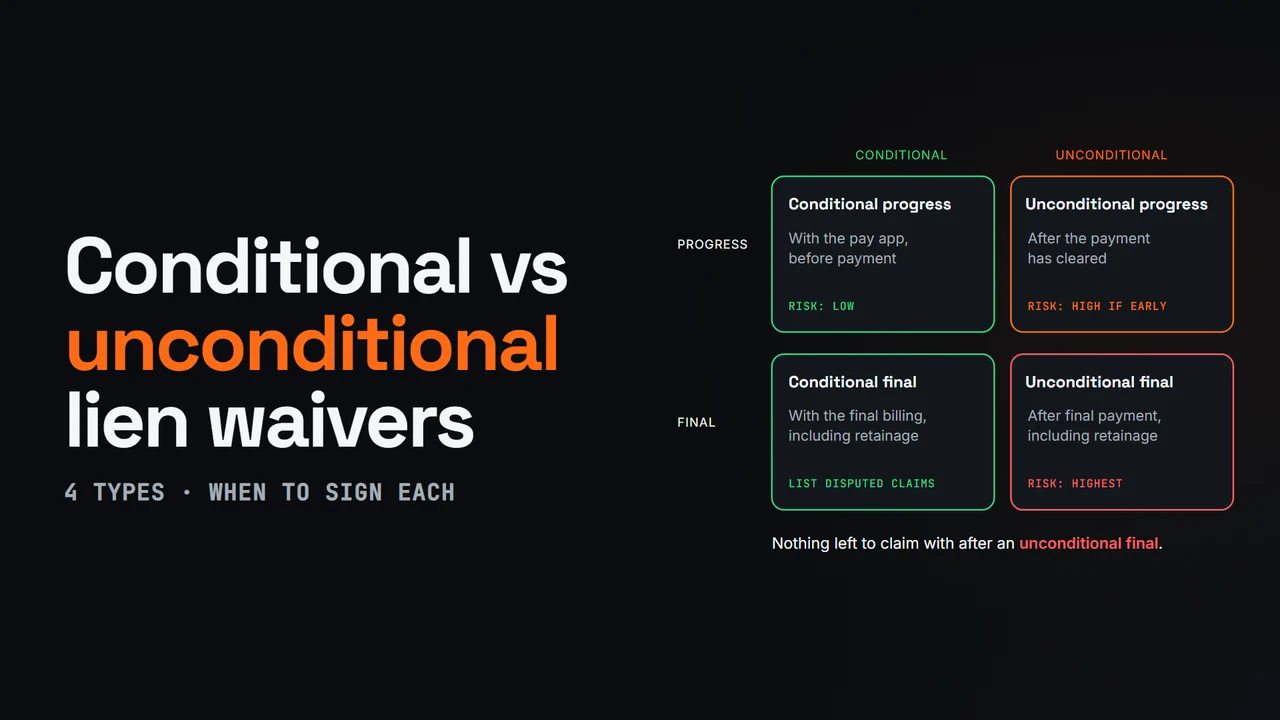
Waivers come in four types, built from two choices: conditional or unconditional (does the waiver take effect only once the payment is received, or as soon as it is signed?) and progress or final (does it cover a payment period, or the whole job?). Some states prescribe the exact wording; elsewhere it is negotiated. This page is general information, not legal advice, and lien law varies by state.
Why it matters
A mechanics lien lets an unpaid party attach the property even if the owner already paid the general contractor in full. That means an owner can end up paying twice for the same work. Lien waivers are how owners and lenders manage that risk: before releasing a draw, they want waivers showing that the previous payment reached the subs and suppliers below the GC.
For the GC, waivers work both ways. Missing waivers from one sub or supplier can hold the whole pay application, including the GC’s own money. And collecting waivers from your subs, and their suppliers, before paying them again is how you avoid a lien or stop payment notice for money you already paid. For a sub or supplier the risk runs the other way: sign the wrong waiver at the wrong time and you can give up your lien rights without being paid.
The four types
| Type | When to sign it | What it gives up |
|---|---|---|
| Conditional progress | With a progress billing, before payment | Rights through the stated date, only once the stated amount is paid |
| Unconditional progress | After the progress payment has cleared | Rights through the stated date, immediately |
| Conditional final | With the final billing, including retainage | All rights on the job, once the final amount is paid |
| Unconditional final | After final payment has cleared | All remaining rights on the job, immediately |
The rule that keeps you out of trouble: trade a conditional waiver for a payment, and sign the unconditional only after the money has cleared. California’s statutory unconditional forms carry a warning in capital letters for exactly this reason.
How it works
- Billing. With each pay app, the sub sends a conditional progress waiver for the amount it is billing, through the period end date.
- Lower tiers. The GC collects the same from each sub, and often from lower-tier suppliers that served a preliminary notice.
- The draw. The GC submits its own conditional waiver with its pay app, plus the lower-tier waivers the owner or lender requires.
- Payment. Once paid, each tier pays the next, often by joint check where a supplier is at risk.
- Unconditional waivers. After funds clear, each party sends an unconditional progress waiver for what it received. These usually come in with the next month’s pay app.
- Closeout. At the end, conditional final waivers go in with the final billing and retainage release, and unconditional finals follow once the final payment clears.
Statutory forms
California, Texas, Georgia and several other states prescribe the wording of waiver and release forms, and a waiver that does not follow the statutory form may be unenforceable. California’s four forms are in Civil Code §§ 8132 (conditional progress), 8134 (unconditional progress), 8136 (conditional final) and 8138 (unconditional final), and they waive stop payment notice and payment bond rights as well as lien rights. Florida provides statutory forms in § 713.20 but does not require them. In states without a statutory form, the wording is negotiated, and owner or lender forms are often broader than they need to be.
Worked example
Illustrative: a drywall sub on a private job bills $90,000 of work for March, with 10% retainage, so $81,000 is due. With its pay app it sends a conditional progress waiver for $81,000 through March 31. The GC includes it in its own draw. When the sub’s $81,000 clears in late April, the sub sends an unconditional progress waiver for $81,000 through March 31, and the GC attaches it to April’s pay app. The sub’s $9,000 of retainage for March is still owed and is listed as an exception on both waivers. If the sub owes its drywall supplier for March deliveries, the GC asks for the supplier’s waiver too, or pays by joint check, before the next payment.
Common mistakes
- Signing an unconditional waiver before the payment clears.
- Amounts or through-dates that don’t match the payment, or gaps between consecutive waivers.
- Collecting waivers from subs but not from their sub-tier suppliers.
- Using a generic form in a state that requires the statutory one.
- Signing a waiver that releases retainage or pending change order claims you meant to keep, instead of listing them as exceptions.
- Accepting a waiver from someone not authorized to sign for the company.
How os.construction handles it
In the Accounting module, Accounts Payable records conditional or unconditional, progress or final waivers for a vendor or a lower-tier party, and an unconditional waiver can name the AP payment it covers. Lien waiver mode decides which bills are held without one, and a final retainage release requires the vendor’s conditional final waiver, its prior unconditional progress waivers and every lower tier’s unconditional final waiver. Vendors can upload waivers in their portal, where they stay pending until an AP user accepts them. Generating waiver requirements automatically from each pay app and showing them on the pay app checklist is planned; see lien waiver tracking. For where waivers sit in the whole payment chain, read getting paid in construction.
Watch the explainer · 1:59
Conditional vs unconditional lien waivers
- 0:00Two questions pick the waiver
- 0:16Conditional vs unconditional
- 0:38Progress vs final
- 0:57One payment, two waivers
- 1:21State forms and exceptions
- 1:42Waivers in accounts payable
Read the transcript
A lien waiver, or lien release, is a signed document that gives up lien rights for a stated amount or period, usually in exchange for payment. Two questions pick the type: has the payment already been received, and is it a progress payment or the final one?
A conditional waiver takes effect only once the stated payment is actually received. If the money never arrives, it's void. An unconditional waiver takes effect the moment it's signed, even if the check later bounces. So the rule is: trade a conditional waiver for a payment, and sign the unconditional only after the money has cleared.
Progress waivers cover work through a stated date, one billing period at a time. Final waivers cover the whole job, including retainage, and go in with the final billing. The unconditional final is the riskiest to sign early: once it's signed, there's nothing left to claim with.
Here's an illustrative month. A sub bills ninety thousand dollars for March, less ten percent retainage, so eighty-one thousand is due. With its pay app, it sends a conditional progress waiver for eighty-one thousand through March thirty-first. When that payment clears, it sends the unconditional for the same amount and date. The nine thousand of retainage is still owed, and it's listed as an exception on both.
California, Texas, Georgia and several other states prescribe the wording, and a waiver that doesn't follow the statutory form may not be enforceable. Elsewhere, a broad waiver can release retainage or pending change orders, so read the exceptions before you sign. General information, not legal advice.
In the os.construction Accounting module, Accounts Payable records all four waiver types, holds a bill when a required waiver is missing, and lets vendors upload waivers through their portal.
Video page with chaptersMore in Construction concepts explained
FAQ
What is a lien release in construction?
In construction, a lien release usually means the same thing as a lien waiver: a signed document in which a contractor, subcontractor or supplier gives up its right to file a mechanics lien for a stated payment or period. The term is also used for a document that removes a lien already recorded against the property, so check which one is being asked for.
What are the four types of lien waivers?
Conditional progress, unconditional progress, conditional final and unconditional final. Conditional waivers take effect only when the stated payment is actually received; unconditional waivers take effect when signed. Progress waivers cover work through a stated date; final waivers cover the whole job, including retainage.
Should I sign an unconditional lien waiver before I get paid?
Generally no. An unconditional waiver gives up your lien rights for the stated amount as soon as you sign it, even if the check later bounces or never arrives. The usual practice is to give a conditional waiver in exchange for the payment and sign the unconditional waiver only after the funds have cleared.
Do lien waivers need to be notarized?
Only where state law or the contract requires it. Most states do not require notarization, a few have required it in some circumstances, and those rules have changed over time. Some statutory forms, such as Georgia's, also have their own execution requirements. Check the statute for the project's state and what the owner or lender asks for.
Does a lien waiver waive retainage or change order claims?
It can, depending on the wording. A progress waiver that says it covers all work through a date may be read to cover retainage and pending change orders for that work. Many statutory forms include a space for exceptions, such as disputed claims or unpaid retainage. List anything you are keeping before you sign.