An unconditional lien waiver is a signed release of lien rights for a stated amount that takes effect as soon as it is signed and delivered, whether or not the money actually arrived. It works as proof that payment reached the contractor, sub or supplier. Because it gives no protection if payment fails, sign one only after the funds have cleared.
It comes in two kinds. An unconditional progress waiver covers a payment for work through a stated date. An unconditional final waiver says the job is paid in full and releases all remaining lien rights, apart from any exceptions the form allows. States such as California and Texas prescribe the exact wording; California’s form tells the signer in bold not to sign it unless it has been paid.
How it works
- Last month’s payment clears. The sub received and deposited payment for the previous pay app, and the funds are final.
- The sub signs the unconditional waiver. It names the same amount and through-date as the conditional lien waiver it sent the month before.
- It goes up the chain. The sub sends it to the GC, usually with the current month’s pay app and conditional waiver. The GC adds its own unconditional waiver for what the owner paid it.
- The lender or title company checks it. Before funding the next draw, the lender compares unconditional waivers against what was paid last month. Missing ones can hold the draw.
- At closeout, the final. After final payment and retainage release, every party signs an unconditional final waiver. Owners often ask for these from every tier before releasing final money or recording a notice of completion.
Unconditional vs conditional
| Unconditional | Conditional | |
|---|---|---|
| Effective when | Signed and delivered | The stated payment clears |
| Risk sits with | The signer | The payer, until payment clears |
| When to sign | After funds are final | With the pay app |
| Purpose | Proof money reached the trades | Lets money be released |
| If payment fails | Lien rights for that amount are gone | Waiver never takes effect |
Why it matters
Owners, lenders and title companies treat unconditional waivers as the evidence that money flowed down the chain. A file of conditional waivers only shows that people expected payment. Without the unconditional ones, the owner can’t prove the GC paid its subs, and a lower-tier claimant could still record a mechanics lien on the property.
For subs, the unconditional waiver is the riskiest document in the billing cycle. Signed early, it gives away the strongest collection tool it has. Signed for the wrong amount or without exceptions, it can release claims for extras that are still being negotiated.
Worked example
Illustrative, using fictional Riverside Medical Center sample data. On Pay App #8, the GC paid three subs:
| Sub | Paid on Pay App #8 | Unconditional waiver received |
|---|---|---|
| Volt Electric | $318,600 | $318,600 |
| Apex Steel | $274,500 | None |
| CoreDry | $152,100 | None |
| Total | $745,200 | $318,600 |
The lender’s draw reviewer asks for unconditional progress waivers covering the $745,200 paid. Only $318,600 is covered, so $426,600 ($274,500 + $152,100) is unsupported. The lender may hold part of the Pay App #9 draw until Apex Steel and CoreDry send theirs. That’s why the GC’s AP team chases them now, not at closeout.
If CoreDry’s payment had come by check that hadn’t cleared yet, CoreDry would be right to wait. Signing an unconditional waiver against an uncleared check is the classic way subs lose lien rights.
Common mistakes
- Signing an unconditional waiver before payment clears, or against a promise to pay.
- Collecting unconditional waivers that cover more than was actually paid.
- Forgetting sub-tier suppliers, whose lien rights are separate from the sub’s.
- Not listing unpaid change orders or disputed extras as exceptions on the form.
- Accepting a progress waiver whose through-date doesn’t match the payment it covers.
- Leaving the unconditional final waivers until after retainage has been paid, when there’s no leverage left to collect them.
See the lien waiver entry for all four waiver types and getting paid in construction for the full billing cycle.
This is general information, not legal advice. Waiver rules and forms vary by state; consult a construction attorney in the property’s state.
How os.construction handles it
In Accounting, Accounts Payable records conditional and unconditional, progress and final waivers for vendors and lower tiers. An unconditional waiver can name the AP payment it covers. It then counts for that payment only, and if its amount is less than the payment, it is kept on file but does not clear the lien waiver hold. A final retainage release needs the vendor’s conditional final waiver and its earlier unconditional progress waivers. Vendors upload waivers through the vendor portal for an AP user to accept; there is no e-signature of waivers. See lien waiver tracking.
Watch the explainer · 1:59
Conditional vs unconditional lien waivers
- 0:00Two questions pick the waiver
- 0:16Conditional vs unconditional
- 0:38Progress vs final
- 0:57One payment, two waivers
- 1:21State forms and exceptions
- 1:42Waivers in accounts payable
Read the transcript
A lien waiver, or lien release, is a signed document that gives up lien rights for a stated amount or period, usually in exchange for payment. Two questions pick the type: has the payment already been received, and is it a progress payment or the final one?
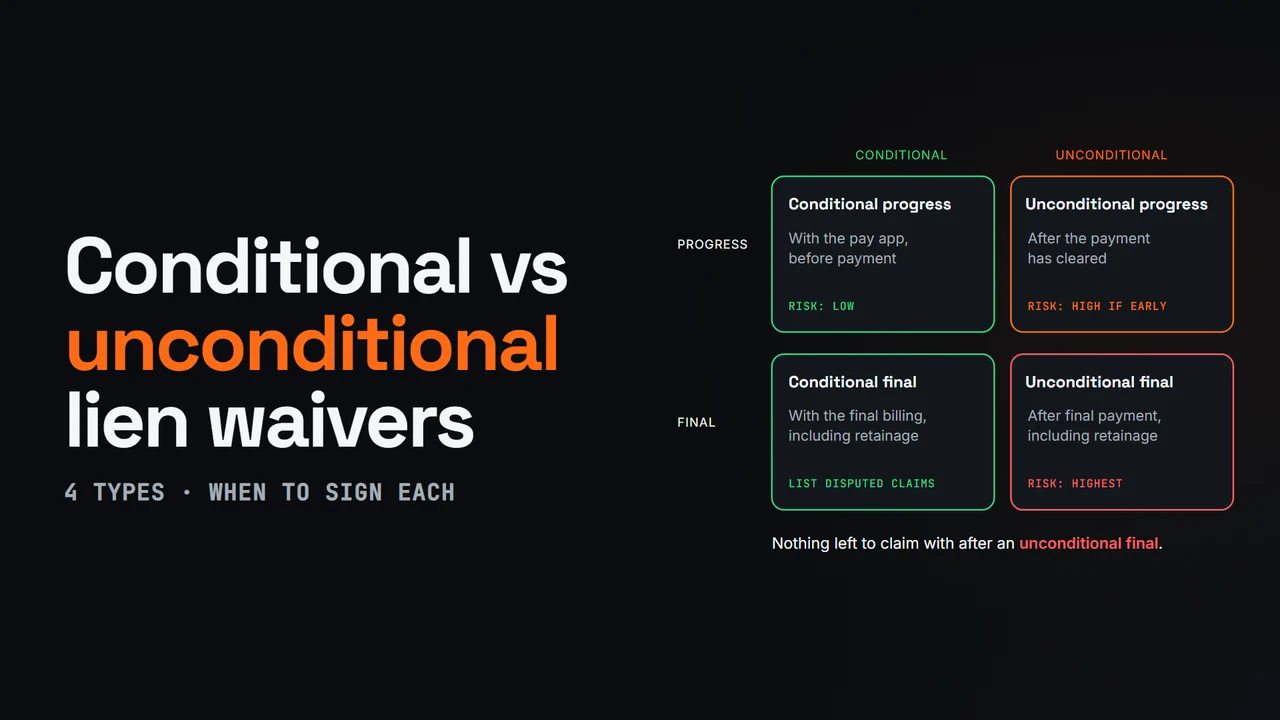
A conditional waiver takes effect only once the stated payment is actually received. If the money never arrives, it's void. An unconditional waiver takes effect the moment it's signed, even if the check later bounces. So the rule is: trade a conditional waiver for a payment, and sign the unconditional only after the money has cleared.
Progress waivers cover work through a stated date, one billing period at a time. Final waivers cover the whole job, including retainage, and go in with the final billing. The unconditional final is the riskiest to sign early: once it's signed, there's nothing left to claim with.
Here's an illustrative month. A sub bills ninety thousand dollars for March, less ten percent retainage, so eighty-one thousand is due. With its pay app, it sends a conditional progress waiver for eighty-one thousand through March thirty-first. When that payment clears, it sends the unconditional for the same amount and date. The nine thousand of retainage is still owed, and it's listed as an exception on both.
California, Texas, Georgia and several other states prescribe the wording, and a waiver that doesn't follow the statutory form may not be enforceable. Elsewhere, a broad waiver can release retainage or pending change orders, so read the exceptions before you sign. General information, not legal advice.
In the os.construction Accounting module, Accounts Payable records all four waiver types, holds a bill when a required waiver is missing, and lets vendors upload waivers through their portal.
Video page with chaptersMore in Construction concepts explained
FAQ
What is an unconditional lien waiver?
An unconditional lien waiver is a signed release of lien rights for a stated amount that takes effect as soon as it is signed and delivered, whether or not the signer was actually paid. It serves as proof that a payment reached the contractor, sub or supplier. Because it gives no protection if payment fails, sign one only after the funds have cleared.
When should you sign an unconditional lien waiver?
Only after the payment it covers is in your account and the funds are final. A check that has been deposited but not yet cleared isn't enough. The usual rhythm is a conditional waiver with this month's pay app and an unconditional waiver for last month's payment.
What happens if I sign an unconditional lien waiver and don't get paid?
In most states you have given up your lien rights for that amount, even though you weren't paid. You may still be able to sue on the contract for the money, but the security of the lien is gone. California's statutory form warns signers in bold not to sign it unless they have been paid.
What is an unconditional final lien waiver?
It's the waiver signed after the last payment on a job, including retainage. It releases all of the signer's lien rights for the project, except any disputed claims the form lets it list. Owners and title companies usually require one from every sub and supplier before releasing final retainage or closing out the loan.
Does an unconditional waiver release claims for unpaid change orders?
It depends on the form and the state. Statutory forms in states like California let the signer list disputed claims as exceptions. Non-statutory forms may release everything through the stated date. List any unpaid extras and pending change orders as exceptions before you sign.