A mechanics lien is a claim against real property, created by state statute, that secures payment for anyone who supplied labor, materials or equipment to improve it. A contractor, subcontractor or supplier who follows the state’s notice and filing rules and still isn’t paid can sue to foreclose the lien and force a sale of the property to collect.
The lien attaches to the land and the building, not to the person who owes the money. That is what gives it teeth: a sub can be owed money by a GC, and the owner’s title is still on the line. Most public property can’t be liened, so on public work the same protection comes from a payment bond instead. Every state writes its own rules, and they differ on who can claim, which notices are required and how many days each step allows.
How it works
The sequence below follows the common pattern. Names and day counts change by state.
- Preliminary notice. Many states require subs and suppliers who don’t contract with the owner to send a preliminary notice early in the job. In California it’s the 20-day notice, which covers work furnished from 20 days before it was served. Skip it and the lien right may be gone before the job is half done.
- Notice of commencement. In states such as Florida and Ohio, the owner records a notice of commencement that tells claimants who the owner, lender and surety are, and where to send notices.
- Payment trouble. A claimant that isn’t paid may send a notice of intent to lien. Some states require one and others don’t. It often settles the invoice on its own.
- Recording the lien. The claimant records a claim of lien with the county recorder within the statutory deadline, usually counted from completion of the project or from the claimant’s last work. A recorded notice of completion can shorten that window.
- Enforcement. A recorded lien expires unless the claimant sues to foreclose within another deadline. In California that is 90 days after recording.
- Release. The lien ends when it is paid and released, when it lapses, when a court removes it, or when the owner or GC records a release bond that moves the claim off the property.
Who is protected and who is exposed
- Claimants: GCs, subs, sub-subs, suppliers and equipment renters, and in many states architects and engineers. Most states stop at some tier, such as a supplier to a supplier.
- Owner: carries the title risk even after paying the GC in full. If the GC didn’t pay its sub, the owner can end up paying twice.
- Lender: a lien can affect the priority of the construction loan, which is why lenders demand lien waivers and title updates with each draw.
- GC: usually has to remove any lien a sub records, by paying it or bonding around it, before the owner will release the next payment or retainage.
Why it matters
For a sub or supplier, lien rights are the strongest leverage it has when payment stops. Without a lien or a bond claim, collecting means suing a contractor that may already be out of money. For owners and GCs, a single lien can freeze a loan draw, block a sale or refinance, and hold up final payment for everyone on the job. That’s why every pay app now travels with conditional and unconditional lien waivers, and why GCs pay shaky lower tiers by joint check.
Worked example
Illustrative, using California rules and Riverside Medical Center sample data (fictional). CoreDry, a drywall sub, completed $640,000 of work. It was paid $456,000, leaving $184,000 unpaid: $120,000 of progress billing plus $64,000 of 10% retainage.
| Step | Date | Rule |
|---|---|---|
| CoreDry starts work | March 3 | |
| 20-day preliminary notice served | March 15 | Covers work from 20 days before service |
| Work of improvement complete | September 30 | |
| Owner records notice of completion | October 10 | Valid if recorded within 15 days of completion |
| CoreDry records a $184,000 lien | November 5 | Inside the shortened window |
| Last day CoreDry could have recorded | November 9 | 30 days after the notice (December 29 if no notice) |
| Last day to sue to foreclose | February 3 | 90 days after recording |
To clear title, the GC records a lien release bond. At 125% of the claim, the bond is $230,000 (184,000 × 1.25). The dispute moves to the bond and the property is free to close on its permanent loan.
Common mistakes
- Assuming the GC’s payment to a sub wipes out the supplier’s lien rights. Each tier has its own.
- Counting days from the wrong trigger. Some states count from the claimant’s last work, others from project completion, and a recorded notice can shorten either.
- Missing the preliminary notice and finding out at the end of the job that there is nothing left to file.
- Recording a lien for more than is owed, or padding it with disputed extras. Many states penalize willfully exaggerated liens.
- Recording a lien and then letting the foreclosure deadline pass.
- Treating public work like private work. A lien isn’t available there, and the bond claim has its own notice deadlines.
Check the mechanics lien deadlines by state table and the statute itself for the project’s state, and see getting paid in construction for how liens fit with pay apps, retainage and notices.
This is general information, not legal advice. Lien rules vary by state and change often; consult a construction attorney in the property’s state before relying on a deadline.
How os.construction handles it
In Accounting, Accounts Payable records conditional or unconditional, progress or final waivers for each vendor and lower-tier party, holds bills that are missing a required waiver or carry a stop pay, and pays by joint check. Vendors can upload waivers through the vendor portal, where they stay pending until an AP user accepts them. See lien waiver tracking for what ships today and what is planned. os.construction does not file liens, serve statutory notices or calculate lien deadlines.
Watch the explainer · 2:04
Mechanics lien deadlines: first vs last furnishing
- 0:00Three deadlines, two start dates
- 0:18First furnishing starts the notice clock
- 0:38Why the notice comes so early
- 0:59Last furnishing starts the lien clock
- 1:17Then enforce it
- 1:39Waivers and holds in os.construction
Read the transcript
A mechanics lien lets an unpaid contractor, sub or supplier make a claim against the improved property. Keeping that right can mean three deadlines: a preliminary notice, the lien itself, and a lawsuit to enforce it. And they don't all start on the same day.
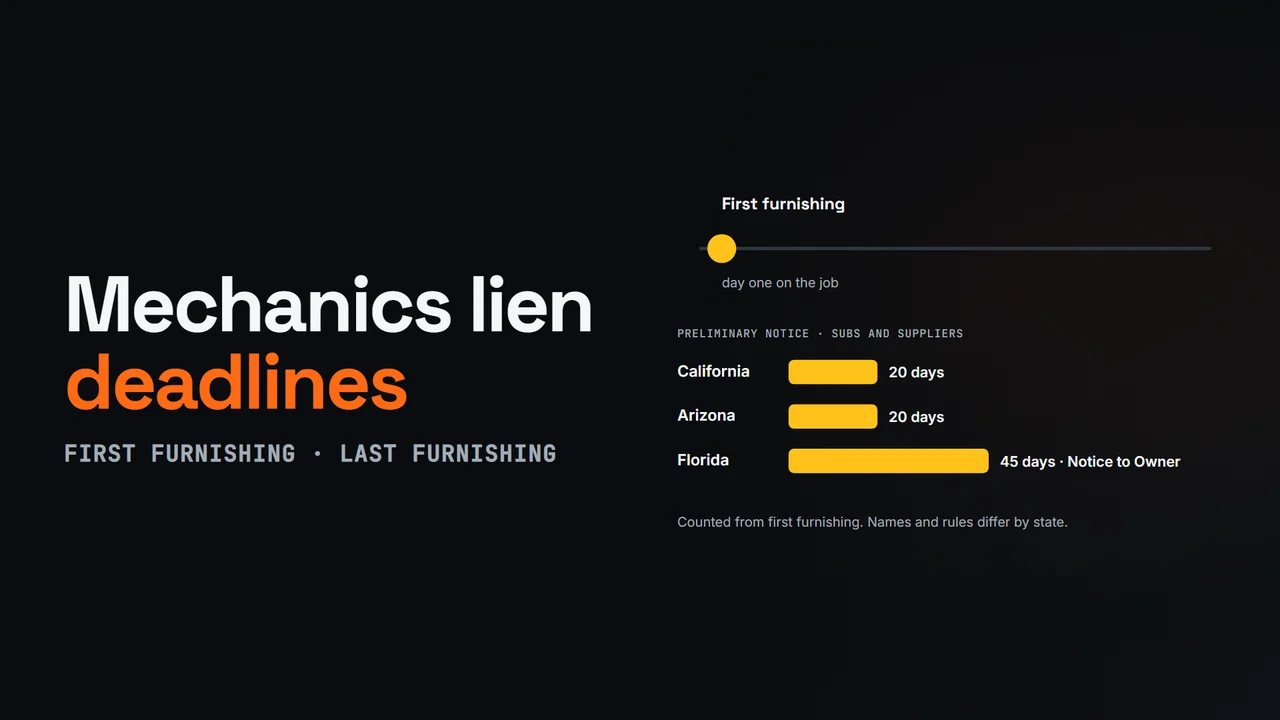
In many states, the notice clock starts at first furnishing: the first day you supply labor or materials to the job. California and Arizona give subs and suppliers twenty days from first furnishing to send a preliminary notice. In Florida, the notice to owner is due within forty-five days after starting to furnish.
Why so early? The notice tells the owner, and often the general contractor and lender, that you're on the job. Miss a required notice and the lien right can be lost or limited, even if you meet every later deadline. In California and Arizona, a late notice covers only work from twenty days before it was served.
The lien deadline is usually counted from your last furnishing, or from completion of the whole project. In Florida, you record within ninety days after your final furnishing. Most states give between about sixty days and six months. Warranty and punch list work often doesn't restart the clock.
Recording isn't the end. The lien expires unless you file suit to enforce it within the state's window. In Florida, that's one year after recording. On public projects you generally can't lien the property; you claim against the payment bond instead. Rules vary by state, and this is general information, not legal advice.
In os.construction, Accounts Payable can hold a bill until the lien waiver it needs is on file, and records conditional and unconditional, progress and final waivers, including from lower tiers. It doesn't calculate or file statutory lien notices, so use the state table and the statute for deadlines.
Video page with chaptersMore in Construction concepts explained
FAQ
What is a mechanics lien?
A mechanics lien is a claim against real property, created by state statute, that secures payment for people who supplied labor, materials or equipment to improve that property. If the claimant follows the notice and filing rules and is still not paid, it can sue to foreclose the lien and have the property sold to satisfy the debt.
Who can file a mechanics lien?
Generally anyone who improved the property under the owner's contract chain: the general contractor, subcontractors, sub-subcontractors, material suppliers, equipment lessors and, in many states, design professionals. Most states cut off lien rights below a certain tier, often suppliers to suppliers. Each state's statute lists who qualifies.
How long do you have to file a mechanics lien?
It depends on the state and on your role. In California a claimant generally has 90 days after completion of the work of improvement, shortened to 60 days for direct contractors and 30 days for everyone else when the owner records a valid notice of completion. Other states count from the claimant's last day of work or from the month of last delivery. Missing the deadline usually forfeits the lien.
Can you put a mechanics lien on a public project?
Usually not. Public property generally cannot be liened. Subcontractors and suppliers on federal jobs rely on the Miller Act payment bond, and most states have Little Miller Act bond requirements for state and local work. Some states also allow a stop payment notice against public funds held for the job.
How does an owner get rid of a mechanics lien?
Pay the claim and get a release, wait for the claimant to miss its foreclosure deadline, or record a lien release bond that moves the claim from the property to the bond. In California the release bond must be 125% of the lien amount. The owner can also challenge an invalid or excessive lien in court.
What is the difference between a mechanics lien and a lien waiver?
A mechanics lien asserts a claim against the property. A lien waiver gives up lien rights, usually in exchange for a payment. Owners and lenders collect waivers with each pay application so that money already paid can't later become the basis of a lien.
Sources
- California Civil Code §8414 (claimant lien deadline)
- California Civil Code §8460 (90 days to commence foreclosure)
- California Civil Code §8424 (lien release bond, 125%)
- Miller Act, 40 U.S.C. §§3131-3134 (payment bonds on federal work)
- Texas Property Code Chapter 53 (mechanic's, contractor's or materialman's liens)