Usually free to withdraw
Bids can generally be modified or withdrawn up to the time set in the solicitation, using the method it allows. Federally, notice must reach the designated office no later than the exact time set for opening (FAR 14.303).
A construction bond is a promise, backed by a surety, that a contractor will do what it said. Here is how the three parties fit together, what each bond covers from bid day to closeout, what happens if you pull a bid, and how a payment bond claim works.
Every construction bond has three parties. The principal is the contractor whose promise is being backed. The obligee is the party protected, usually the project owner (or the general contractor, when a subcontractor is bonded). The surety is the company that guarantees the principal’s promise to the obligee, up to a stated amount called the penal sum.
A bond is not insurance, even though insurance companies often write them and brokers sell them. An insurer expects losses and prices them into premiums. A surety underwrites the contractor expecting no loss at all, and before it issues bonds it has the contractor (and usually its owners personally) sign a general indemnity agreement. If the surety pays a claim, it turns to the contractor to be repaid.
That is why surety underwriting looks like lending. Sureties often describe what they look for as capital, capacity and character: financial strength, the ability to do the work, and a record of keeping promises. They study financial statements, the WIP schedule, backlog and experience, then set a bonding capacity, usually a single-job limit and an aggregate limit. Our post on what sureties look for in your WIP and the bonding capacity estimator go further.
Small contractors who struggle to qualify can look at the SBA Surety Bond Guarantee program, in which the US Small Business Administration guarantees bid, performance, payment and ancillary bonds issued by participating sureties, within contract size limits that SBA publishes.
Watch the explainer · 1:58
Bid bonds, performance bonds and payment bonds often travel together on public work, but each one protects a different promise. Every surety bond has three parties: the contractor, called the principal; the party it protects, called the obligee; and the surety, which guarantees the contractor's promise.
The bid bond comes first. It goes in with the bid and protects the owner if the winning bidder won't sign the contract or provide the required bonds. The amount is set in the bid documents. Five to ten percent of the bid is common on public work, and federal jobs that require one set it higher.
At award, the contractor delivers a performance bond. It protects the owner if the contractor defaults before the work is done. The surety can finance the contractor, bring in a completion contractor or pay the owner's cost to finish, up to the bond amount, which on public work is often the full contract price.
The payment bond protects the subcontractors and suppliers. On public jobs they usually can't put a lien on public property, so the payment bond is how they get paid if the contractor doesn't pay them. The federal Miller Act and state laws, often called Little Miller Acts, set who can claim and the notice deadlines.
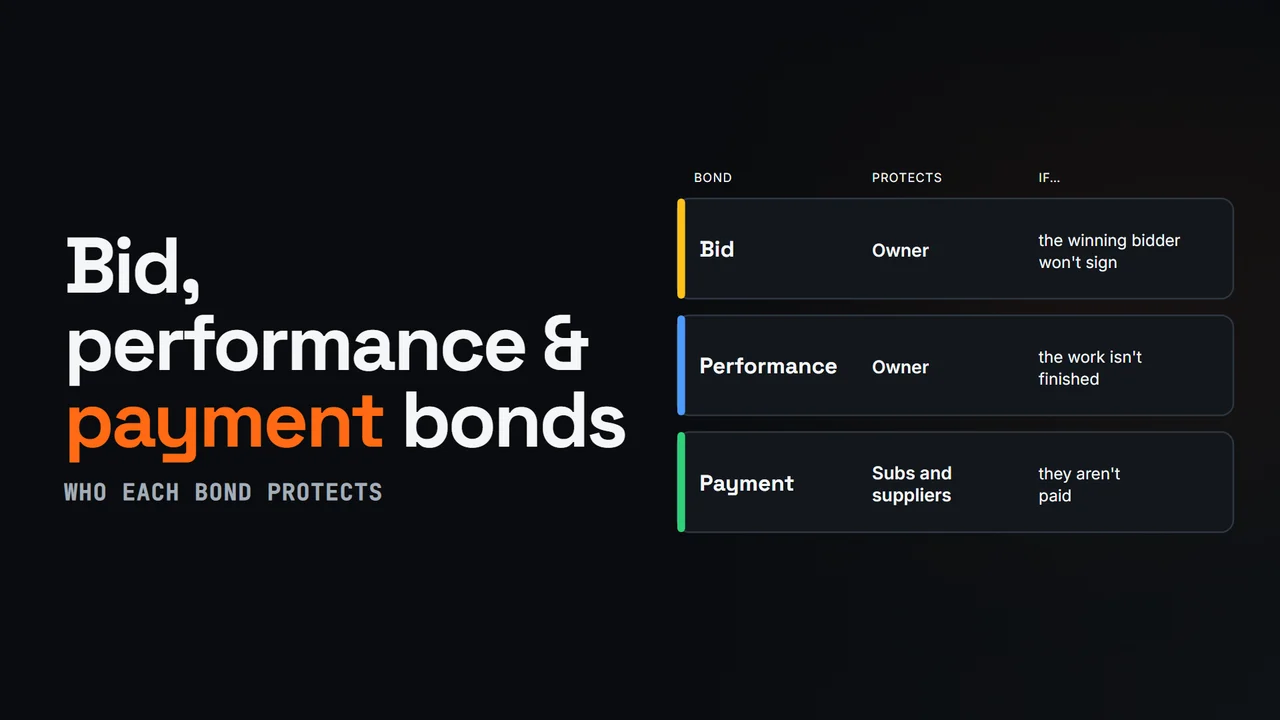
So: the bid bond protects the owner at bid time. The performance bond protects the owner if the work isn't finished. The payment bond protects subs and suppliers if they aren't paid. Amounts and rules vary by state and by contract, and this is general information, not legal advice.
Sureties look closely at how you run jobs and pay subs. In os.construction, commitments, payment applications and change orders sit on the same project record, and prequalification records each vendor's bonding capacity.
Video page with chaptersMore in Construction concepts explained
Scroll through a typical bonded public project. The panel tracks which bond is live at each stage.
Long before bid day, the contractor sets up a bond program: financial statements, WIP, the indemnity agreement and a bonding line. Owners often check bonding capacity during prequalification, and a surety may decline a job that stretches the line.
A bid bond promises that if this bid is accepted, the bidder will sign the contract and furnish the required performance and payment bonds. A missing or defective bid guarantee can make the bid nonresponsive.
Up to the deadline in the solicitation, a bidder can usually withdraw by the method the solicitation allows. After opening, bids are generally irrevocable for the stated acceptance period. Walking away now, without a recognized mistake, puts the bid bond at risk.
The low bidder signs and delivers a performance bond and a payment bond, often each for 100% of the contract price on public work. With those in place the bid bond has done its job and is released.
Subs and suppliers who go unpaid can claim against the payment bond, within the notice and suit deadlines that apply. On public work this matters because liens generally can’t be placed on public property. Clean lien waivers and on-time payment keep claims away.
If the owner declares the contractor in default under the contract’s procedure, the surety investigates. Depending on the bond form, it may finance or help the contractor finish, take over completion, tender a replacement contractor, or pay up to the penal sum, or deny the claim if it finds a defense.
At closeout, owners commonly ask for the surety’s written consent before releasing final payment and retainage, for example on the AIA G707 form. The bonds usually stay in force for contract obligations such as warranty work, and payment bond claims can arrive until their deadlines pass.
A bid bond protects the owner from a low bidder who won’t follow through. If the bidder is awarded the contract and fails to sign it or to provide the required bonds, the owner can claim against the bid bond. Many bid bond forms, such as the AIA A310, limit recovery to the owner’s actual loss, usually the difference between the defaulting bid and the price the owner pays to award the work to someone else, capped at the penal sum. Some solicitations and statutes instead treat the full bond amount as forfeited. The bond form and the solicitation decide which applies.
The amount is set in the solicitation. On many public projects a bid bond of 5 to 10 percent of the bid is typical, but that is a common range, not a rule. US federal construction solicitations that require a bid guarantee set it at at least 20 percent of the bid price, up to $3 million (FAR 28.101-2). Federal rules call the requirement a bid guarantee, which can be a bid bond or another accepted form of security.
It depends on when you withdraw and why. The rules below are the general pattern; the solicitation and the law of the jurisdiction control, and they vary.
Bids can generally be modified or withdrawn up to the time set in the solicitation, using the method it allows. Federally, notice must reach the designated office no later than the exact time set for opening (FAR 14.303).
Many jurisdictions let a bidder withdraw without forfeiting the bond for an honest clerical or arithmetic error, such as a dropped line or a transposed figure, if it notifies the owner promptly and can prove the mistake. A judgment error, such as underestimating productivity, usually doesn’t qualify. Federally, FAR 14.407-3 allows correction with clear and convincing evidence of both the mistake and the intended bid, and may allow withdrawal on weaker evidence.
Withdrawing during the acceptance period because the bid now looks too low, or because a better job came along, is the situation the bid bond exists for. The owner can usually pursue the bond, subject to the bond form and applicable law.
Failing to sign the contract or to furnish the performance and payment bonds after award is the core default a bid bond covers. If your surety won’t write the final bonds, find out before bid day, not after.
If you find an error after opening, move fast: notify the owner in writing, preserve your original estimate and worksheets, and get advice before you do anything else. Our post will you lose your bid bond if you withdraw your bid? goes through the mistake-in-bid doctrine, FAR 14.407 and state deadlines in more detail.
The penal sum is the most the surety can owe under the bond, set as a percentage of the bid or the contract price. Typical figures are labeled as typical; your solicitation or contract decides.
What you pay the surety, the premium, is a different number from the penal sum and is set by your surety based on your underwriting and the job. Bid bonds are often provided as part of a bond program rather than priced one by one; ask your surety or broker rather than relying on rules of thumb. Once you have your surety’s rate schedule, the bond premium calculator applies it band by band and grosses the premium into your bid.
Most contractors with a surety relationship pay little or nothing for an individual bid bond. The surety is really deciding whether it will write the final bonds if you win, so it prices the risk into the performance and payment bond premium and treats the bid bond as part of your bond program. The real cost is qualifying for that program. Expect the surety to ask for:
From those, the surety sets your bonding capacity: a single-job limit and an aggregate limit. Request bid bonds early, well before bid day, especially for a job larger than your usual work. Small businesses that can’t qualify in the standard market can use the SBA Surety Bond Guarantee program, which covers contracts up to $9 million (non-federal) or $14 million (federal); SBA charges no fee for bid bond guarantees and 0.6% of the contract price for performance and payment bond guarantees.
A bid bond is one form of bid security, or bid guarantee in federal language. Many owners also accept:
| Form | What it ties up | Notes |
|---|---|---|
| Bid bond | Bonding capacity and your indemnity | Most common; no cash held |
| Certified or cashier’s check | Cash, until bids are returned | Often returned to losing bidders after award |
| Irrevocable letter of credit | Bank credit line, plus a bank fee | Must match the owner’s required terms and expiry |
| US bonds or notes | Securities pledged to the government | Federal work (FAR 28.204) |
Federal rules list the accepted alternatives to sureties in FAR 28.204: United States bonds or notes, cash equivalents such as certified or cashier’s checks, and irrevocable letters of credit. State and local owners set their own list in the bid documents; submitting a form they don’t accept can make the bid non-responsive.
A performance bond guarantees the contractor will perform the contract. It is not a quick payout. Most bond forms make the owner follow a procedure first: notice that it is considering a default, often a conference with the contractor and the surety, a formal declaration of default and termination of the contract, and the owner’s own continued performance, chiefly paying the remaining contract balance toward completion.
Once the procedure is met, common forms such as the AIA A312 give the surety a set of options: arrange for the original contractor to finish with the owner’s consent, take over and complete the work itself through a completion contractor, obtain bids and tender a new contractor to the owner, or pay what it owes in money, or deny liability with reasons. Owners who skip the bond’s steps can weaken their own claim, which is why the default letter is usually written with counsel.
Subcontractor performance bonds work the same way, one tier down, with the general contractor as obligee. Some GCs use subcontractor default insurance instead, which is an insurance product the GC buys, not a surety bond.
A payment bond guarantees that the contractor will pay the subcontractors, suppliers and workers on the job. On private work, an unpaid sub can often file a mechanics lien against the property. Public property generally can’t be liened, so public payment bonds take the lien’s place as the supply chain’s security.
The Miller Act. On US federal construction contracts above a threshold, the prime contractor must furnish both a performance bond and a payment bond. The statute is 40 U.S.C. chapter 31, subchapter III, still widely called the Miller Act, and the FAR currently applies it to contracts exceeding $150,000 (FAR 28.102-1). The payment bond protects those with a direct contract with the prime, and those with a direct contract with a first-tier subcontractor. More remote tiers are generally not covered.
Little Miller Acts. States have their own bond statutes, requiring bonds on state and often local public works. Thresholds, who is covered, notice deadlines and where to sue all differ, and some require a notice near the start of work, not just at the end. Read the statute for the state and the bond itself before relying on federal rules.
The steps below are the general shape of a claim. Deadlines are strict and missing one can end the claim, so involve a construction attorney early, especially near a deadline.
Most of that backup comes from records you already keep. In os.construction, commitments, payment applications, change orders and the daily log sit on the same project record, and prequalification records each vendor’s bonding capacity.
The four bonds a contractor meets most often cover different stretches of the same job and protect different people. The bid bond covers bid day to contract signing. The performance and payment bonds take over at award. A maintenance bond, where the owner requires one, covers the warranty period after completion.
| Bid bond | Performance bond | Payment bond | Maintenance bond | |
|---|---|---|---|---|
| Guarantees | You sign at your bid price and furnish final bonds | You complete the contract | You pay subs, laborers and suppliers | You fix defects during the warranty period |
| Protects | Owner | Owner | Claimants down the chain | Owner |
| Typical amount | 5–10% of bid; at least 20% on federal work | Often 100% of contract | Often 100% of contract | Set by the owner, often a share of the contract |
| In force | Bid through contract signing | Award through completion, plus contract obligations such as warranty work | Award through claim deadlines | Completion through the warranty period, often 1 to 2 years |
Other bonds you may meet: supply bonds for material contracts, subdivision or site improvement bonds that guarantee public improvements to a municipality, license bonds required by some state contractor licensing boards, and lien release or discharge bonds that move a mechanics lien off the property and onto a bond.
Generally, a bid can be withdrawn without penalty up to the deadline the solicitation sets, usually the bid opening, by the method the solicitation allows. After opening, bids are usually firm for the acceptance period stated in the solicitation, and withdrawing, or refusing to sign the contract and provide the required bonds after award, can let the owner claim against the bid bond. Many jurisdictions allow relief for a genuine clerical or arithmetic mistake if the bidder acts promptly and can prove it, but the rules vary by jurisdiction and solicitation. Get advice before withdrawing.
The bid bond’s penal sum is set by the solicitation. Five to ten percent of the bid is a typical range on many public projects, but it is not universal. On US federal contracts that require a bid guarantee, the FAR sets it at at least 20 percent of the bid price, not to exceed $3 million. What the contractor pays the surety for a bid bond is a separate question; ask your surety or broker.
A bid bond is one kind of bid guarantee. Bid guarantee is the broader term, used in US federal contracting, for any security that the bidder will sign the contract and provide the required bonds if awarded. Depending on the solicitation, it may also take forms such as a certified check or an irrevocable letter of credit.
For a contractor with an established bond line, a bid bond often costs nothing or only a small fee, because the surety earns its premium on the performance and payment bonds if you win. The real cost is qualifying: financial statements, a work-in-progress schedule and a signed indemnity agreement. Small businesses that use the SBA Surety Bond Guarantee program pay SBA no fee for bid bond guarantees.
Many solicitations accept other bid security, such as a certified or cashier’s check, an irrevocable letter of credit or, on federal work, United States bonds or notes. These tie up cash or bank credit for the whole acceptance period, which is why most contractors use a bond. The solicitation lists the forms it accepts; anything else can make the bid non-responsive.
A maintenance bond, also called a warranty bond, guarantees that the contractor will correct defects in materials and workmanship that show up during a set period after completion, often one or two years. Public owners and municipalities often require one, especially on site improvement and infrastructure work. Some performance bonds already cover warranty obligations, so check before buying both.
It depends on the bond and the law behind it. Under the federal Miller Act, subcontractors and suppliers who contracted directly with the prime contractor can claim, and so can those who contracted with a first-tier subcontractor, if they give written notice to the prime within 90 days. More remote tiers are generally not covered. State Little Miller Acts and private bond forms set their own rules.
No. Insurance spreads expected losses across many policyholders. A surety bond is a guarantee the surety expects never to pay; if it does pay, the contractor and usually its owners have agreed in an indemnity agreement to pay the surety back.
Only if the contract requires them. Private owners and lenders often require bonds on larger projects, and general contractors may require them from major subcontractors, but there is no general legal requirement. On public projects, statutes such as the Miller Act and state Little Miller Acts usually require them above a threshold.
General information only, not legal advice. Bond terms, statutes and deadlines vary by jurisdiction, owner and bond form.
Keep exploring
os.construction keeps the contract, commitments, pay apps and lien waivers on one record, and tracks vendor bonding capacity in prequalification.
14-day free trial. Pricing for paid plans isn't set yet. Talk to us. Already have an account? Sign in →
General information, not legal advice. Bond forms, statutes and solicitations differ, and deadlines on bond claims are strict. Read the bond and the governing law, and talk to a construction attorney or your surety about a specific situation.