Construction cost reporting: accruals, earned revenue, EAC and WIP
A cost report tells you what a job will cost when it is done. Get that number right and percent complete, earned revenue, profit and over/under billing follow from it. Here is the whole chain on one illustrative job, column by column and month by month.
What is construction cost reporting?
Construction cost reporting is the monthly comparison of each job’s budget against its cost to date and its forecast cost to finish. The output is the cost report: one row per cost code, showing what was budgeted, what has been committed and spent, what is left to spend and where the job will land. The bottom line is the estimate at completion (EAC), and almost every other number in construction finance is computed from it.
That is why the cost report matters beyond the project team. Under the cost-to-cost method, percent complete is cost to date divided by EAC, earned revenue is that percentage times the contract, and the WIP schedule compares earned revenue with billings. A cost to complete that nobody updated quietly changes revenue, profit, the balance sheet and what your surety sees.
Watch the explainer · 1:57
How to read a construction cost report
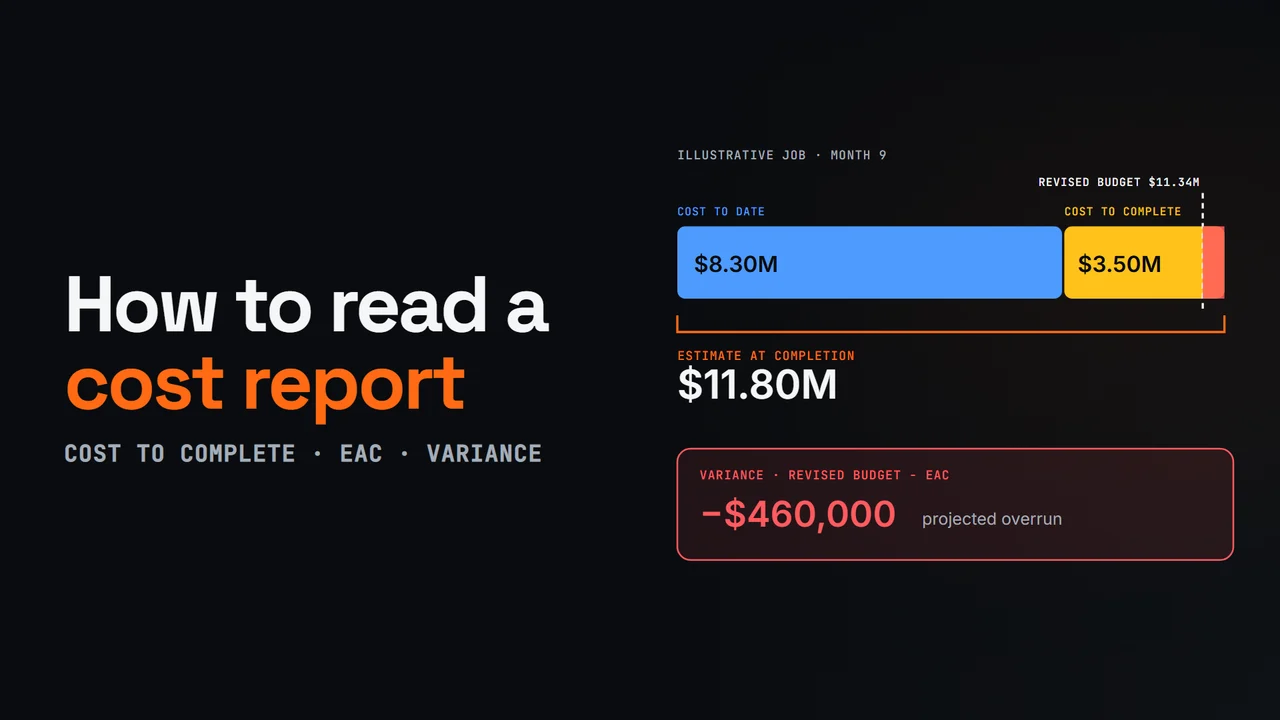
- 0:00One row per cost code
- 0:14Budget and committed cost
- 0:32Cost to date and accruals
- 0:48Cost to complete and EAC
- 1:11From EAC to earned revenue
- 1:34The cost report in os.construction
Read the transcript
A construction cost report tells you what a job will cost when it's done. It has one row per cost code, and its bottom line, the estimate at completion, drives almost every other number in construction finance.
Read it left to right. Original budget plus approved changes is the revised budget. Committed cost is signed subcontracts and purchase orders, and it's the early warning column. On this illustrative job, HVAC commitments already run above the HVAC budget, months before cost to date showed it.
Cost to date means cost incurred, not just invoiced: posted invoices, payroll and equipment, plus accruals for work in place that hasn't been billed yet. Without the accrual, cost to date is understated until the invoice lands.
Cost to complete is the project manager's forecast of what's left. Cost to date plus cost to complete is the estimate at completion. Here, eight point three million spent, plus three point five million to go, is an EAC of eleven point eight million. Against an eleven point three four million revised budget, that's a four hundred sixty thousand dollar overrun.
The EAC then drives revenue. Percent complete is cost to date divided by EAC, about seventy percent. Times the twelve point six million dollar contract, that's about eight point eight six million earned. With nine point one five million billed, the job is over billed by about two hundred eighty-seven thousand. A stale cost to complete changes all of it.
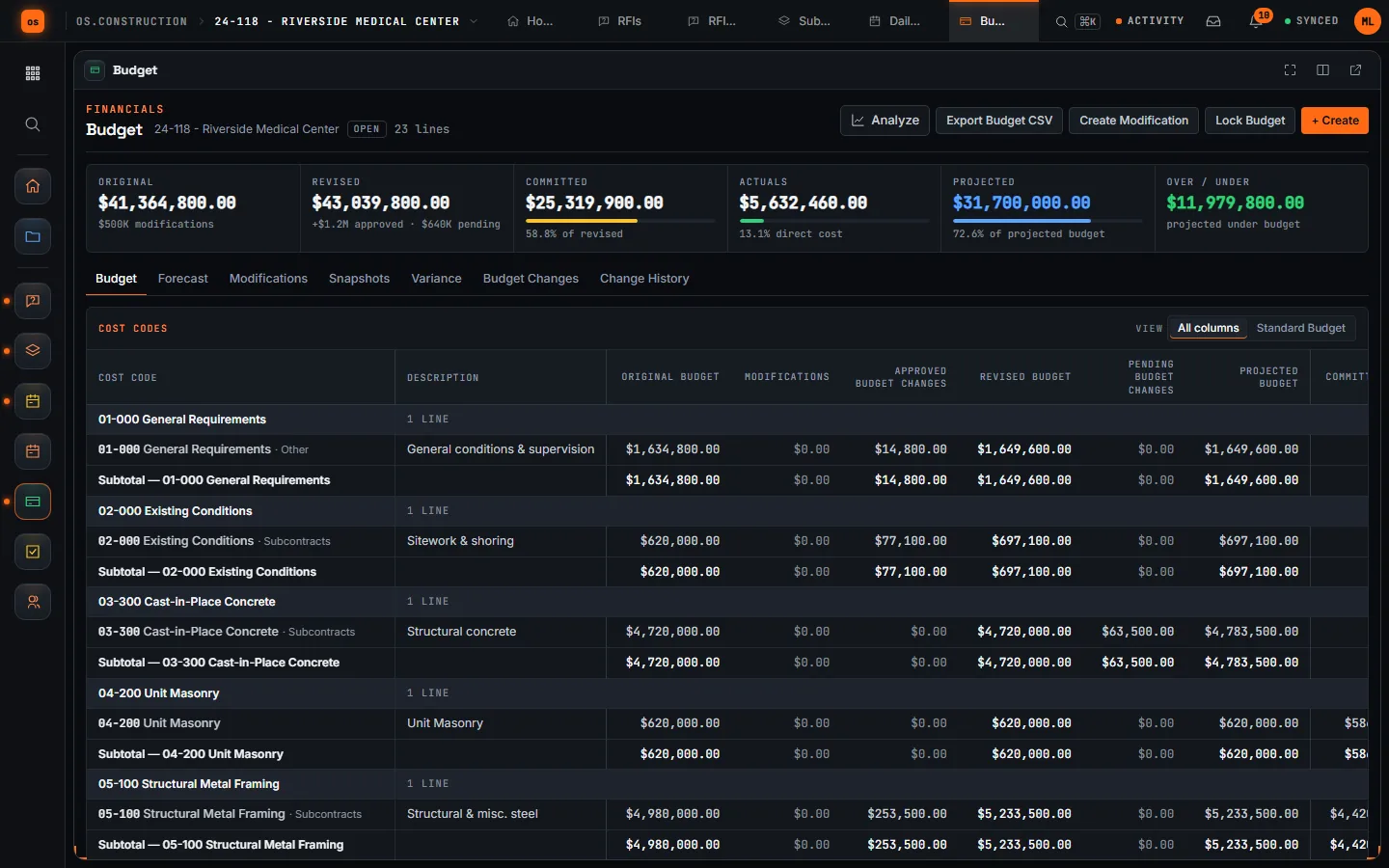
In os.construction, the Budget tool is the cost report: budget, commitments, cost and forecast to complete by cost code, with month-end snapshots. Accounting builds a WIP snapshot from posted job cost, billings and approved forecasts, reviewed before it posts.
Video page with chaptersMore in Construction concepts explained
The cost report, column by column
A construction cost report has eight core columns, and each one comes from a different place. Accounting supplies cost to date, contracts supply commitments, change orders move the budget, and the project manager supplies cost to complete. The report is only as good as the weakest of those feeds.
| Column | What it means | Where it comes from | Common mistake |
|---|---|---|---|
| Original budget | The cost estimate at award, spread by cost code | Estimate turned over to operations | Re-spreading it later to hide a bust |
| Approved changes | Budget added by approved change orders and transfers | Change order log | Adding owner COs to revenue but not to budget |
| Revised budget | Original budget plus approved changes | Calculated | Mixing pending changes into it |
| Committed cost | Signed subcontracts and purchase orders, with their approved changes | Commitments | Leaving unsigned or verbal buyout out |
| Cost to date | Cost incurred: posted invoices, payroll, equipment and accruals | Job cost ledger | Counting only invoices received |
| Cost to complete | The PM’s estimate of remaining cost | Monthly forecast | Defaulting it to budget minus cost to date |
| Estimate at completion | Cost to date plus cost to complete | Calculated | Accepting it without asking what changed |
| Variance | Revised budget minus EAC; negative is an overrun | Calculated | Measuring against the original budget |
A worked cost report
Here is the cost report for an illustrative $12,000,000 building job at month 9 of 12. Two change orders have added $540,000 of budget and $600,000 of contract. The team bought steel well, but self-performed electrical is behind on productivity and general conditions are running long.
| Cost code | Original budget | Approved COs | Revised budget | Committed | Cost to date | Cost to complete | EAC | Variance |
|---|---|---|---|---|---|---|---|---|
| 01 General conditions | $1,080,000 | – | $1,080,000 | $240,000 | $830,000 | $330,000 | $1,160,000 | ($80,000) |
| 03 Concrete | $1,620,000 | $90,000 | $1,710,000 | $1,700,000 | $1,710,000 | $30,000 | $1,740,000 | ($30,000) |
| 05 Structural steel | $1,890,000 | – | $1,890,000 | $1,830,000 | $1,830,000 | $0 | $1,830,000 | $60,000 |
| 09 Finishes | $1,440,000 | $90,000 | $1,530,000 | $1,380,000 | $450,000 | $1,110,000 | $1,560,000 | ($30,000) |
| 23 HVAC | $2,160,000 | $180,000 | $2,340,000 | $2,390,000 | $1,640,000 | $830,000 | $2,470,000 | ($130,000) |
| 26 Electrical (self-performed) | $1,620,000 | $180,000 | $1,800,000 | $1,750,000 | $1,220,000 | $830,000 | $2,050,000 | ($250,000) |
| 31 Sitework | $990,000 | – | $990,000 | $960,000 | $620,000 | $370,000 | $990,000 | $0 |
| Total | $10,800,000 | $540,000 | $11,340,000 | $10,250,000 | $8,300,000 | $3,500,000 | $11,800,000 | ($460,000) |
Variance in parentheses is a projected overrun. Cost to date includes a $180,000 accrual for HVAC work in place that the subcontractor had not yet billed.
Read it the way a project executive would. The job is projected $460,000 over its revised budget, and two lines carry most of it: electrical (−$250k) and HVAC (−$130k). Steel’s $60k of buyout savings is already banked. On HVAC, committed cost ($2,390,000) is above the revised budget ($2,340,000), which flagged the problem months before cost to date did. Committed cost is the early-warning column; cost to date is the late one.
Two checks catch most bad cost reports. First, cost to complete should never be less than the open commitments on a line (committed minus cost to date), because that money is already owed. Finishes has $930,000 of open commitments and a $1,110,000 cost to complete, so it passes. Second, a line where cost to complete is exactly revised budget minus cost to date usually means nobody forecast it.
The free budget, commitments and cost explainer builds the same columns step by step on a sample project, and the cost-to-complete worksheet (CSV) gives you the layout to fill in.
Accruals: getting cost to date right
An accrual records cost in the month the work was performed, even when the invoice arrives later. In a cost report, cost to date should mean cost incurred, not cost invoiced. Subcontractors bill on their own cycle, suppliers invoice after delivery, and payroll for the last days of the month may post in the next one. Each gap understates cost to date.
That understatement is not harmless. With the $180,000 HVAC accrual left out, this job’s cost to date would be $8,120,000, percent complete would drop from 70.3% to 68.8%, and earned revenue would fall by about $192,203. The over billing would look $192k bigger, and next month, when the invoice arrives, the job would suddenly jump. Months like that are where surprise fade comes from.
- What gets accrued. Subcontract work in place not yet billed (use the sub’s pencil draft or the PM’s estimate), material received without an invoice, unbilled equipment rental, and wages earned but not yet paid.
- How it reverses. Most accruals are posted as reversing entries: booked at month-end, reversed on the first day of the next month, so the real invoice does not double count.
- What it is not. An accrual is not a reserve for future work. Cost you expect to spend later belongs in cost to complete, not in cost to date.
Cost to complete and estimate at completion
Estimate at completion is cost to date plus cost to complete, and cost to complete is the one column a person has to think about. Every other column is recorded or calculated. Cost to complete is the PM’s judgment of what is left: remaining commitments, scope not yet bought, self-performed labor at the productivity the crew is actually achieving, and known risks.
There are several ways to forecast it, and they rarely agree. Budget remaining (revised budget minus cost to date) assumes the rest of the job goes exactly to plan. A performance-based forecast divides remaining budget by a cost performance index. A bottom-up forecast prices what is actually left. The estimate at completion calculator runs five methods side by side so you can see how far apart they are on your numbers.
The difference between this month’s EAC and last month’s is the number to explain. On this job EAC moved from $11,720,000 to $11,800,000 in month 9. Projected gross profit is now $800,000 (6.3%), down from $1,200,000 (10.0%) at bid. That drop in projected margin is margin fade, and a job that fades a little every month is usually a job whose forecast is lagging the field. Contingency held in the budget is part of the revised budget, not a cushion inside cost to complete; spend it with a budget transfer so the report shows where it went.
Earned revenue: from cost to revenue
Earned revenue is the share of the contract a contractor has earned by performing the work, whatever it has billed. Most contractors measure it with the cost-to-cost method: percent complete is cost to date divided by EAC, and earned revenue is percent complete times the current contract value.
Percent complete   = cost to date ÷ estimate at completion
                   = $8,300,000 ÷ $11,800,000 = 70.34%
Earned revenue     = percent complete × revised contract
                   = 70.34% × $12,600,000 = $8,862,712
Revenue this month = earned to date − earned through last month
                   = $8,862,712 − $7,686,860 = $1,175,852
Under ASC 606, most construction contracts recognize revenue over time, and cost-to-cost is an input method of measuring progress (ASC 606-10-25-27 and 606-10-55-20). The standard also says to leave out costs that do not show progress, such as wasted materials or rework the owner will not pay for, and it treats uninstalled materials specially: revenue equal to their cost, with no margin, until they are installed (606-10-55-21). For tax, long-term contracts follow their own rules under IRC section 460. Your CPA decides how these apply to your contracts.
Two consequences are worth saying plainly. Because EAC is the denominator, raising the forecast lowers percent complete and earned revenue on the same cost. And if EAC climbs above the contract value, the job is a loss contract: the expected loss is generally recorded in full as soon as it is evident (ASC 605-35), as a loss provision, not spread over the remaining months.
The same job over nine months
Plotting budget, EAC, cost to date and earned revenue together shows when a job started to slip. Here the EAC dips in month 2 when steel buys out under budget, then crosses the revised budget in month 6 as electrical productivity falls behind. Each approved change order steps the budget up, and the overrun band between the two lines keeps widening.
- Revised budget
- $11,340,000
- EAC
- $11,800,000
- Cost to date
- $8,300,000
- Earned revenue
- $8,862,712
- Percent complete
- 70.3%
- Projected margin
- 6.3%
From the cost report to the WIP schedule
The WIP schedule is the cost report’s answer, summarized for every open job. Each row takes the contract value, the EAC from the cost report, cost to date, percent complete and earned revenue, then compares earned revenue with billed to date. Billed more than earned is over billing, a liability. Earned more than billed is under billing, an asset.
This job has billed $9,150,000 against $8,862,712 earned, so it is over billed by $287,288. That is not good or bad on its own. Whether it is a healthy front-loaded schedule of values or a sign the forecast is stale depends on which number moved, which is why the anatomy of a WIP schedule walks four jobs through the columns and our post on what over and under billing are telling you covers the review questions.
A month-end cost reporting routine
Good cost reports come from a fixed monthly sequence: close the cost, update the forecast, explain the change, then build WIP. Doing it in a different order is how a WIP schedule ends up built on last month’s estimate.
- Cut off cost. Post invoices and payroll through the period end, and book accruals for work in place that has not been billed.
- Post approved changes. Add approved change orders to the contract and the budget, and approved commitment changes to committed cost. Keep pending changes in their own column.
- Update cost to complete by cost code. The PM forecasts every line, not just the ones that look wrong, and checks each against open commitments.
- Explain the movement. Any line whose EAC moved more than an agreed threshold gets one sentence: what changed and why.
- Review and approve. A project executive or controller reviews the forecast before it is used for revenue.
- Build WIP from the approved EAC. Percent complete, earned revenue, over/under billing and any loss provision follow, and the snapshot is kept so next month has something to compare with.
In os.construction, the Budget tool is the cost report: original and revised budget, committed and direct costs, pending changes, forecast to complete and estimated cost at completion by cost code, with month-end snapshots you can compare. In the Accounting module, job cost and WIP uses posted job cost, billings and controller-approved PM cost-to-complete to compute a WIP snapshot that is reviewed before it posts. See construction WIP software.
Terms in this guide
- Cost report
- Job costing
- Cost code
- Commitment
- Accrual
- Reversing entry
- Cost to complete
- Estimate at completion (EAC)
- Contingency
- Margin fade
- Percent complete
- Cost-to-cost method
- Earned revenue
- Revenue recognition
- ASC 606
- Uninstalled materials
- Loss provision
- WIP schedule
- Over billing
- Under billing
- Contract asset
- Contract liability
- IRC section 460
Common questions
What is cost reporting in construction?
Construction cost reporting is the monthly process of comparing each job’s budget with what it has cost so far and what it will cost to finish. A cost report lists every cost code with original budget, approved changes, revised budget, committed cost, cost to date, cost to complete, estimate at completion and variance. Its estimate at completion then drives percent complete, earned revenue and the WIP schedule.
How do you calculate estimate at completion (EAC) in construction?
Estimate at completion is cost to date plus the project manager’s cost to complete, summed by cost code. Variance is the revised budget minus EAC; a negative number is a projected overrun. A cost to complete should never be less than the open commitments on a line, because that money is already owed.
How is earned revenue calculated?
Under the cost-to-cost method, percent complete is cost to date divided by estimated total cost (EAC), and earned revenue is percent complete times the current contract value, including approved change orders. Earned revenue this month is earned revenue to date minus earned revenue through last month. Billings do not change it.
Why do accruals matter in a cost report?
Cost to date has to include cost for work performed even when the invoice has not arrived. Without an accrual, cost to date is understated, percent complete and earned revenue are understated, and the job looks under billed and more profitable than it is until the invoice lands. Most accruals are reversed at the start of the next month when the real invoice posts.
What is the difference between a cost report and a WIP report?
A cost report looks inside one job, cost code by cost code. A WIP schedule looks across every open job at the contract level: contract value, estimated cost, percent complete, earned revenue, billings and over or under billing. The cost report’s estimate at completion is the WIP schedule’s estimated total cost, so a stale cost report means a wrong WIP.
What happens when the estimate at completion is higher than the contract?
The job is a loss contract. Under US GAAP for construction contracts, the whole expected loss is generally recognized as soon as it becomes evident, not spread over the remaining work, through a provision for anticipated losses. It shows on the WIP schedule as a loss provision, and sureties and lenders will ask about it.
Keep going
Sources and further reading
- Financial Accounting Standards Board: ASC 606, Revenue from Contracts with Customers (606-10-25-27 over-time recognition; 606-10-55-20 and 55-21 input methods and uninstalled materials) and ASC 605-35 (provision for anticipated losses on construction contracts).
- 26 U.S.C. 460: special rules for long-term contracts (percentage-of-completion for tax).
- IRS Publication 538: accounting periods and methods.
- GAO Cost Estimating and Assessment Guide: estimate at completion and earned value methods.
- AACE International: cost engineering and project controls practice.
General information only, not accounting or tax advice. Every figure on this page is illustrative.
Keep exploring
Related across os.construction
- GlossaryEstimate at completionThe forecast total cost of a job when finished: cost to date plus estimated cost to complete.
- GlossaryCost reportA job report showing, by cost code, the original and revised budget, committed cost, actual cost, cost-to-complete, forecast and variance.
- Free toolJob cost report templateFree construction job cost report template for Excel.
- Free toolEstimate at completion calculatorForecast final cost, cost-to-complete and margin fade.
- BlogHow to prepare a WIP schedule, step by stepA work-in-progress schedule turns four numbers per job into earned revenue, gross profit and over or under billing. Here's the month-end procedure in order, from cost cutoff to the journal entry, with a three-job percentage-of-completion example that ties out and the review questions that catch a bad forecast.
- PlatformInsightsAnalytics in preview: dashboards, earned value, Project Story and a WIP view, every number traced to its records.
Want this on live job data?
In os.construction the Budget tool keeps budget, commitments, cost and forecast to complete on one record, and Accounting builds reviewed WIP snapshots from posted cost, billings and approved PM forecasts.
14-day free trial. Pricing for paid plans isn't set yet. Talk to us. Already have an account? Sign in →
General information, not accounting or tax advice. The job and every figure on this page are illustrative. How you recognize revenue, measure progress and book losses depends on your contracts, your reporting framework and your CPA.