Design-bid-build is the traditional construction delivery method. The owner hires an architect or engineer to complete the design, bids the finished documents to contractors, then signs a separate construction contract with the winning bidder. The owner holds two contracts, and the three phases, design, bid and build, run one after the other.
It is still the default for a lot of public work, because it fits competitive sealed bidding: every contractor prices the same complete documents and the award is easy to defend. Private owners use it too when the scope is well understood and price competition matters more than speed.
How it works
- Design. The owner contracts with an architect, for example on an AIA B101, to take the project from schematic design through design development to construction documents: drawings, specifications and the bid form.
- Bid. The owner advertises or invites bids. Contractors attend the pre-bid meeting and site visit, ask questions, and receive addenda that clarify or change the documents. They collect sub and supplier quotes, level them, and submit a sealed price, usually a lump sum with any alternates or unit prices the bid form asks for. Public work typically requires a bid bond as bid security.
- Award. Bids are opened, often publicly. The owner checks that the low bid is responsive (it follows the solicitation) and that the bidder is responsible (able to perform), then awards and signs a construction contract, for example an AIA A101 with A201 general conditions. Performance and payment bonds follow on public jobs.
- Build. The contractor builds to the documents. The architect administers the contract: answering RFIs, reviewing submittals, certifying pay applications and preparing change orders when the scope changes.
Design-bid-build vs other methods
| Design-bid-build | Design-build | CM at risk | |
|---|---|---|---|
| Owner contracts | Designer + contractor | One design-builder | Designer + CM |
| Builder joins | After design is complete | At the start | During design |
| Price basis | Bid on complete documents | Lump sum, cost-plus or GMP | Usually a GMP |
| Design risk toward the builder | Owner | Design-builder | Owner, mostly |
| Schedule | Sequential | Overlapping | Can overlap |
| Typical selection | Lowest responsive, responsible bid | Best value or qualifications | Qualifications, then GMP negotiation |
See design-build and CM at risk for how those methods work, and the project delivery methods guide for the full comparison.
Who carries the design risk
In design-bid-build, the owner gives the contractor a set of plans and specifications and tells it to build them. US courts have long held that the owner impliedly warrants those plans are adequate. That rule comes from United States v. Spearin (1918) and is usually called the Spearin doctrine. If the contractor follows the documents and the result is defective because the design was wrong, the contractor is generally entitled to an adjustment rather than bearing the cost.
The owner, in turn, looks to its architect under the design contract. The architect is held to a professional standard of care, not perfection, so the owner often ends up absorbing some design gaps itself. That is why owners on design-bid-build jobs carry their own contingency for change orders.
Why it matters
Design-bid-build gives the owner price competition on a defined scope and full control over the design. The trade-offs are time, because construction can’t start until design and bidding are done, and conflict, because the contractor had no input into the design. Every gap in the documents can become an RFI, then a change order.
For a contractor, low-bid pricing leaves little room to absorb those gaps. The bid is only as good as the read of the documents behind it, and the margin on the job often depends on how well the team documents design conflicts once work starts.
Worked example
Illustrative: an owner bids a 60,000 sq ft clinic on complete documents with one add alternate for a canopy. Three general contractors submit:
| Bidder | Base bid | Alternate 1 | Base + Alt 1 |
|---|---|---|---|
| A | $12,400,000 | $185,000 | $12,585,000 |
| B | $12,850,000 | $140,000 | $12,990,000 |
| C | $13,100,000 | $160,000 | $13,260,000 |
Bidder A is low on the base bid and on base plus alternate, so accepting the alternate doesn’t change who wins. A’s bid is responsive and A passes the responsibility review. With a budget of $12,700,000, the owner can afford the alternate and awards $12,585,000.
During construction, the duct mains on the drawings don’t fit above a corridor ceiling. Bidder A writes an RFI, the architect issues a revised detail, and the added cost of $46,000 comes back as a change order. Under Spearin, that cost is generally the owner’s, because A priced and built what the documents showed. The contract sum becomes $12,631,000, still inside the owner’s budget with $69,000 to spare.
Common mistakes
- Bidding without a pre-bid site visit or a careful read of every addendum, then finding the bid is non-responsive or the scope moved.
- Assuming “or equal” substitutions will be approved after award.
- Under-documenting design conflicts early, then losing the change order argument later.
- Leveling sub bids without checking scope exclusions, so the low number isn’t really low. See bid leveling.
- Treating the low bid as the owner’s final cost. Design gaps are mostly the owner’s risk, so the owner needs a change order contingency.
This is general information, not legal advice. Procurement rules vary by owner and state.
How os.construction handles it
The Bidding tool compares sub quotes, records an award review and creates a draft commitment from the winning quote. During construction, RFIs track ball in court and official responses, and change events can name the RFI they came from, so a design gap stays linked to the change order it becomes. Submittals route through ordered reviewers with each reviewer’s response recorded on its step.
Watch the explainer · 1:57
Design-build vs design-bid-build vs CM at risk
- 0:00Three ways to buy a building
- 0:12Design-bid-build
- 0:31Design-build
- 0:49CM at risk and the GMP
- 1:14Side by side
- 1:36One project record
Read the transcript
Design-bid-build, design-build and construction manager at risk are three ways an owner can buy a building. The difference comes down to how many contracts the owner signs, and when the builder gets involved.
Design-bid-build is the traditional sequence. The owner hires an architect, the design is finished, and then contractors bid on it. The low responsive bidder usually wins. The owner holds two separate contracts, so when the drawings have gaps, the owner sits between the designer and the builder.
In design-build, the owner signs one contract with one team that both designs and builds. Design and construction can overlap, which can shorten the schedule, and one party answers for both. The trade-off is less owner control over design details once the criteria are set.
Construction manager at risk keeps the architect on its own contract, but hires the builder early, during design, to advise on cost, schedule and constructability. When the design is far enough along, the construction manager commits to a guaranteed maximum price, or GMP, and then holds the trade contracts. Costs above the GMP are generally the construction manager's risk, unless the scope changes.
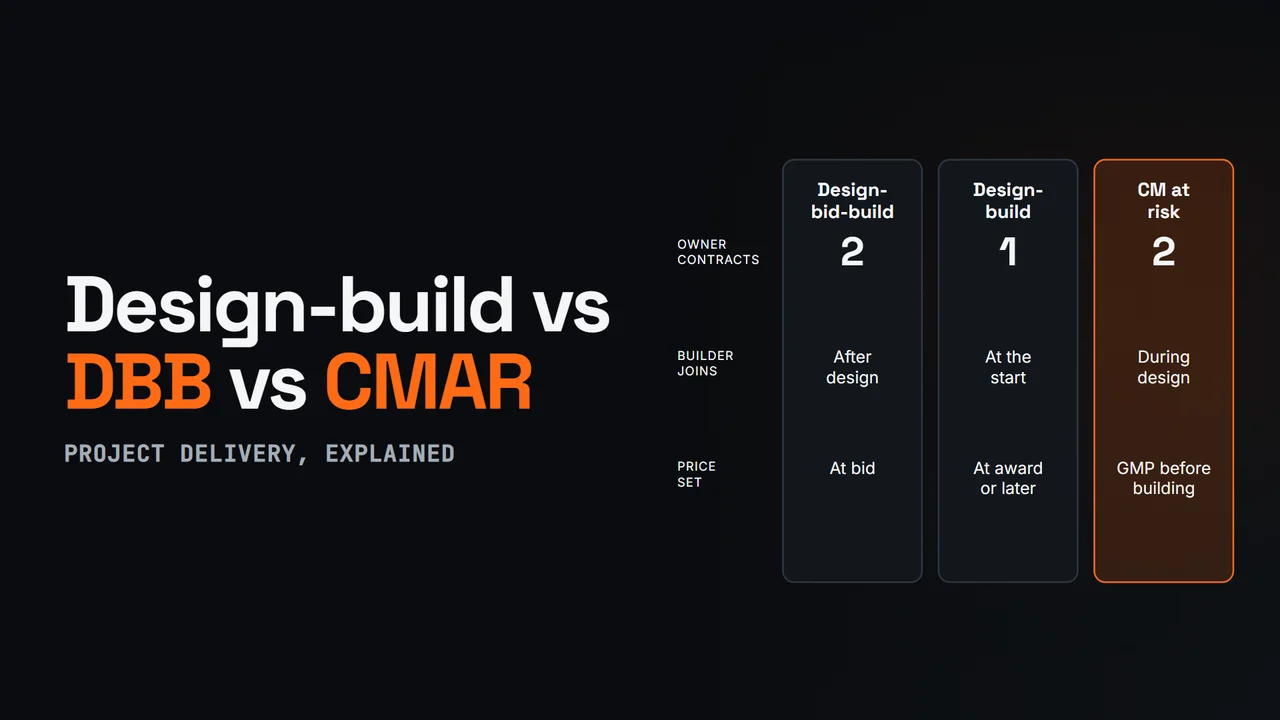
So, design-bid-build: two contracts, and a builder picked on price after design. Design-build: one contract for both. CM at risk: two contracts, with the builder in early and a price ceiling set before construction. The right one depends on how much speed, design control and price certainty the owner needs.
Whatever the method, the builder tracks the same things. In os.construction, the prime contract, budget, commitments, change orders and payment applications sit on one project record, so a GMP job and a lump-sum job are run from the same data.
Video page with chaptersMore in Construction concepts explained
FAQ
What is design-bid-build?
Design-bid-build is the traditional project delivery method. The owner hires an architect or engineer to complete the design, invites contractors to bid on the finished documents, and awards a separate construction contract, often to the lowest responsive and responsible bidder. The owner holds two contracts, one with the designer and one with the builder, and the phases run in sequence.
Is design-bid-build the same as hard bid?
Mostly. Hard bid describes the procurement step: contractors submit fixed prices on complete documents, and the low qualified bid usually wins. Design-bid-build is the whole delivery method around it. Some owners run design-bid-build with prequalified bidders or best-value award instead of pure low bid, so the terms overlap but aren't identical.
What are the advantages and disadvantages of design-bid-build?
Advantages: open price competition on a fully defined scope, a clear record for spending public money, and owner control of the design through its architect. Disadvantages: the longest overall schedule because the phases run in sequence, no contractor input during design, and a tendency for gaps in the documents to turn into RFIs, change orders and disputes after award.
Why do public owners use design-bid-build?
Many public procurement laws were built around competitive sealed bidding, which design-bid-build fits naturally. Federal agencies use sealed bidding under FAR Part 14 and most states have similar statutes. It gives transparent price competition and a defensible award. Many states now also authorize design-build or CM at risk, often with conditions.
Who pays for design errors in design-bid-build?
Generally the owner, as between owner and contractor. Under the Spearin doctrine, US courts usually treat the owner as impliedly warranting that the plans it provides are adequate, so a contractor that builds to them is typically entitled to an adjustment for defects. The owner may then pursue its architect, depending on the design contract and the standard of care.
What does responsive and responsible bidder mean?
A responsive bid conforms to the solicitation in every material respect: right forms, acknowledged addenda, bid security, no unauthorized conditions. A responsible bidder is one able to perform: it has the capacity, experience, financial resources, licensing and bonding to do the job. Public award usually goes to the lowest bidder that is both.