Construction manager at risk (CMAR) is a delivery method where the owner hires a construction manager during design to provide preconstruction services, then the CM commits to building the project for a guaranteed maximum price. The CM holds the trade subcontracts and the risk of finishing within the GMP. The owner keeps a separate contract with the architect.
It sits between design-bid-build and design-build. The builder joins early, as in design-build, but the owner still owns the design, as in design-bid-build. Public owners often call it CM/GC or CM as constructor; GSA uses the term CMc.
How it works
- Selection. The owner picks a CM mostly on qualifications, often with a proposed preconstruction fee, general conditions and a construction fee percentage. There’s no full construction price yet because the design isn’t finished.
- Preconstruction. Under a precon agreement or the first phase of the CMAR contract, the CM estimates cost at each design milestone, reviews constructability, proposes value engineering, builds the schedule and advises on long-lead items. See preconstruction.
- GMP proposal. When the documents support it, often during design development or construction documents, the CM submits a GMP with its assumptions, clarifications, allowances and contingency. The owner accepts it as a contract amendment, for example the GMP amendment to an AIA A133.
- Buyout. The CM bids trade packages, often under owner-approved procurement rules on public work, and awards subcontracts. Results versus the GMP estimate become buyout savings or a buyout overrun.
- Construction. The CM builds the project and bills actual cost plus fee monthly, open-book, up to the GMP. Owner changes adjust the GMP by change order.
- Final accounting. At closeout, final cost plus fee is compared with the adjusted GMP, and any savings are returned or shared under the contract.
CMAR vs other delivery methods
| CM at risk | CM agency | Design-build | Design-bid-build | |
|---|---|---|---|---|
| Builder joins | During design | During design (adviser only) | At the start | After design |
| Holds trade contracts | CM | Owner | Design-builder | General contractor |
| Price basis | GMP | Fee for services | Lump sum, cost-plus or GMP | Lump sum bid |
| Design contract held by | Owner | Owner | Design-builder | Owner |
| Cost risk after the price is set | CM, up to the GMP | Owner | Design-builder | Contractor |
Worked example
Illustrative: an owner budgets $48,500,000 for a medical office building and hires a CM at risk for a $180,000 preconstruction fee.
- At schematic design, the CM’s estimate is $49,800,000, $1,300,000 over budget.
- By design development, the design team has resolved open scope and the estimate is $49,100,000.
- The CM proposes value engineering items; the owner accepts $1,100,000 of them.
- The GMP is set at $48,000,000, including contractor contingency and fee, $500,000 under the owner’s budget.
Then buyout starts. The mechanical package comes in $420,000 under its line in the GMP estimate and the electrical package $180,000 over, a net $240,000 in buyout savings. Whether that money goes back to the owner, into contingency or into shared savings depends on the contract. Later the owner adds an imaging suite upgrade by change order for $350,000, raising the GMP to $48,350,000. If the CM misses a scope item in a trade package, that cost comes out of its contingency and does not raise the GMP.
Why it matters
The CM earns its place by catching problems before they’re built. Preconstruction estimates have to be honest because they become the GMP. Once the GMP is signed, the job is open-book: owners audit costs, contingency draws and buyout results, and any cost you can’t support becomes a dispute.
CMAR also changes the risk picture from design-bid-build. The owner still warrants the design, but because the CM reviewed the documents during preconstruction, some contracts limit its claims for design problems it should have caught. Read the constructability review clause before signing.
Common mistakes
- Setting a GMP on drawings that are too early, with thin contingency and vague assumptions.
- Mixing buyout savings into contingency without telling the owner, when the contract says savings belong to the owner.
- Treating preconstruction as a sales phase instead of a real estimating effort.
- Letting the GMP exclusions and allowances list drift out of sync with what the design actually shows.
- Not tracking the adjusted GMP separately from the cost forecast after change orders.
This is general information, not legal advice. CMAR procurement rules vary by state and owner.
How os.construction handles it
The CM-at-risk money flow runs on one record today. The Bidding tool levels trade bids, records an approved award and turns it into a draft subcontract or purchase order, with buyout allocated against a budget snapshot. Budget transfers are recorded as modifications, so buyout savings and contingency draws stay visible, and the PM forecasts cost to complete by cost code. In Accounting, payables hold a sub’s bill when its lien waiver or certificate of insurance is missing, and a prime contract set to GMP bills through the Accounting API with the fee, the GMP cap and shared savings applied. See Budget, Accounts receivable and Accounts payable. Building GMP pay-app backup directly from job cost is planned. os.construction does not include estimating tools, so precon estimates stay in your estimating software.
See CM at risk software for the full flow and what is still planned.
Watch the explainer · 1:57
Design-build vs design-bid-build vs CM at risk
- 0:00Three ways to buy a building
- 0:12Design-bid-build
- 0:31Design-build
- 0:49CM at risk and the GMP
- 1:14Side by side
- 1:36One project record
Read the transcript
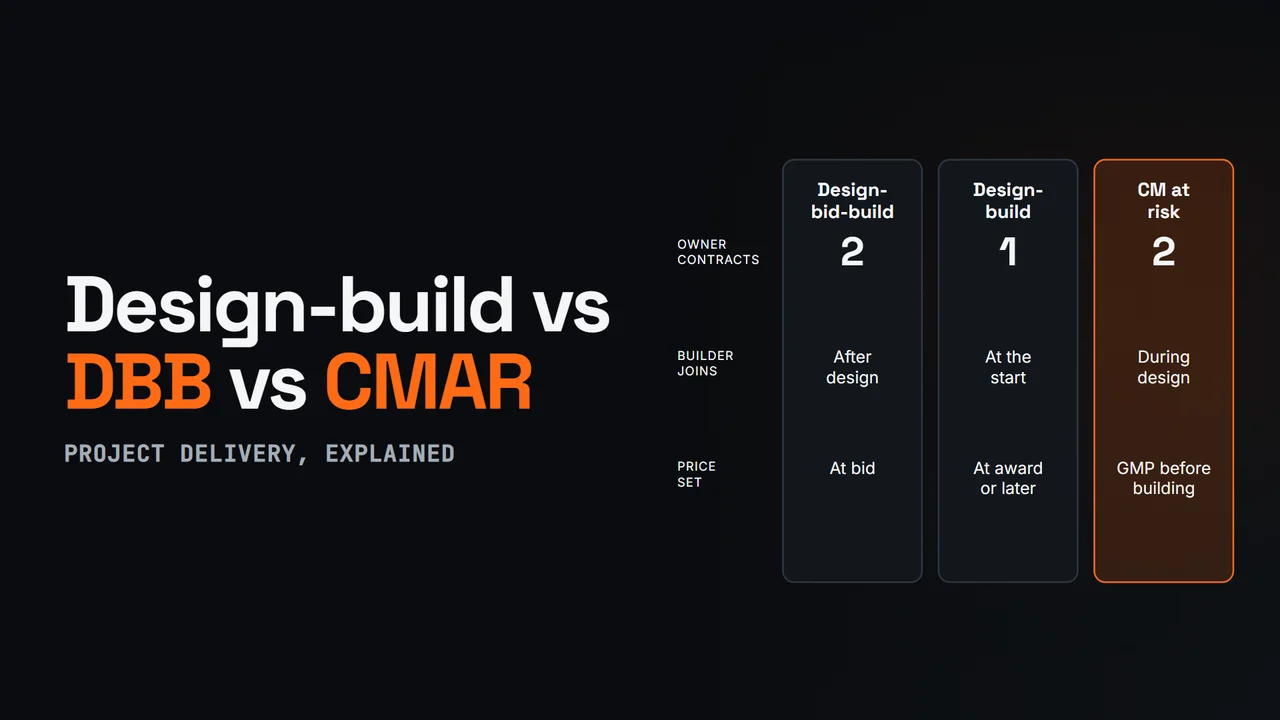
Design-bid-build, design-build and construction manager at risk are three ways an owner can buy a building. The difference comes down to how many contracts the owner signs, and when the builder gets involved.
Design-bid-build is the traditional sequence. The owner hires an architect, the design is finished, and then contractors bid on it. The low responsive bidder usually wins. The owner holds two separate contracts, so when the drawings have gaps, the owner sits between the designer and the builder.
In design-build, the owner signs one contract with one team that both designs and builds. Design and construction can overlap, which can shorten the schedule, and one party answers for both. The trade-off is less owner control over design details once the criteria are set.
Construction manager at risk keeps the architect on its own contract, but hires the builder early, during design, to advise on cost, schedule and constructability. When the design is far enough along, the construction manager commits to a guaranteed maximum price, or GMP, and then holds the trade contracts. Costs above the GMP are generally the construction manager's risk, unless the scope changes.
So, design-bid-build: two contracts, and a builder picked on price after design. Design-build: one contract for both. CM at risk: two contracts, with the builder in early and a price ceiling set before construction. The right one depends on how much speed, design control and price certainty the owner needs.
Whatever the method, the builder tracks the same things. In os.construction, the prime contract, budget, commitments, change orders and payment applications sit on one project record, so a GMP job and a lump-sum job are run from the same data.
Video page with chaptersMore in Construction concepts explained
FAQ
What is CM at risk?
Construction manager at risk (CMAR) is a project delivery method where the owner hires a construction manager during design to provide preconstruction services such as estimating, constructability review and scheduling. When the design is far enough along, the CM commits to a guaranteed maximum price and builds the project, holding the trade subcontracts and the risk of finishing within the GMP.
What is the difference between CM at risk and CM agency?
A CM at risk becomes the builder: it holds the trade contracts and guarantees a price. A CM agent (agency CM or CM as adviser) only advises the owner and manages the process for a fee; the owner holds the trade or prime contracts directly and keeps the cost risk. AIA uses A133 for CM as constructor and the C132 family for CM as adviser.
What is the difference between CMAR and design-build?
In CMAR the owner holds two contracts, one with the architect and one with the construction manager, so the owner still owns the design. In design-build the owner holds one contract with a design-builder that is responsible for both design and construction. Both bring the builder in early, but design risk sits in different places.
How is a CM at risk selected?
Mostly on qualifications, often with a fee and general conditions proposal rather than a full construction price, because the design isn't finished. Public owners typically use a request for qualifications, a shortlist, interviews and a scored proposal under their state's CMAR statute. The GMP is negotiated later, once the design supports it.
What happens if the owner and CMAR can't agree on the GMP?
Many CMAR contracts let the owner decline the GMP proposal and end the agreement after paying for preconstruction services, then bid the work another way. The owner keeps the design, since it holds the architect's contract. Check the termination and GMP proposal provisions in your agreement.
What are preconstruction services?
Work the CM does before construction to shape the design and price: cost estimates at each design milestone, constructability and phasing reviews, value engineering options, early schedules, long-lead procurement advice, site logistics and subcontractor market outreach. It is usually paid as a separate preconstruction fee.