A temporary certificate of occupancy (TCO) is a time-limited approval from the local building department that lets an owner occupy all or part of a building before every item of work is complete. It’s issued when the areas to be occupied are safe, lists conditions to clear, and expires on a set date unless a final certificate of occupancy replaces it or it is extended.
| TCO at a glance | |
|---|---|
| Stands for | Temporary certificate of occupancy (not total cost of ownership) |
| Issued by | The building official of the local jurisdiction |
| Issued when | The areas to be occupied pass life-safety inspections, with other work still open |
| Covers | All or part of a building, such as finished floors or a tenant space |
| Lasts | A period the building official sets; renewable in many jurisdictions |
| Ends with | The final certificate of occupancy, an extension, or loss of permission to occupy |
| Code basis | International Building Code Section 111.3, as locally adopted and amended |
In plain English
Illustrative: a six-story office building is finished except for the top-floor tenant space, the rooftop terrace and the final landscaping. The anchor tenant’s lease starts June 1. Floors 1 to 5 have working fire alarm, sprinklers, exits and emergency lights, so the owner applies for a TCO covering those floors. The building department issues it on May 24, valid for 90 days, with three conditions: finish and inspect floor 6, complete the terrace guardrails, and plant the required landscaping. The tenant moves in on time. The GC clears the three conditions by August 10, passes the remaining finals, and the department issues the final CO before the TCO expires.
What a “TCO permit” is
People search for “TCO permits” because it is handled like a permit step at their local building department, with its own application, fee and inspection. Strictly, a TCO isn’t a new building permit. It is issued under the existing permit, as a temporary version of the certificate of occupancy.
The International Building Code, which most US jurisdictions adopt with local amendments, allows the building official to issue a temporary certificate before the entire work covered by the permit is completed, provided the portions to be occupied can be occupied safely, and to set the period it’s valid (Section 111.3 in recent editions). The code leaves the details to the jurisdiction, so the form, fee, required letters, inspections and validity period differ from city to city. Some large cities, such as New York, run their own building code and TCO procedures. Always check the current requirements on your building department’s own site.
How it works
- Decide what will be occupied. A floor, a tenant space, or the whole building with site work still open. Agree it with the owner, architect and, often, the fire marshal early.
- Finish life safety for those areas. Fire alarm, sprinklers, exits, emergency lighting, fire-rated separations from unfinished areas, and fire department access.
- Separate occupied areas from active work. Protected separations, egress paths that don’t run through construction, and controlled access to work zones.
- Pass the required inspections for the occupied areas, then apply to the building department with any letters, fees or deposits it requires.
- Receive the TCO with its conditions and expiration date. Put both on the schedule.
- Clear the conditions and pass the remaining finals, then receive the final CO before the TCO expires, or request an extension in time.
What a TCO application usually needs
Requirements vary by jurisdiction. A typical package includes:
- The permit number and a plan showing which areas will be occupied.
- Passed life-safety inspections for those areas: fire alarm acceptance, sprinkler final, egress and emergency lighting, and fire department access.
- Elevator approvals, where elevators serve the occupied areas.
- A letter from the architect or engineer of record, where required, stating the occupied areas are complete and safe.
- A list of open items with target completion dates.
- The fee, and sometimes a bond or deposit for unfinished site work such as paving or landscaping.
The free closeout and TCO checklist has a TCO application section you can adapt.
TCO vs final certificate of occupancy
| Temporary CO (TCO) | Final certificate of occupancy | |
|---|---|---|
| When | Before full completion, when occupied areas are safe | All permitted work and inspections complete |
| Scope | All or part of the building | The work covered by the permit |
| Duration | Expires on a date the building official sets | Permanent for the approved use |
| Conditions | Listed items to finish, sometimes a bond or fee | None open |
| Typical use | Phased move-in, holding a lease or opening date | Final turnover |
Who is responsible
- Owner: usually applies for the TCO as permit holder or occupant, and decides what to occupy early.
- General contractor: completes life-safety work for the occupied areas, schedules inspections, separates occupied space from work zones, and clears the conditions.
- Architect or engineer of record: provides letters or certifications the department requires.
- Building official and fire marshal: decide whether the TCO is issued, on what conditions and for how long.
Why it matters
A TCO can save a lease start date, a school opening or a hospital move. But it isn’t the finish line. Contracts may or may not treat a TCO as substantial completion, and an expired TCO can leave an occupied building out of compliance. Once tenants move in, the remaining work gets harder: crews work around occupants, access is restricted, and the owner’s attention shifts to operations. The open conditions often overlap the punch list, so track them together.
Common mistakes
- Treating the TCO as the end of the job and demobilizing too early.
- Missing the expiration date while conditions are still open.
- Not separating occupied areas from active construction, which can fail the TCO inspection.
- Assuming the TCO triggers substantial completion when the contract requires a final CO.
- Leaving bonded or deposited site work, such as landscaping, until the season it can’t be done.
- Applying the rules from the last city you built in; TCO procedures are local.
This is general information, not legal advice. TCO rules, fees and periods vary by jurisdiction.
How os.construction handles it
Inspections and the Punch List track the open items behind a TCO. The Permits tool records each permit’s conditions with an owner and due date and warns when a recorded expiration date has passed, and in Scheduling the TCO, its expiration and the final CO can be milestones with contract-date constraints.
TCO vs certificate of occupancy compares the two in more depth and shows how New York City and Philadelphia handle TCO permits.
Watch the explainer · 1:56
TCO vs certificate of occupancy
- 0:00Two approvals, two tracks
- 0:15The TCO
- 0:38The certificate of occupancy
- 0:53The contract track
- 1:16Before the owner moves in
- 1:34Tracking both tracks
Read the transcript
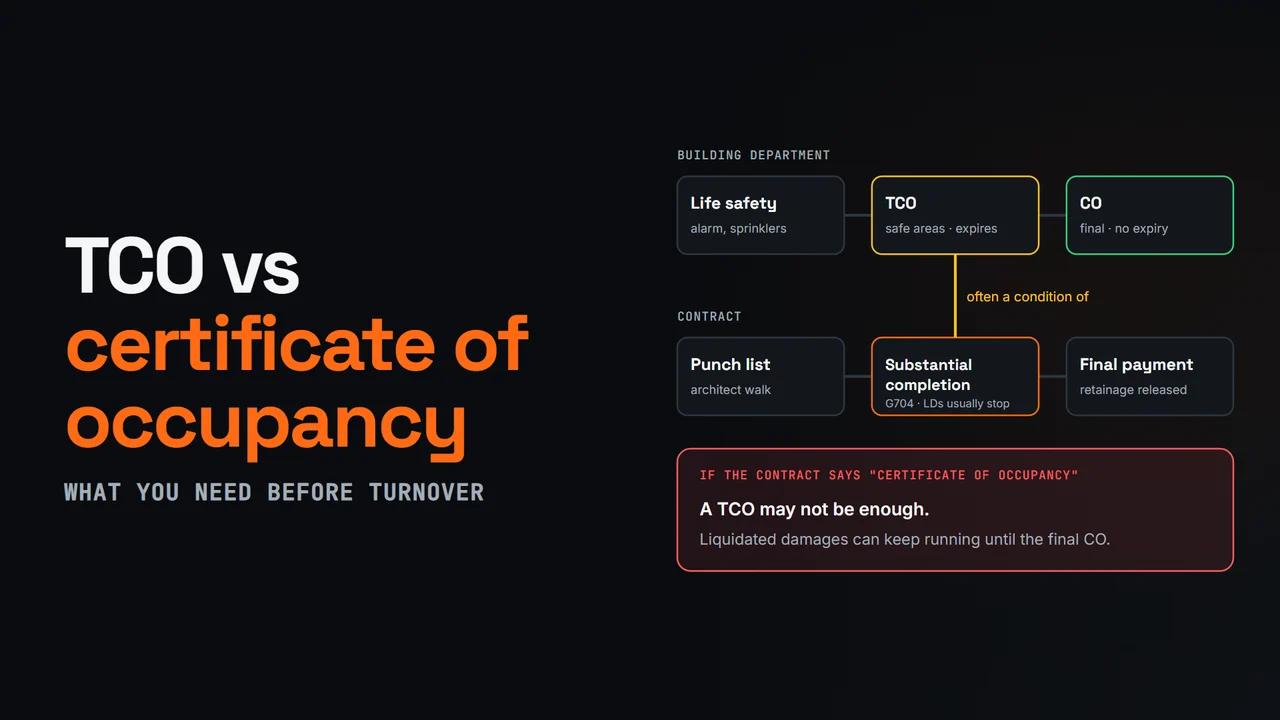
A temporary certificate of occupancy, or TCO, and a certificate of occupancy, or CO, both come from the local building official. Neither one is substantial completion under your contract. Closeout runs on two tracks at once.
A TCO lets the owner occupy all or part of a building before all permitted work is finished, as long as the occupied areas are safe. Under Section 111.3 of the International Building Code, the official sets how long it's valid, so it comes with open items and an expiry date. In New York City, TCOs typically expire ninety days after issuance.
The certificate of occupancy is the final approval. It's issued when all permitted work has passed final inspection, and it doesn't expire while the building's use stays the same. Health, utility and public works sign-offs can still hold it up.
Meanwhile the contract runs its own track: punch list, substantial completion, then final completion and final payment. Many contracts make a TCO or CO a condition of substantial completion. If yours requires a certificate of occupancy, a TCO may not be enough, and liquidated damages can keep running until the final CO.
Before the owner moves in under a TCO, finish life safety in the occupied areas, separate them from active work, put the expiry on the schedule with a renewal date ahead of it, and agree in writing who insures and maintains the space. Rules vary by jurisdiction.
In os.construction, inspections and the punch list track the open items behind a TCO, and the schedule can carry the TCO, its expiry and the final CO as milestones, so you see when an inspection slip reaches substantial completion.
Video page with chaptersStep-by-step guideMore in Construction concepts explained
FAQ
What is a temporary certificate of occupancy?
A temporary certificate of occupancy (TCO) is permission from the building official to occupy all or part of a building before all work is complete. It is issued when the areas to be occupied are safe, with life safety systems such as fire alarm, sprinklers and exits working. It lists conditions to clear and expires on a set date, after which a final certificate of occupancy is needed.
How long is a TCO good for?
The building official sets the period, and it varies by jurisdiction and project. TCOs are commonly issued for periods measured in weeks or months, and some departments allow extensions for a fee if progress is shown. If the TCO expires before its conditions are cleared, occupancy may no longer be legal, so track the date like a contract milestone.
What is needed to get a TCO?
Requirements vary, but typically the areas to be occupied must pass fire and life safety inspections: fire alarm, sprinklers, egress, emergency lighting and fire department access. Some departments also require the architect's or engineer's letter, a list of open items with completion dates, a fee, and occasionally a bond or deposit to cover unfinished site work.
What is a TCO permit?
"TCO permit" is the everyday name for a temporary certificate of occupancy, or for the application a building department uses to issue one. It isn't a separate building permit: it is issued under the existing permit once the areas to be occupied pass their life-safety inspections. Each jurisdiction sets its own form, fee, inspections and validity period, so check your local building department's TCO page.
What does TCO mean in construction?
In construction, TCO almost always means temporary certificate of occupancy: the building official's time-limited approval to occupy all or part of a building before the final certificate of occupancy. In finance and IT, TCO means total cost of ownership, which is unrelated. On a project schedule or closeout log, a TCO milestone refers to the occupancy approval.
What is the difference between a TCO and a CO?
A TCO allows occupancy before all work is done, for a set period, with listed conditions, and may cover only part of the building. A certificate of occupancy (CO) is issued when all permitted work and inspections are complete, is permanent for the approved use and has no open conditions. A TCO must be followed by a final CO, or extended, before it expires.
What happens when a TCO expires?
It depends on the jurisdiction. Generally, once a TCO lapses without a final CO or an approved extension, the occupancy it allowed is no longer authorized, and the department can issue violations or require the space to be vacated. Many departments allow renewal for a fee if the remaining items are progressing. Apply for any extension well before the expiration date.
Does a TCO count as substantial completion?
Only if the contract says so. Some contracts define substantial completion as receipt of a certificate of occupancy or temporary certificate, and others require the final CO or simply that the owner can use the work for its intended purpose. Because substantial completion can stop liquidated damages and start warranties, read the definition before assuming a TCO triggers it.