On this page
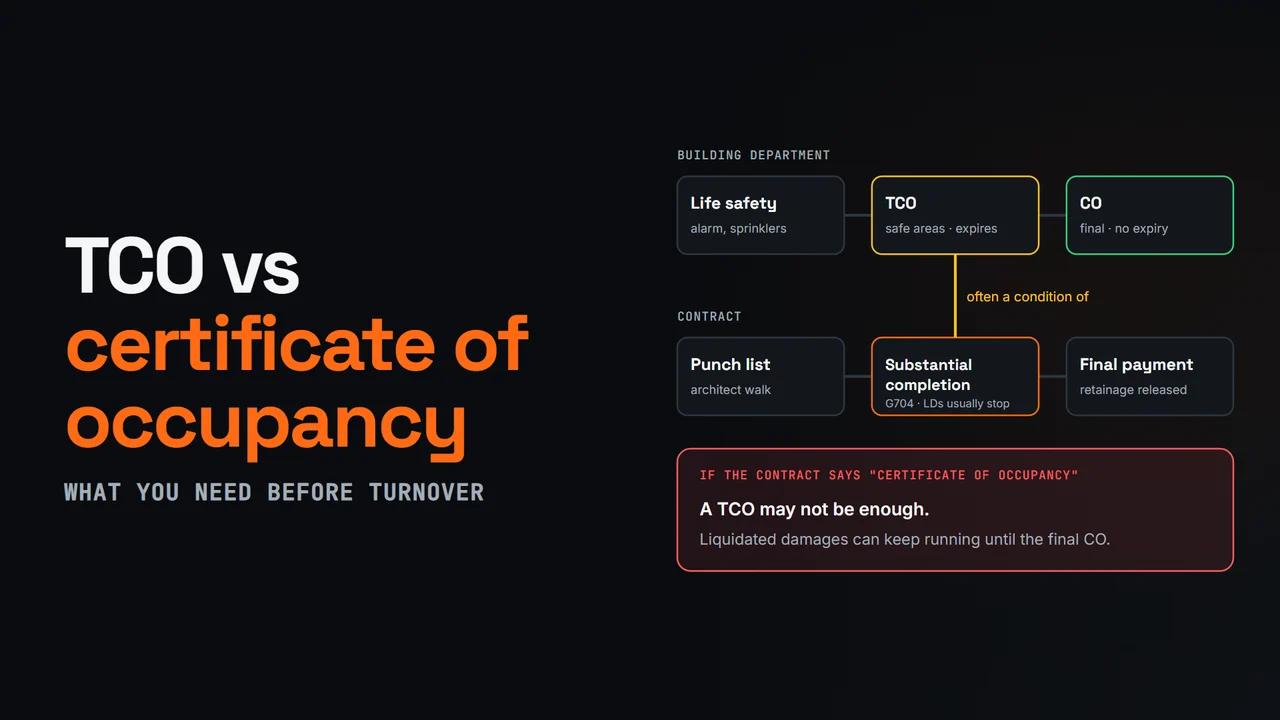
A temporary certificate of occupancy (TCO) lets an owner legally occupy all or part of a building before every item of permitted work is finished, as long as the occupied areas are safe. It comes with conditions and an expiry date. A certificate of occupancy (CO) is the final approval, issued when all permitted work has passed final inspection, and it doesn’t expire while the building’s use stays the same. Both come from the local building official, not the owner or the architect, and neither one is the same thing as substantial completion under your contract.
That last point is where most turnover problems start. The building department decides when people may move in. The contract decides when the job is done. On a lot of jobs one depends on the other, and nobody checks how until the last month.
What the building code says
Most US jurisdictions adopt the International Building Code, with local amendments. Its Chapter 1, Section 111, covers the certificate of occupancy:
- 111.1: no building may be used or occupied, and no change of occupancy made, until the building official has issued a certificate of occupancy.
- 111.2: after inspection, the official issues the certificate, which states things like the use and occupancy classification, the type of construction, the design occupant load and any special conditions of the permit.
- 111.3: the official may issue a temporary certificate before the entire work covered by the permit is complete, provided the portions to be occupied can be occupied safely, and sets the period during which it is valid.
- 111.4: the official may suspend or revoke a certificate in writing if it was issued in error or on incorrect information, or the building violates the code.
Notice what 111.3 does not say: how long a TCO lasts, what it costs, or what paperwork goes with it. That is left to the official, which is why “TCO permits” means something slightly different in every city. Check the code edition and the amendments your jurisdiction actually adopted; some cities, such as New York, run their own building code.
TCO vs CO at a glance
| TCO | Certificate of occupancy | |
|---|---|---|
| Allows | Occupancy of safe areas before all work is done | Occupancy of the building for its approved use |
| Code basis (IBC) | 111.3 | 111.2 |
| Issued when | Life safety is complete in the occupied areas | All permitted work passes final inspection |
| Lasts | A period the building official sets | No expiry while use and occupancy are unchanged |
| Comes with | Open items, sometimes a fee, deposit or bond | Ongoing code compliance |
| Used for | Phased move-ins, tenant fit-outs, holding an opening date | Final turnover |
Watch the explainer · 1:56
TCO vs certificate of occupancy
- 0:00Two approvals, two tracks
- 0:15The TCO
- 0:38The certificate of occupancy
- 0:53The contract track
- 1:16Before the owner moves in
- 1:34Tracking both tracks
Read the transcript
A temporary certificate of occupancy, or TCO, and a certificate of occupancy, or CO, both come from the local building official. Neither one is substantial completion under your contract. Closeout runs on two tracks at once.
A TCO lets the owner occupy all or part of a building before all permitted work is finished, as long as the occupied areas are safe. Under Section 111.3 of the International Building Code, the official sets how long it's valid, so it comes with open items and an expiry date. In New York City, TCOs typically expire ninety days after issuance.
The certificate of occupancy is the final approval. It's issued when all permitted work has passed final inspection, and it doesn't expire while the building's use stays the same. Health, utility and public works sign-offs can still hold it up.
Meanwhile the contract runs its own track: punch list, substantial completion, then final completion and final payment. Many contracts make a TCO or CO a condition of substantial completion. If yours requires a certificate of occupancy, a TCO may not be enough, and liquidated damages can keep running until the final CO.
Before the owner moves in under a TCO, finish life safety in the occupied areas, separate them from active work, put the expiry on the schedule with a renewal date ahead of it, and agree in writing who insures and maintains the space. Rules vary by jurisdiction.
In os.construction, inspections and the punch list track the open items behind a TCO, and the schedule can carry the TCO, its expiry and the final CO as milestones, so you see when an inspection slip reaches substantial completion.
Video page with chaptersMore in Construction concepts explained
How two cities handle TCO permits
New York City. The Department of Buildings issues a TCO when it finds a building safe to occupy but items remain before a final CO. Its own page says TCOs typically expire 90 days after issuance, and a TCO can be renewed if the final CO requirements are still open. It lists temporary or final construction, plumbing and electrical sign-offs, plus elevator sign-off where there is one, and a fee. If the space sits unoccupied for more than 30 days, a new TCO is needed to re-occupy it (NYC DOB).
Philadelphia. The Department of Licenses and Inspections requires an approved building permit, with all fire protection systems, egress components and required building certifications in place. You request and pass an inspection under the permit, then apply online, and the approval lasts for a defined period. Single-family dwellings can’t get one (City of Philadelphia).
Two cities, two sets of rules, both inside the same IBC idea. Fees and procedures change, so check the current page for your jurisdiction before you plan around them.
What you need before turnover
The building department’s list varies, but the GC’s list is fairly consistent. Before the owner moves in under a TCO, you want these in hand:
- The contract’s definition of substantial completion. If it requires “a certificate of occupancy,” a TCO may not be enough, and liquidated damages can keep running until the final CO. If it says “a temporary or permanent certificate,” you have more room.
- Life safety finished in the occupied areas. Fire alarm and sprinkler acceptance, exits, exit signs, emergency lighting and fire department access. These are the inspections that gate a TCO almost everywhere.
- Separation from active work. Rated separations and secure barriers between occupied space and the areas still under construction, plus a plan for how trades get in and out.
- The TCO’s conditions and expiry on the schedule. Treat the expiry like a contract milestone with a renewal date ahead of it. An expired TCO can leave an occupied building out of compliance, and in some cities it means a new application.
- Risk transfer in writing. Who insures, secures, heats and maintains the occupied areas from the move-in date. On AIA contracts, partial occupancy is handled under A201 Section 9.9, and the parties should agree on responsibilities before it starts.
- A punch and inspection list that covers both tracks. The TCO’s open items usually overlap the punch list. Track them together so one sign-off clears both.
Then, for the final CO: every remaining final inspection, outside agency approvals such as health or public works, special inspection reports, and the elevator certificate. Our closeout and TCO checklist lays all of this out with an owner and date per line.
Where TCOs go wrong
- Treating the TCO as the finish line. Crews demobilize, the last finals slip, and the TCO expires with a tenant inside.
- Booking inspections late. Fire marshal and elevator inspections run on the inspector’s calendar, not yours. A failed test can cost a week of waiting for the next slot.
- Not reading the contract. The difference between “TCO” and “CO” in the substantial completion definition can be weeks of liquidated damages.
- Forgetting outside agencies. Health departments, utilities and public works sign-offs can hold a CO after the building department is satisfied.
Where this sits in closeout
The TCO and CO are two steps in a longer sequence that starts at substantial completion and ends when the last retainage is paid: punch, commissioning, final inspections, occupancy, turnover documents and the final pay app. The closeout to occupancy guide walks through the whole sequence, and the glossary has more on the temporary certificate of occupancy and the certificate of occupancy.
In os.construction, inspections and the punch list track the open items behind a TCO, the Permits tool keeps each permit’s conditions with an owner and a due date (how to track construction permits), and in the schedule the TCO, its expiry and the final CO can be milestones with contract-date constraints, so you see the day an inspection slip reaches substantial completion.
General information, not legal advice. Building codes are adopted and amended locally, and TCO periods, fees and procedures vary by jurisdiction. Your contract and your building department govern.
Your next step
See it on one project record.
Create an account and open the sample project to see contracts, costs, changes and billing on the same record.
Try it in the app- Next · Construction concepts explainedCritical path and float in 2 minutesWatch the next explainer
- ExplainerCloseout to occupancy: punch, Cx, as-builts, TCO and COThe full written guide, with worked examples and sources.
- Video libraryMore in Construction concepts explainedEvery video, grouped by topic.
Share this article