Substantial completion is the contract milestone when the work, or a designated portion of it, is complete enough under the contract documents that the owner can occupy or use it for its intended purpose. Minor items can stay open on a punch list. The architect certifies the date, often on AIA G704, and that date moves money, risk and time.
AIA A201-2017 §9.8.1 uses this definition. The UK counterpart is practical completion under JCT contracts, and Canadian lien statutes use substantial performance. They play similar roles but are tested differently, so the term on your contract matters.
How it works
- The contractor says it’s ready. Under A201 §9.8.2, the contractor notifies the architect and submits a list of items still to be completed or corrected (the punch list). Leaving something off the list doesn’t relieve the contractor of finishing it.
- The architect inspects. If the work isn’t substantially complete, the architect says what’s missing and the contractor goes back to work. If it is, the architect prepares the certificate.
- The certificate is signed. G704 records the date, the work covered, the attached punch list and who is responsible for security, maintenance, heat, utilities, damage to the work and insurance from that date. Owner and contractor accept it in writing.
- Money and time move. Retainage is released under the contract terms, adjusted for incomplete or nonconforming work. Warranties begin unless the certificate says otherwise.
- Final completion follows. The punch list is closed, closeout documents are delivered, and the job moves to final completion and final payment.
What substantial completion triggers
| Item | Typical effect on AIA-based contracts |
|---|---|
| Contract time | Ends; liquidated damages stop accruing |
| Warranties | Start, unless the certificate sets other dates |
| Retainage | Released, less amounts held for open punch and nonconforming work |
| Risk and utilities | Shift as the certificate assigns them |
| Insurance | Builder’s risk and owner’s property coverage change hands per the certificate |
| Lien and notice deadlines | In some states a recorded notice of completion shortens lien periods |
The owner’s ability to occupy is often tied to a certificate of occupancy from the building department, but that is a separate document. Many contracts make a TCO or CO a condition of substantial completion.
US, UK and Canada compared
| Substantial completion (US) | Practical completion (UK) | Substantial performance (Canada) | |
|---|---|---|---|
| Where defined | Contract (A201 §9.8.1) | Not defined in the main JCT forms; judgement and case law | Provincial lien statute, e.g. Ontario Construction Act s. 2 |
| Test | Owner can use the work for its intended purpose | Work complete apart from trivial items, in the contract administrator’s opinion | Ready for use and finishable for no more than a set cost |
| Who certifies | Architect (G704) | Contract administrator or employer’s agent | Payment certifier, owner or contractor, as the statute sets out |
| Retained money | Retainage released, adjusted for open work | Typically half the retention released; rest at end of rectification period | Statutory holdback release timing keys off it |
The Ontario test is arithmetic: the improvement must be ready for use and capable of completion for no more than 3% of the first $1,000,000 of the contract price, 2% of the next $1,000,000 and 1% of the balance. A $3,000,000 contract is substantially performed when what’s left would cost $60,000 or less. UK practical completion has no formula, and US substantial completion turns on usability, so a building can meet one test and not another.
Why it matters
More money changes hands on this one date than on almost any other. On a job holding 10% retainage, millions can be waiting on a signature. Every day the date slips can also mean a day of liquidated damages. And because warranties usually start here, an undocumented date lets the owner argue that warranties started later, at final completion.
For the owner, accepting substantial completion takes on risk: security, utilities and insurance of a building it can now use. That is why architects are careful about signing, and why the punch list attached to the certificate matters.
Worked example
Illustrative: on Riverside Medical Center, retainage of 10% stands at about $4.9M when the architect signs G704 for the whole building. The attached punch list is valued at $400,000, and the contract lets the owner keep 150% of the value of open punch work. The owner keeps $600,000 and releases about $4.3M. Liquidated damages stop on the certificate date, and the one-year correction period starts the same day. The remaining $600,000 is released at final completion, once the punch list is closed and final lien waivers are in.
Common mistakes
- No signed, dated certificate. Without it, the LD end date, warranty start and retainage trigger are all open to argument.
- Letting warranty start dates drift. If the certificate is silent, warranty dates can slide to final completion by default or dispute.
- Assuming occupancy equals substantial completion. An owner moving in early doesn’t by itself certify anything. Use a partial certificate for a designated portion.
- An open-ended punch list. Long punch tails delay final payment for months.
- Applying the wrong market’s test. A UK or Canadian project doesn’t use the A201 definition; read the contract and the statute.
This is general information, not legal advice. Contract terms and lien statutes vary by state and province; check your contract and local law.
How os.construction handles it
Today the Punch List tool holds the evidence for substantial completion: open and closed items, and who reviewed and closed each one. Payment applications record retainage released in a period. Tracking substantial completion as a dated event that sets warranty start dates and makes partial retainage release billable is planned, as described in closeout and retainage release.
Watch the explainer · 1:56
TCO vs certificate of occupancy
- 0:00Two approvals, two tracks
- 0:15The TCO
- 0:38The certificate of occupancy
- 0:53The contract track
- 1:16Before the owner moves in
- 1:34Tracking both tracks
Read the transcript
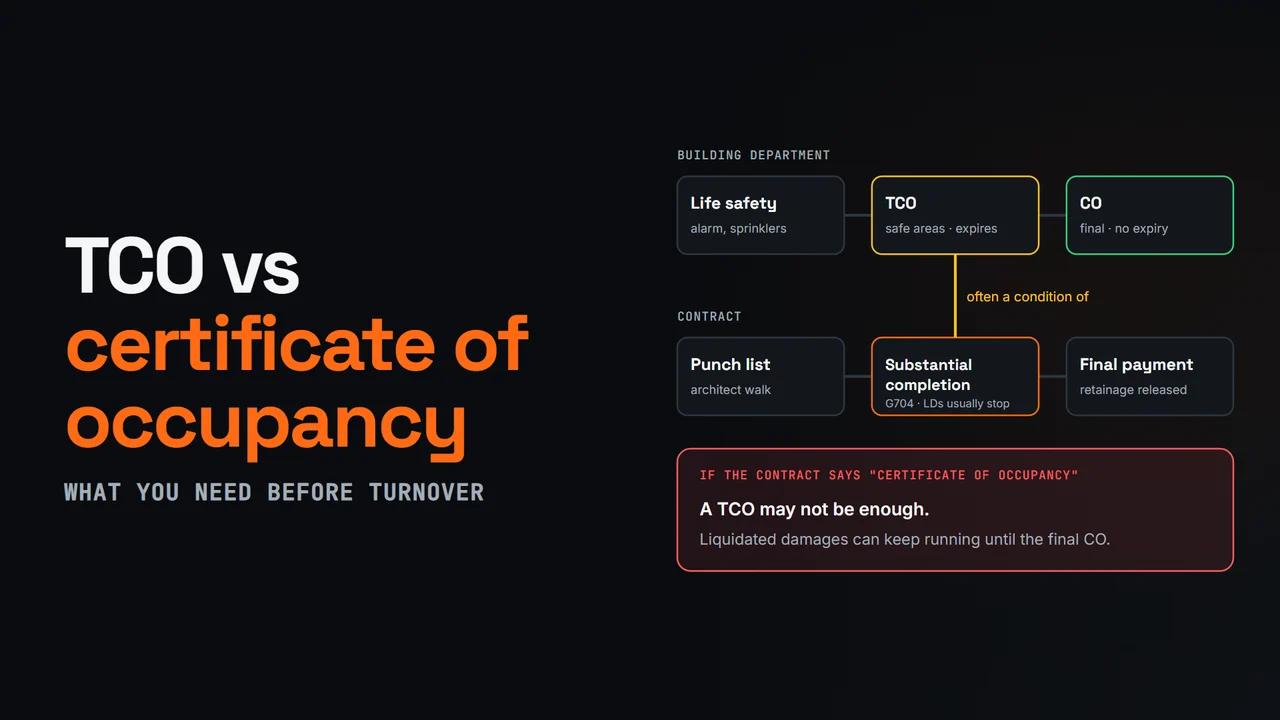
A temporary certificate of occupancy, or TCO, and a certificate of occupancy, or CO, both come from the local building official. Neither one is substantial completion under your contract. Closeout runs on two tracks at once.
A TCO lets the owner occupy all or part of a building before all permitted work is finished, as long as the occupied areas are safe. Under Section 111.3 of the International Building Code, the official sets how long it's valid, so it comes with open items and an expiry date. In New York City, TCOs typically expire ninety days after issuance.
The certificate of occupancy is the final approval. It's issued when all permitted work has passed final inspection, and it doesn't expire while the building's use stays the same. Health, utility and public works sign-offs can still hold it up.
Meanwhile the contract runs its own track: punch list, substantial completion, then final completion and final payment. Many contracts make a TCO or CO a condition of substantial completion. If yours requires a certificate of occupancy, a TCO may not be enough, and liquidated damages can keep running until the final CO.
Before the owner moves in under a TCO, finish life safety in the occupied areas, separate them from active work, put the expiry on the schedule with a renewal date ahead of it, and agree in writing who insures and maintains the space. Rules vary by jurisdiction.
In os.construction, inspections and the punch list track the open items behind a TCO, and the schedule can carry the TCO, its expiry and the final CO as milestones, so you see when an inspection slip reaches substantial completion.
Video page with chaptersStep-by-step guideMore in Construction concepts explained
FAQ
What does substantial completion mean in construction?
Substantial completion is the stage when the work, or a designated portion of it, is complete enough under the contract documents that the owner can occupy or use it for its intended purpose. Minor items can remain on a punch list. AIA A201 defines it this way, and the architect usually certifies the date on AIA G704.
What happens at substantial completion?
On most AIA-based contracts: contract time ends, so liquidated damages stop; warranties start unless the certificate says otherwise; the certificate assigns responsibility for security, maintenance, utilities, damage to the work and insurance; and the owner releases retainage, adjusted for incomplete or nonconforming work. The exact list depends on your contract.
What is the difference between substantial completion and final completion?
Substantial completion means the owner can use the work. Final completion means everything is done: every punch item is closed and closeout documents such as warranties, O&M manuals, as-builts and final lien waivers are delivered. Final payment usually follows final completion.
Is substantial completion the same as a certificate of occupancy?
No. Substantial completion is a contract milestone between owner and contractor, certified by the architect. A certificate of occupancy is issued by the local building authority under the building code. Many contracts make a temporary or permanent certificate of occupancy a condition of substantial completion, but they are separate documents from separate parties.
What is practical completion in the UK?
Practical completion is the UK counterpart, used in JCT contracts. The main JCT forms don't define it, so it is left to the contract administrator's judgement and case law. It typically releases half the retention, starts the rectification period and ends the contractor's exposure to liquidated damages.
What is substantial performance in Canada?
Substantial performance is the Canadian lien-statute milestone. In Ontario, the Construction Act tests it with a cost-to-complete threshold: 3% of the first $1,000,000 of the contract price, 2% of the next $1,000,000 and 1% of the balance, once the improvement is ready for use. Its certificate drives lien and holdback deadlines.