TCO vs certificate of occupancy
What a TCO allows and when it expires, what the final certificate of occupancy means, and why neither one is substantial completion.
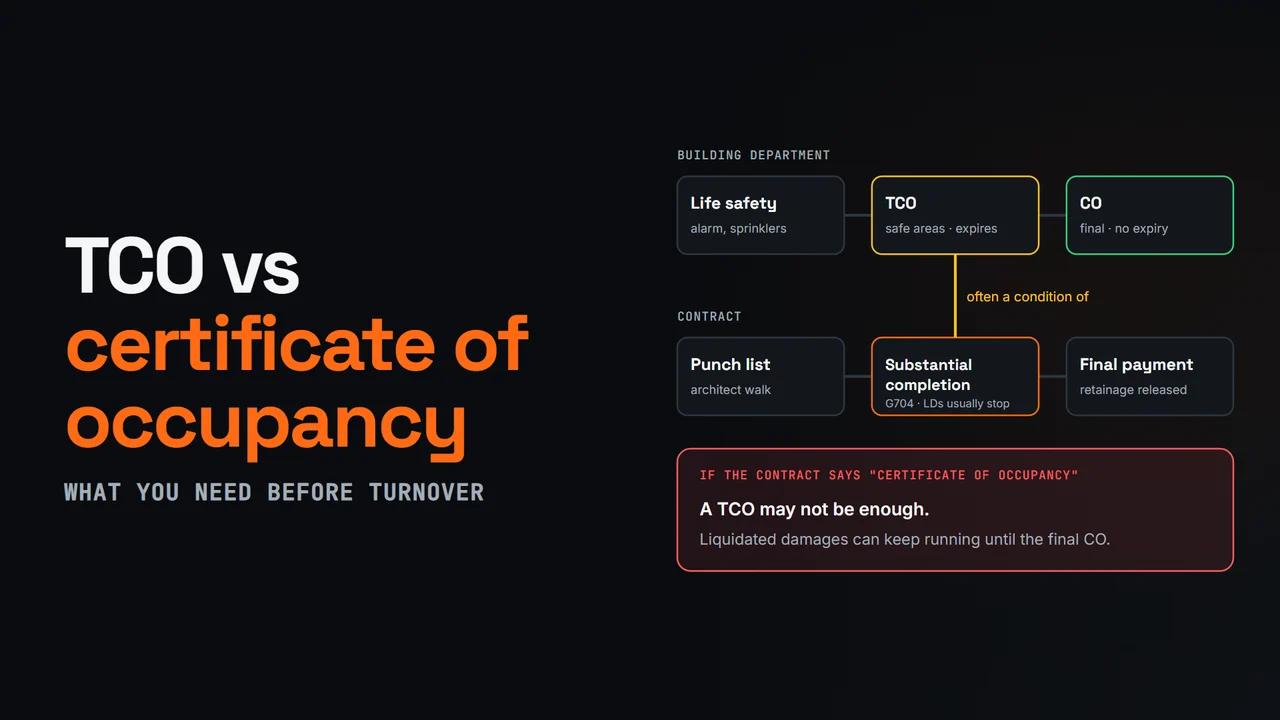
Diagram from this explainer
Chapters
- 0:00 Two approvals, two tracks
- 0:15 The TCO
- 0:38 The certificate of occupancy
- 0:53 The contract track
- 1:16 Before the owner moves in
- 1:34 Tracking both tracks
Video transcript
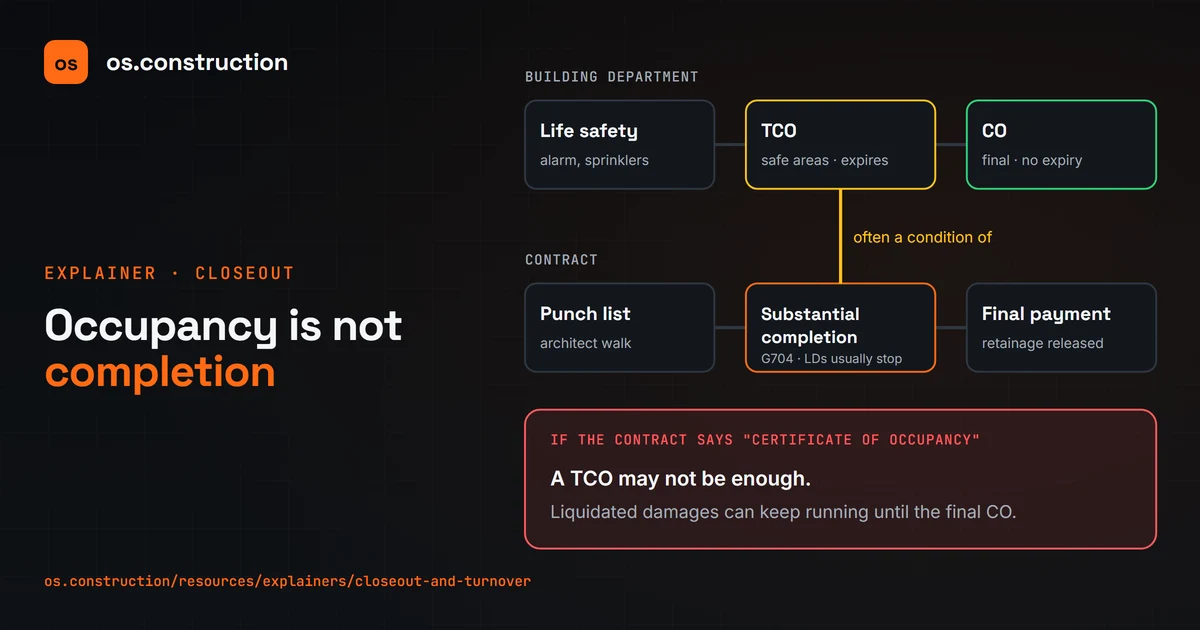
A temporary certificate of occupancy, or TCO, and a certificate of occupancy, or CO, both come from the local building official. Neither one is substantial completion under your contract. Closeout runs on two tracks at once.
A TCO lets the owner occupy all or part of a building before all permitted work is finished, as long as the occupied areas are safe. Under Section 111.3 of the International Building Code, the official sets how long it's valid, so it comes with open items and an expiry date. In New York City, TCOs typically expire ninety days after issuance.
The certificate of occupancy is the final approval. It's issued when all permitted work has passed final inspection, and it doesn't expire while the building's use stays the same. Health, utility and public works sign-offs can still hold it up.
Meanwhile the contract runs its own track: punch list, substantial completion, then final completion and final payment. Many contracts make a TCO or CO a condition of substantial completion. If yours requires a certificate of occupancy, a TCO may not be enough, and liquidated damages can keep running until the final CO.
Before the owner moves in under a TCO, finish life safety in the occupied areas, separate them from active work, put the expiry on the schedule with a renewal date ahead of it, and agree in writing who insures and maintains the space. Rules vary by jurisdiction.
In os.construction, inspections and the punch list track the open items behind a TCO, and the schedule can carry the TCO, its expiry and the final CO as milestones, so you see when an inspection slip reaches substantial completion.
Your next step
See it on one project record.
Create an account and open the sample project to see contracts, costs, changes and billing on the same record.
Try it in the app- Next · Construction concepts explainedCritical path and float in 2 minutesWatch the next explainer
- ExplainerCloseout to occupancy: punch, Cx, as-builts, TCO and COThe full written guide, with worked examples and sources.
- Video libraryMore in Construction concepts explainedEvery video, grouped by topic.