CSI MasterFormat is the Construction Specifications Institute’s standard for organizing construction specifications by type of work. It uses 50 numbered divisions (00 to 49), such as 03 Concrete, 09 Finishes, 23 HVAC and 26 Electrical, each broken into six-digit sections like 08 71 00 Door Hardware. Many contractors also build their cost codes on it.
MasterFormat is published by CSI and CSI Canada. Because architects write project manuals in MasterFormat, it becomes a shared language across the job: the spec section tells you what’s required, the submittal is logged against that section, the subcontract scope references it, and the budget line can carry the same number.
In plain English
MasterFormat is the filing system for a building’s specifications. Every kind of work gets a number, so everyone on the job files it in the same drawer. Illustrative: the fire dampers on a hospital job are specified in section 23 33 00. The damper submittal is logged as 23 33 00, the mechanical subcontract covers “Division 23”, and the estimator’s budget line is 23-3300. When an RFI about those dampers turns into a $12,000 change, all four records point to the same number.
How MasterFormat is organized
The 50 divisions fall into groups and subgroups. Numbers not listed below are reserved for future use.
| Group / subgroup | Divisions |
|---|---|
| Procurement and contracting requirements | 00 Procurement and Contracting Requirements |
| General requirements | 01 General Requirements |
| Facility construction | 02 Existing Conditions · 03 Concrete · 04 Masonry · 05 Metals · 06 Wood, Plastics, and Composites · 07 Thermal and Moisture Protection · 08 Openings · 09 Finishes · 10 Specialties · 11 Equipment · 12 Furnishings · 13 Special Construction · 14 Conveying Equipment |
| Facility services | 21 Fire Suppression · 22 Plumbing · 23 Heating, Ventilating, and Air Conditioning (HVAC) · 25 Integrated Automation · 26 Electrical · 27 Communications · 28 Electronic Safety and Security |
| Site and infrastructure | 31 Earthwork · 32 Exterior Improvements · 33 Utilities · 34 Transportation · 35 Waterway and Marine Construction |
| Process equipment | Divisions 40 to 48, covering process interconnections, material handling, process heating and cooling, gas and liquid handling, pollution control, industry-specific manufacturing equipment, water and wastewater equipment, and electrical power generation |
CSI numbers for MEP work: then and now
The most common lookup is which CSI number covers a trade. Mechanical, electrical and plumbing work changed the most when MasterFormat went from 16 to 50 divisions in 2004.
| Work | Current division | Before 2004 |
|---|---|---|
| Fire suppression (sprinklers, standpipes) | 21 Fire Suppression | 15 Mechanical |
| Plumbing | 22 Plumbing | 15 Mechanical |
| HVAC, ductwork, hydronics | 23 Heating, Ventilating, and Air Conditioning | 15 Mechanical |
| Building automation and controls integration | 25 Integrated Automation | 15 or 16 |
| Electrical power and lighting | 26 Electrical | 16 Electrical |
| Data, voice, AV | 27 Communications | 16 Electrical |
| Fire alarm, access control, security | 28 Electronic Safety and Security | 16 Electrical |
HVAC controls are commonly specified in 23 09 00 Instrumentation and Control for HVAC, which is why controls often appear as a separate line in a mechanical subcontract.
MasterFormat editions
The 50-division structure dates from the 2004 edition. Since then CSI has issued periodic updates, such as the 2014, 2016 and 2018 editions, that add, retitle or renumber sections while keeping the same divisions. Project manuals usually state which edition the specifier used. If your cost codes were built on an older edition, most of the numbers still match; check new or renumbered sections in the divisions you self-perform.
How to read a section number
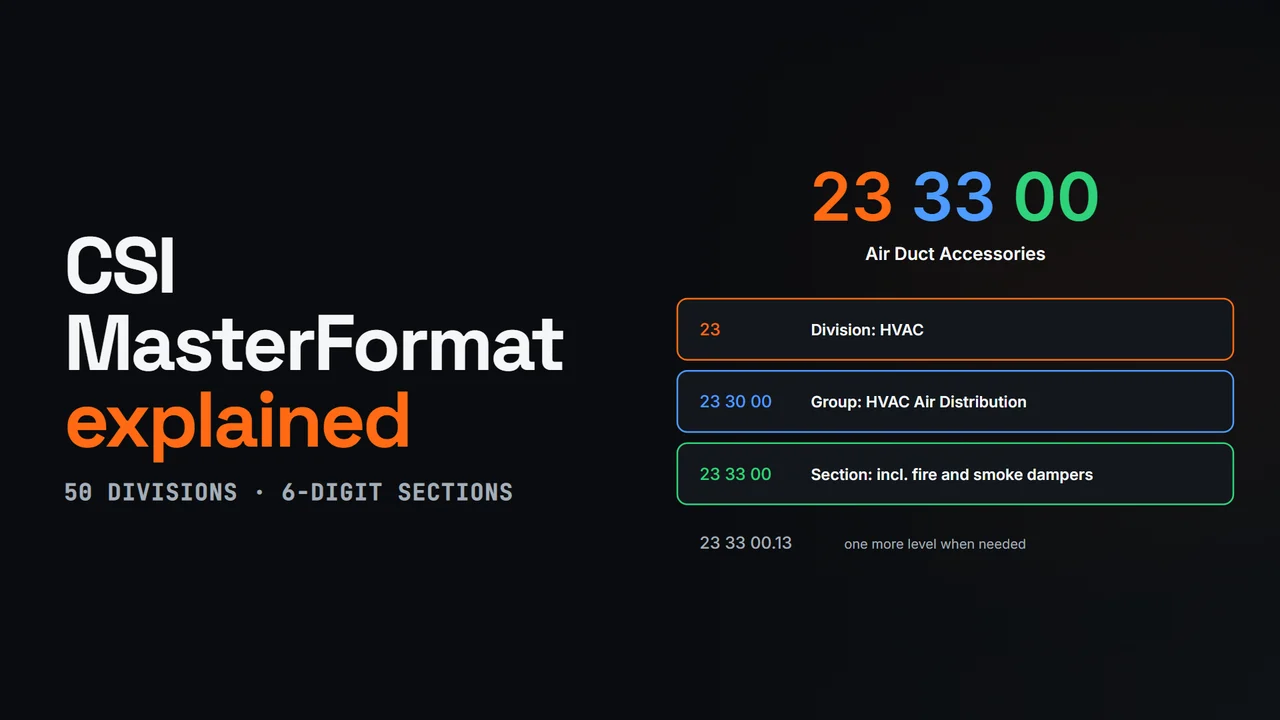
Take 23 33 00 Air Duct Accessories:
- 23 is the division: HVAC.
- 23 30 00 is the level-two grouping: HVAC Air Distribution.
- 23 33 00 is the level-three section: Air Duct Accessories, where fire and smoke dampers are specified.
- A decimal extension such as 23 33 00.13 can add a further level when a specifier needs it.
From spec section to cost code
MasterFormat describes work results, not cost types, so most contractors add a cost type and sometimes a phase:
| Element | Example |
|---|---|
| Spec section | 23 33 00 Air Duct Accessories |
| Contractor cost code | 23-3300 |
| Cost types | Labor · Material · Equipment · Subcontract · Other |
| Budget line | 23-3300 Subcontract |
| Submittal | 23 33 00-003 Fire dampers, product data |
| Subcontract scope | “All work of Division 23 except 23 09 00 Controls” |
Worked example
Illustrative: during construction, an RFI confirms that fire dampers are required at a rated corridor wall. The dampers are specified in 23 33 00. The damper submittal, the change order lines and the budget update can all be tagged 23 33 00 (or the contractor’s matching cost code), so anyone tracing the issue lands on the same section. If the mechanical subcontract excluded controls (23 09 00) and an electrical sub is wiring the damper actuators (26 05 00 Common Work Results for Electrical), the same numbering makes the split visible in buyout and on the schedule of values.
MasterFormat vs UniFormat
MasterFormat organizes by work result (concrete, openings, HVAC), which suits specifications, procurement and subcontracts. UniFormat, also published by CSI, organizes by building element (substructure, shell, interiors, services), which suits early conceptual estimates before specs exist. Some estimators start in UniFormat and map to MasterFormat as design develops.
Why it matters
Aligning to MasterFormat means a spec section, a submittal, a subcontract and a budget line can all point to the same thing. That shortens the path from a field question to a priced change, makes takeoffs and bids comparable across jobs, and gives historical cost data a stable structure for the next estimate.
Common mistakes
- Using the old 16-division format (replaced in 2004) on new jobs, which scatters MEP work in ways that no longer match the specs.
- Treating MasterFormat as a cost code list as-is. It describes work results, not cost types; you still need labor, material and subcontract splits.
- Creating a cost code for every spec section, which makes job cost reports too granular to manage.
- Renumbering cost codes job by job, which breaks historical comparisons.
- Ignoring Division 01, where closeout, testing and temporary facility requirements live.
How os.construction handles it
Cost codes are set up per project in the Admin tool, and many contractors base theirs on CSI MasterFormat divisions, then add their own detail. The Budget groups lines by division, the root of each cost code, and each line is a cost code plus a cost type: Labor, Equipment, Materials, Subcontracts or Other. The submittal log shows each submittal’s spec section, and submittals can be generated from spec sections in the Specifications tool. See Cost codes and budgets, Budget and Submittals.
Watch the explainer · 3:06
CSI MasterFormat explained: divisions to cost codes
- 0:00A shared numbering system
- 0:24From 16 divisions to 50
- 0:47How the divisions are grouped
- 1:10Reading a section number
- 1:34One number, many records
- 1:54From spec section to cost code
- 2:17MasterFormat versus UniFormat
- 2:36Mistakes to avoid
Read the transcript
CSI MasterFormat is the standard numbering system for organizing construction specifications by type of work. It's published by the Construction Specifications Institute and CSI Canada. Concrete lives in Division zero three, finishes in zero nine, electrical in twenty-six. Because architects write specs this way, it becomes a shared language for the whole job.
Since the two thousand four edition, MasterFormat has fifty division numbers, zero zero through forty-nine. Before that, there were just sixteen divisions, with mechanical work in Division fifteen and electrical in sixteen. The expansion gave fire suppression, plumbing, HVAC, electrical and communications their own divisions, and several numbers are reserved for future use.
The divisions fall into groups. Division zero zero covers procurement and contracting, and Division zero one holds general requirements, like closeout and testing. Facility construction runs from zero two to fourteen, facility services from twenty-one to twenty-eight, site and infrastructure from thirty-one to thirty-five, and process equipment from forty to forty-eight.
Section numbers are three pairs of digits. Take twenty-three, thirty-three, zero zero: Air Duct Accessories. Twenty-three is the division, HVAC. Twenty-three, thirty, zero zero is the broader group, HVAC Air Distribution. The last pair narrows it to the section where fire and smoke dampers are specified, and a decimal extension can add one more level.
That one number can tie the job together. The spec section says what's required. The damper submittal is logged against it. The mechanical subcontract scope references it. And the budget line can carry the matching cost code, so anyone tracing a fire damper question lands on the same section.
Many contractors base cost codes on MasterFormat, but it describes work results, not cost types. So most add a cost type: labor, material, equipment, subcontract or other. In this illustrative setup, section twenty-three, thirty-three, zero zero becomes cost code twenty-three thirty-three hundred, with a subcontract line in the budget.
MasterFormat isn't CSI's only standard. UniFormat organizes by building element, like substructure, shell, interiors and services, which suits early estimates before specs exist. Some estimators start in UniFormat and map to MasterFormat as the design develops.
Watch for three common mistakes: using the old sixteen-division format, creating a cost code for every spec section, and renumbering codes job by job, which breaks historical comparisons. In os.construction, project cost codes can follow MasterFormat, the budget groups lines by division with a cost type on each, and the submittal log shows each submittal's spec section.
Video page with chaptersMore in Construction concepts explained
FAQ
What is CSI MasterFormat?
MasterFormat is the standard published by the Construction Specifications Institute (CSI) and CSI Canada for organizing construction specifications and related information. It groups work into numbered divisions, such as 03 Concrete, 09 Finishes and 26 Electrical, and breaks each division into numbered sections. Architects use it to write specifications, and contractors often use it for estimates and cost codes.
How many divisions are in MasterFormat?
The current structure has 50 division numbers, 00 through 49. Not all are used: several numbers are reserved for future expansion. The divisions are grouped into procurement and contracting requirements (00) and a specifications group covering general requirements, facility construction, facility services, site and infrastructure, and process equipment.
What is the difference between the 16-division and 50-division MasterFormat?
Before the 2004 edition, MasterFormat had 16 divisions, with mechanical and electrical work in Divisions 15 and 16. The 2004 edition expanded it to 50 divisions, giving building systems such as fire suppression, plumbing, HVAC, electrical and communications their own divisions and adding site, infrastructure and process equipment divisions.
How do you read a MasterFormat section number?
Section numbers are three pairs of digits. The first pair is the division, the second is the broad level-two grouping and the third narrows it further. In 08 71 00 Door Hardware, 08 is Openings and 08 70 00 is Hardware. Some sections add a decimal extension, such as 08 71 00.13, for more detail.
Should cost codes follow CSI MasterFormat?
Many contractors base cost codes on MasterFormat because specifications, submittals and subcontract scopes already use it, so a single number can tie them together. You usually still need cost types such as labor, material, equipment and subcontract, and some groupings, like general conditions, that suit job cost tracking better than spec writing.
What is the CSI division for mechanical work?
In the current 50-division MasterFormat, what used to be Division 15 Mechanical is split across Division 21 Fire Suppression, Division 22 Plumbing and Division 23 Heating, Ventilating, and Air Conditioning (HVAC), with building automation in Division 25. Electrical moved from the old Division 16 to Division 26, with communications in 27 and electronic safety and security in 28.