CSI MasterFormat explained: divisions to cost codes
How MasterFormat's 50 divisions are grouped, how to read a section number like 23 33 00, and how one number ties specs, submittals and cost codes together.
Diagrams from this explainer
Chapters
- 0:00 A shared numbering system
- 0:24 From 16 divisions to 50
- 0:47 How the divisions are grouped
- 1:10 Reading a section number
- 1:34 One number, many records
- 1:54 From spec section to cost code
- 2:17 MasterFormat versus UniFormat
- 2:36 Mistakes to avoid
Video transcript
CSI MasterFormat is the standard numbering system for organizing construction specifications by type of work. It's published by the Construction Specifications Institute and CSI Canada. Concrete lives in Division zero three, finishes in zero nine, electrical in twenty-six. Because architects write specs this way, it becomes a shared language for the whole job.
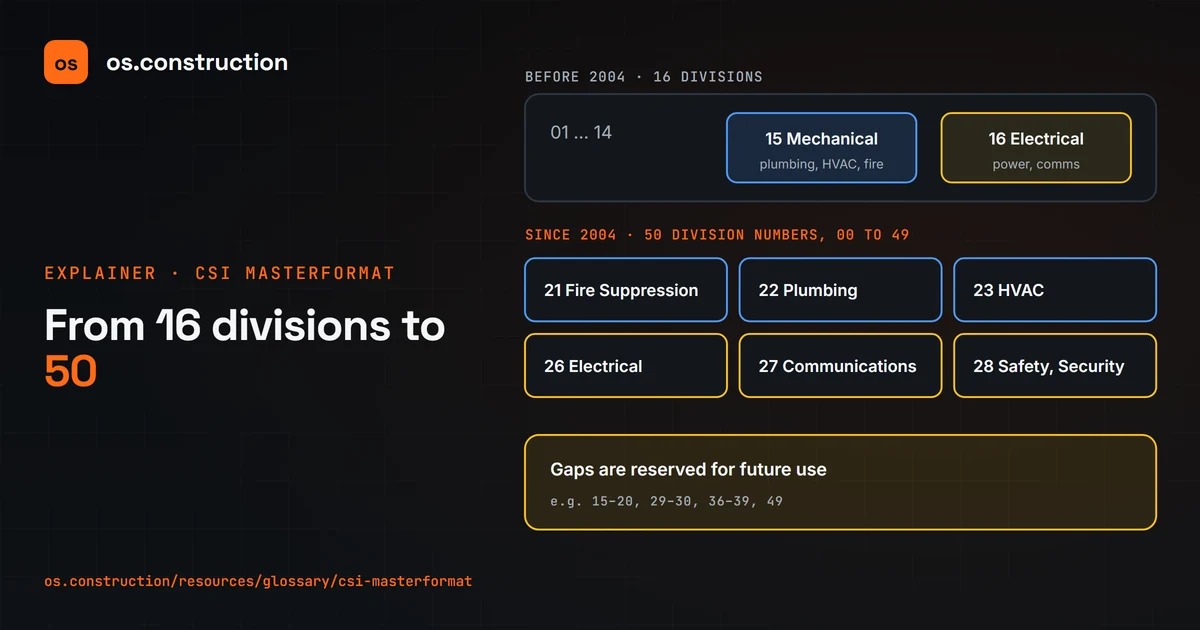
Since the two thousand four edition, MasterFormat has fifty division numbers, zero zero through forty-nine. Before that, there were just sixteen divisions, with mechanical work in Division fifteen and electrical in sixteen. The expansion gave fire suppression, plumbing, HVAC, electrical and communications their own divisions, and several numbers are reserved for future use.
The divisions fall into groups. Division zero zero covers procurement and contracting, and Division zero one holds general requirements, like closeout and testing. Facility construction runs from zero two to fourteen, facility services from twenty-one to twenty-eight, site and infrastructure from thirty-one to thirty-five, and process equipment from forty to forty-eight.
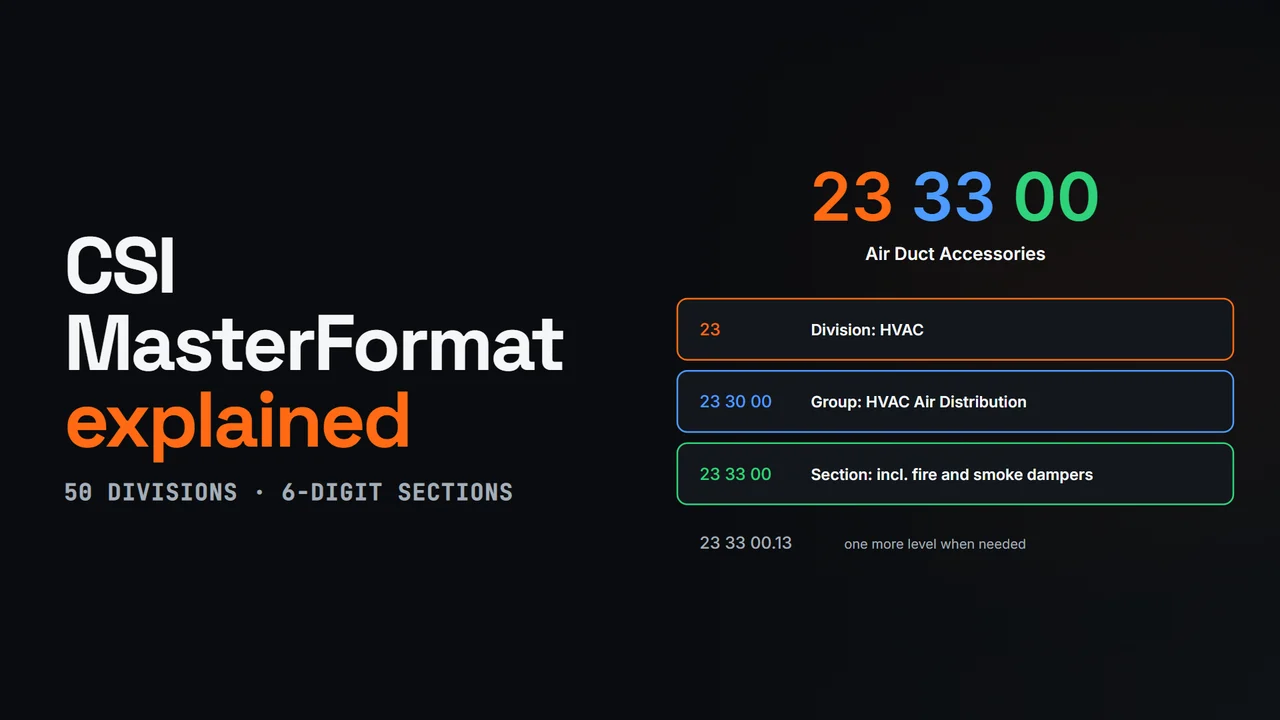
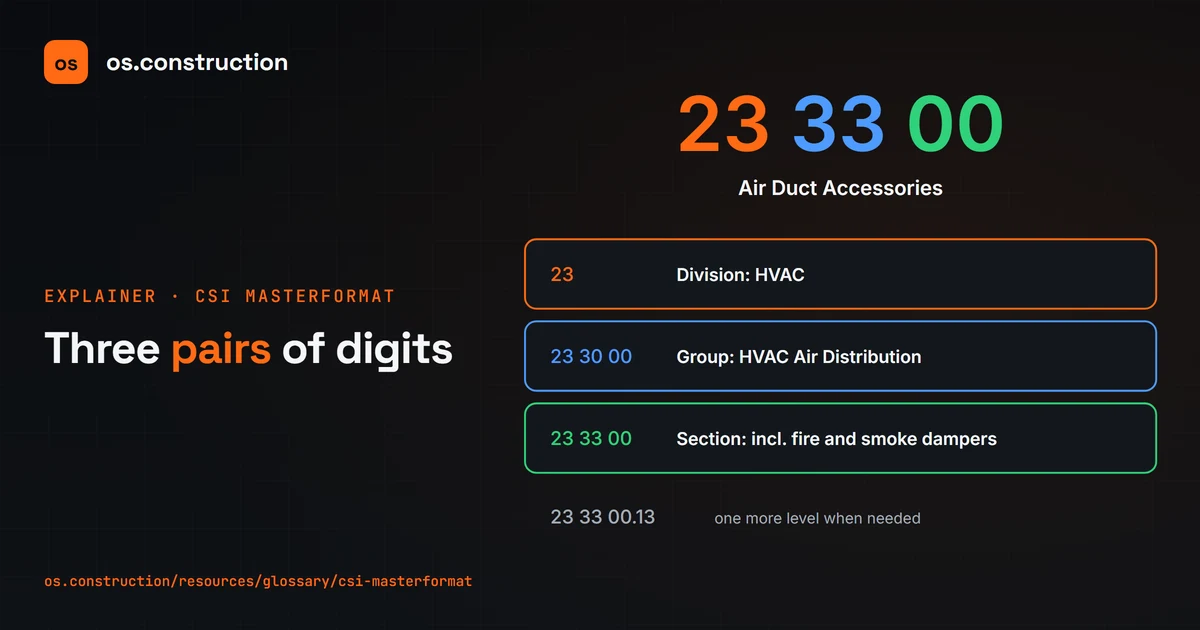
Section numbers are three pairs of digits. Take twenty-three, thirty-three, zero zero: Air Duct Accessories. Twenty-three is the division, HVAC. Twenty-three, thirty, zero zero is the broader group, HVAC Air Distribution. The last pair narrows it to the section where fire and smoke dampers are specified, and a decimal extension can add one more level.
That one number can tie the job together. The spec section says what's required. The damper submittal is logged against it. The mechanical subcontract scope references it. And the budget line can carry the matching cost code, so anyone tracing a fire damper question lands on the same section.
Many contractors base cost codes on MasterFormat, but it describes work results, not cost types. So most add a cost type: labor, material, equipment, subcontract or other. In this illustrative setup, section twenty-three, thirty-three, zero zero becomes cost code twenty-three thirty-three hundred, with a subcontract line in the budget.
MasterFormat isn't CSI's only standard. UniFormat organizes by building element, like substructure, shell, interiors and services, which suits early estimates before specs exist. Some estimators start in UniFormat and map to MasterFormat as the design develops.
Watch for three common mistakes: using the old sixteen-division format, creating a cost code for every spec section, and renumbering codes job by job, which breaks historical comparisons. In os.construction, project cost codes can follow MasterFormat, the budget groups lines by division with a cost type on each, and the submittal log shows each submittal's spec section.
Your next step
See it on one project record.
Create an account and open the sample project to see contracts, costs, changes and billing on the same record.
Try it in the app