SPI(t) measures schedule performance in units of time. It comes from the Earned Schedule method:
- ES (earned schedule) is the point in the baseline at which the work performed to date was planned to be done.
- AT (actual time) is the time elapsed from the baseline start to the data date.
- SPI(t) = ES ÷ AT, and SV(t) = ES − AT.
An SPI(t) of 0.93 means the job has earned about 93 days of baseline progress for every 100 days elapsed.
Why it matters
The classic earned value SPI (EV ÷ PV) is measured in dollars and drifts back to 1.00 as a project finishes, even a late one, because all the planned value is eventually earned. SPI(t) is measured in time, so it stays informative to the end. It also supports a simple forecast: IEAC(t) = planned duration ÷ SPI(t), the duration the job will take if current performance continues.
Worked example
Illustrative: the baseline planned duration (PD) is 283 working days. At the data date, 175 working days have elapsed (AT), and the work complete matches the baseline at day 162.5 (ES). SPI(t) = 162.5 ÷ 175 ≈ 0.93. SV(t) = −12.5 working days. IEAC(t) = 283 ÷ 0.93 ≈ 304.8 working days, about 22 working days late.
Common mistakes
- Treating a duration-weighted SPI(t) as cost-weighted earned value.
- Forecasting from SPI(t) without checking whether the critical work is the work that’s behind.
- Measuring against a baseline that has been rebaselined without saying so.
How os.construction handles it
Schedule analysis measures Earned Schedule for a saved version against a baseline or earlier saved version. It shows ES, AT, SPI(t), SV(t), percent complete and IEAC(t), all in working days, with the method’s limits stated.
Watch the explainer · 2:02
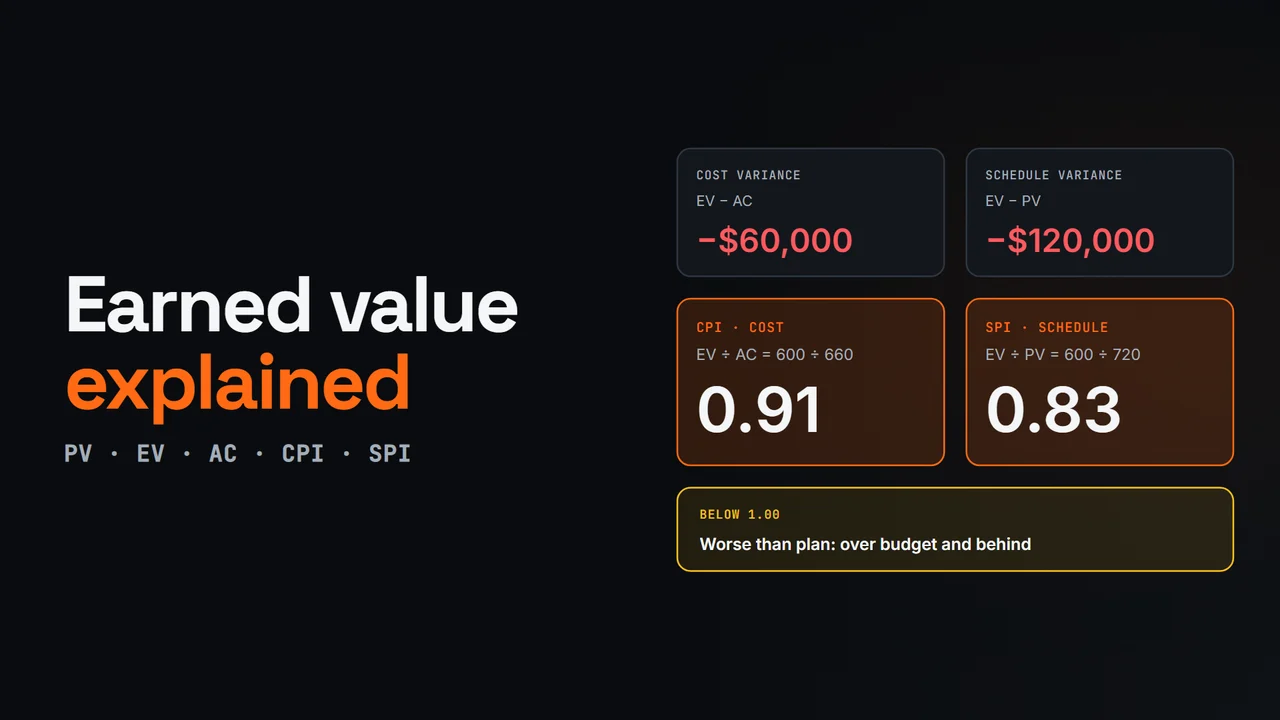
Earned value explained: PV, EV, AC, CPI and SPI
- 0:00Three numbers, one status date
- 0:20Planned value
- 0:38Earned value and actual cost
- 0:57Variances, CPI and SPI
- 1:20Forecast the finish
- 1:39Earned value in os.construction
Read the transcript
Earned value compares three numbers at the same status date: what you planned to do, what you actually did, and what it cost. Spending against the budget alone can't tell you whether a job is under budget or just behind. Earned value can, because it measures progress in budget dollars.
Start with the budget at completion. Take an illustrative control account with a budget of one point two million dollars, spread over a ten month baseline schedule. Planned value is the budget for the work scheduled by each date. At the end of month six, planned value is seven hundred twenty thousand dollars.
Earned value is the budget for the work actually done. The team has completed half the scope, so earned value is fifty percent of one point two million: six hundred thousand dollars. Actual cost is what that work really cost, from job cost with accruals: six hundred sixty thousand dollars.
Now read the gaps. Cost variance is earned value minus actual cost: minus sixty thousand, so the work cost more than its budget. Schedule variance is earned value minus planned value: minus one hundred twenty thousand. As ratios, CPI is zero point nine one and SPI is zero point eight three. Below one is worse than plan.
If cost efficiency stays where it is, the estimate at completion is the budget divided by CPI: one point three two million dollars, one hundred twenty thousand over budget. One caution: SPI is a ratio of money, not time. It drifts back to one as the job finishes, so don't read it as a finish date.
In os.construction Scheduling, the Planner shows earned value for each activity against the project baseline, with variances, CPI, SPI and the estimate at completion. Storing period performance keeps each period's figures as a permanent record.
Video page with chaptersMore in Construction concepts explained