Earned value explained: PV, EV, AC, CPI and SPI
Planned value, earned value and actual cost on one illustrative control account, read as variances, CPI and SPI, and turned into an estimate at completion.
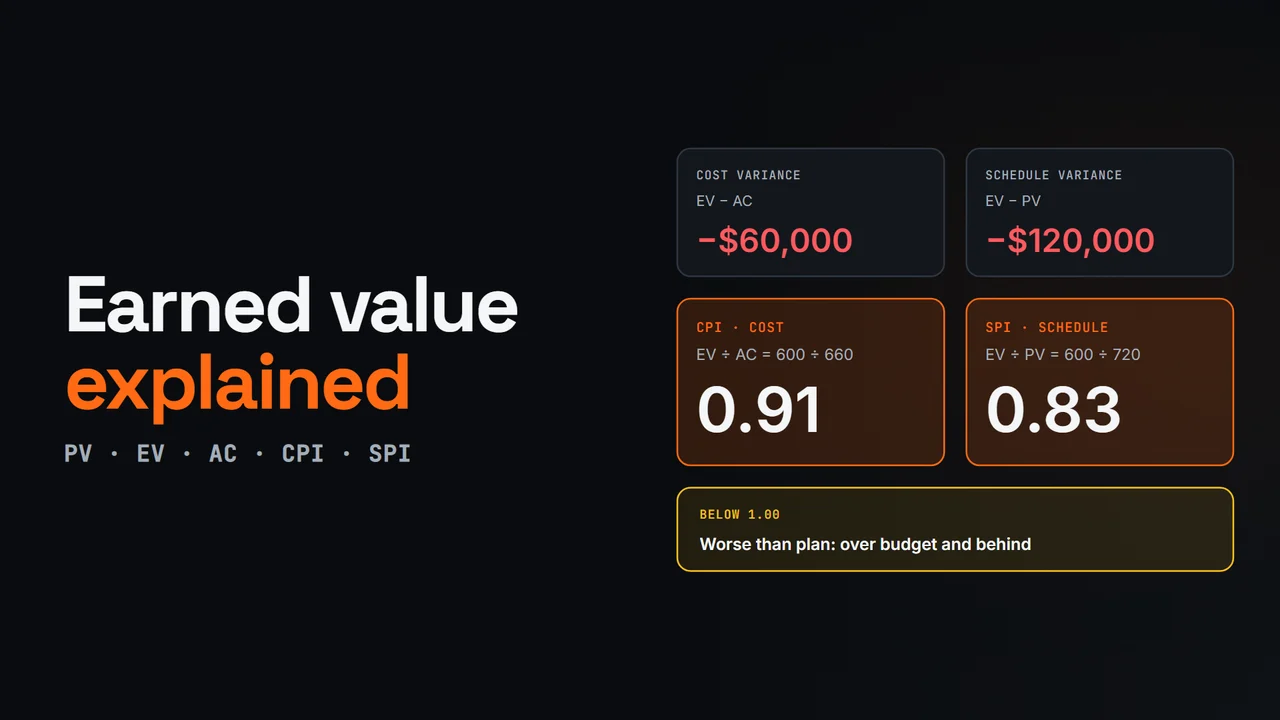
Diagram from this explainer
Chapters
- 0:00 Three numbers, one status date
- 0:20 Planned value
- 0:38 Earned value and actual cost
- 0:57 Variances, CPI and SPI
- 1:20 Forecast the finish
- 1:39 Earned value in os.construction
Video transcript
Earned value compares three numbers at the same status date: what you planned to do, what you actually did, and what it cost. Spending against the budget alone can't tell you whether a job is under budget or just behind. Earned value can, because it measures progress in budget dollars.
Start with the budget at completion. Take an illustrative control account with a budget of one point two million dollars, spread over a ten month baseline schedule. Planned value is the budget for the work scheduled by each date. At the end of month six, planned value is seven hundred twenty thousand dollars.
Earned value is the budget for the work actually done. The team has completed half the scope, so earned value is fifty percent of one point two million: six hundred thousand dollars. Actual cost is what that work really cost, from job cost with accruals: six hundred sixty thousand dollars.
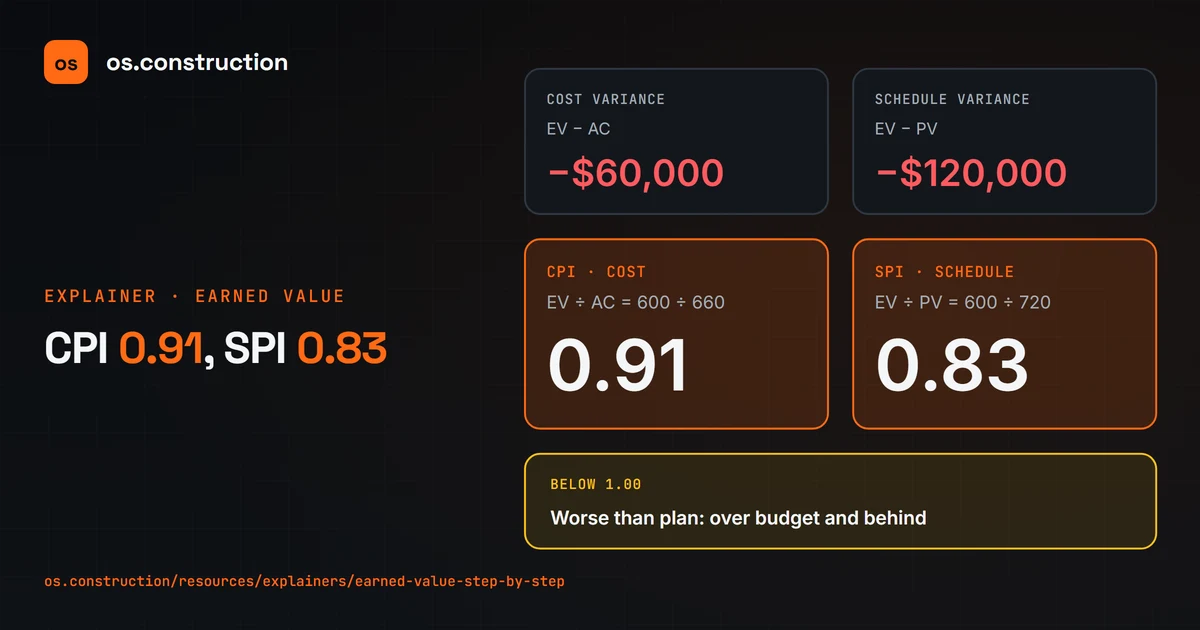
Now read the gaps. Cost variance is earned value minus actual cost: minus sixty thousand, so the work cost more than its budget. Schedule variance is earned value minus planned value: minus one hundred twenty thousand. As ratios, CPI is zero point nine one and SPI is zero point eight three. Below one is worse than plan.
If cost efficiency stays where it is, the estimate at completion is the budget divided by CPI: one point three two million dollars, one hundred twenty thousand over budget. One caution: SPI is a ratio of money, not time. It drifts back to one as the job finishes, so don't read it as a finish date.
In os.construction Scheduling, the Planner shows earned value for each activity against the project baseline, with variances, CPI, SPI and the estimate at completion. Storing period performance keeps each period's figures as a permanent record.
Your next step
See it on one project record.
Create an account and open the sample project to see contracts, costs, changes and billing on the same record.
Try it in the app