From the field to the invoice: daily log → T&M → priced change
Extra work happens at 4 p.m. and gets argued about at month-end. This video follows one owner-directed blockout move through the daily log, a $1,525 T&M ticket, sign-off and review, and the change event and PCO that price it.
The full walkthrough
Watch the walkthrough · 7:32
From the field to the invoice: daily log to priced change
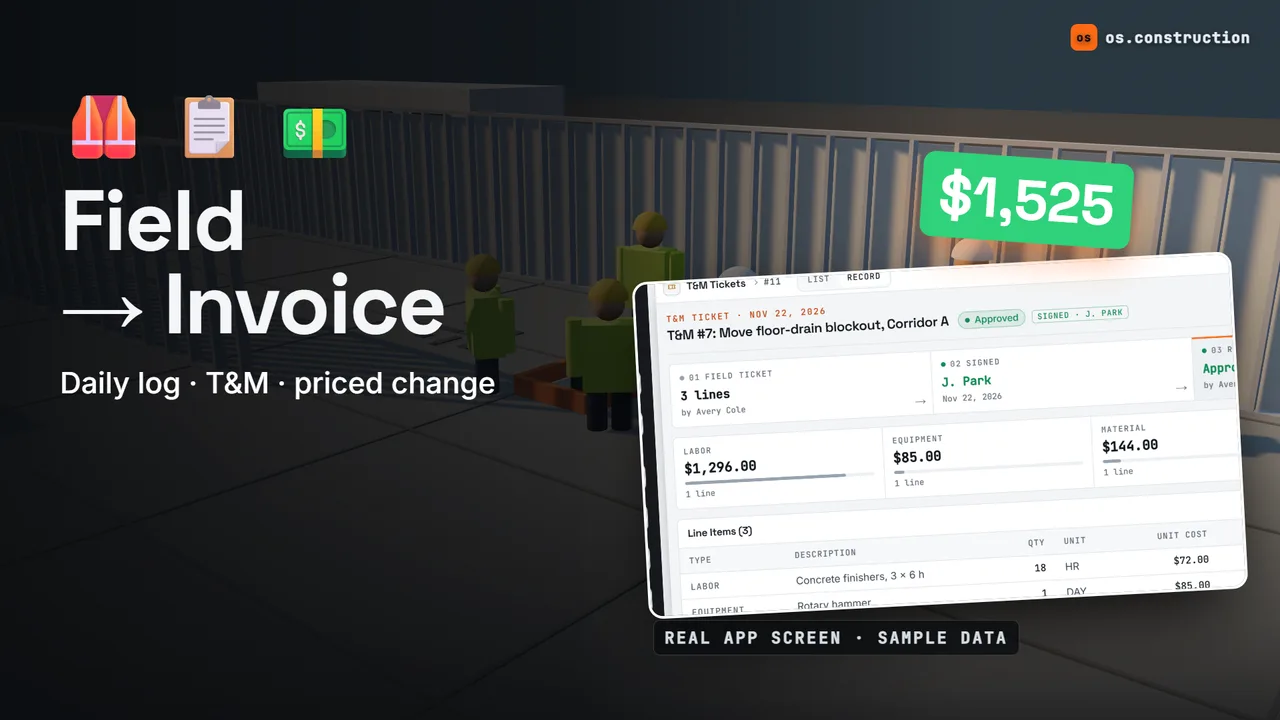 Loads from YouTube when played
- 0:00The 4 p.m. problem
- 0:26Three records, one chain
- 1:07Why the same day matters
- 1:40Step 1: the daily log
- 2:55Step 2: the T&M ticket
- 3:49Step 3: sign-off and review
- 4:18Step 4: carry it to a change event
- 5:24Five mistakes that cost money
- 6:37Month-end: the PM's check
- 6:54Recap checklist
Read the transcript
It's 4 p.m. Your crew just spent the afternoon on work that isn't in the contract. By tomorrow, that work is either a priced change, or a memory nobody agrees on.
In this walkthrough, we follow one piece of extra work from the field to the invoice in os.construction: the daily log, the T&M ticket, the sign-off, and the change event that gets it priced. Real app screens, sample data.
Three records carry the story. The daily log says what happened on site that day: who was there, for how many hours, and what equipment ran. The T&M ticket says what was extra, line by line, at what cost, and who signed for it. And the change event is where that cost gets priced and sent toward a change order.
Here's the honest part. In os.construction, a T&M ticket does not create a change event by itself. You carry it across: you create the change event, and attach the approved ticket as backup. From the change event on, the links are stored, all the way to a change order.
Why do it the same day? Because extra work gets harder to prove every day it isn't written down. A week later, was it four hours or six? Who directed it? The person who saw it may be on another job.
Picture a superintendent at 4 p.m. This is an illustrative example. The owner's rep asked for a floor-drain blockout in Corridor A to be moved. Three concrete finishers spent six hours on it. Before the crew leaves, she logs the day and writes the ticket, while everyone still agrees on the numbers.
Step one: the daily log. Open Daily Log from the project's tools, and pick the work date. It's one page per day, and the cards at the top total the workers, man-hours and entries.
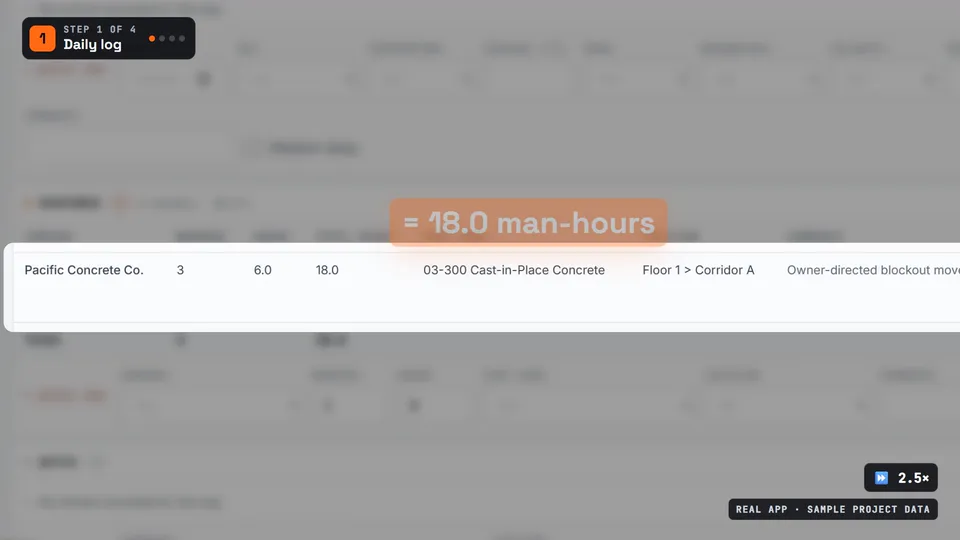
In Manpower, add the crew: the company, three workers, six hours each, the cast-in-place concrete cost code, and the location, Corridor A. Add a short comment that points to the T&M ticket.
In Equipment, log what ran: a rotary hammer, six hours operating, with the same cost code and location.
Then a note with the time, the place and what you saw. At 3:40, the owner's rep directed the move, and it's not on the current drawings. That's an observation, not a price.
Back at the top, the day now shows three workers and 18 man-hours. Remember that number.
When the day's entries are in, check the acknowledgement and click Complete Day. A completed day shows who completed it and when, and its entries can't be changed until someone reopens it. Export PDF gives you the day's report to keep with the backup.
Step two: the T&M ticket. In T&M Tickets, under Financials, click Create. A title and a work date are required. Use the same date as the daily log, and say in the description who directed the work and why it's extra.
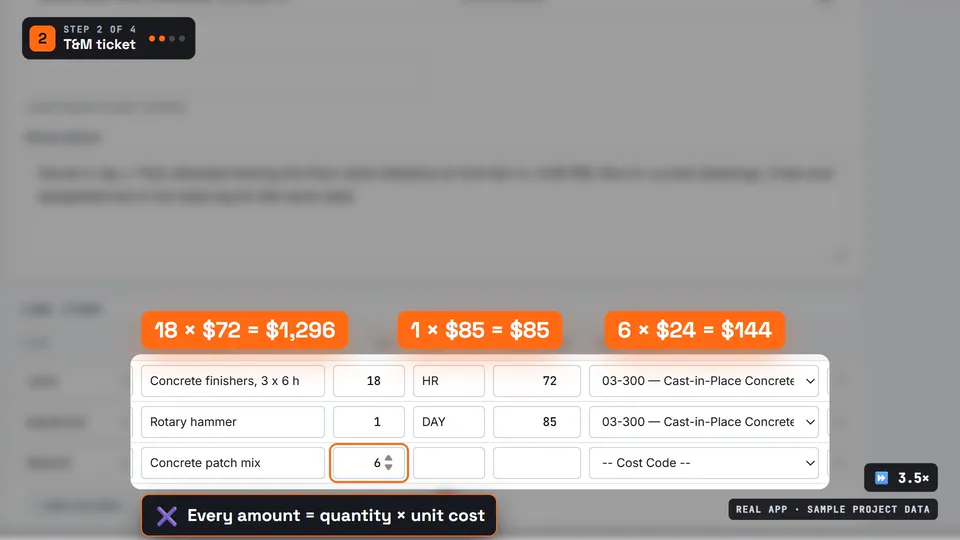
Now the lines. Labor: concrete finishers, eighteen hours at seventy-two dollars an hour. Equipment: the rotary hammer, one day at eighty-five dollars. Material: six bags of patch mix at twenty-four dollars each. Every line gets a cost code, and every amount is quantity times unit cost.
Create it, and the ticket starts as a Draft. The total is one thousand, five hundred twenty-five dollars: the sum of the lines. Notice what isn't here: markup. The ticket records cost. Markup belongs on the priced change.
Step three: sign-off. Type the field signer's name in Signed By, and submit. It's a typed name, not a drawn signature, and the stage strip now shows the ticket as signed.
An admin reviews it. Check the lines against the daily log for the same day: 18 hours on the ticket, 18 man-hours in the log. Then approve. A rejected ticket can be fixed and submitted again.
Step four is the one the app leaves to you. Open Change Events and click Create. Give it a clear title, set the scope to Out of Scope, and the type to Owner Change.
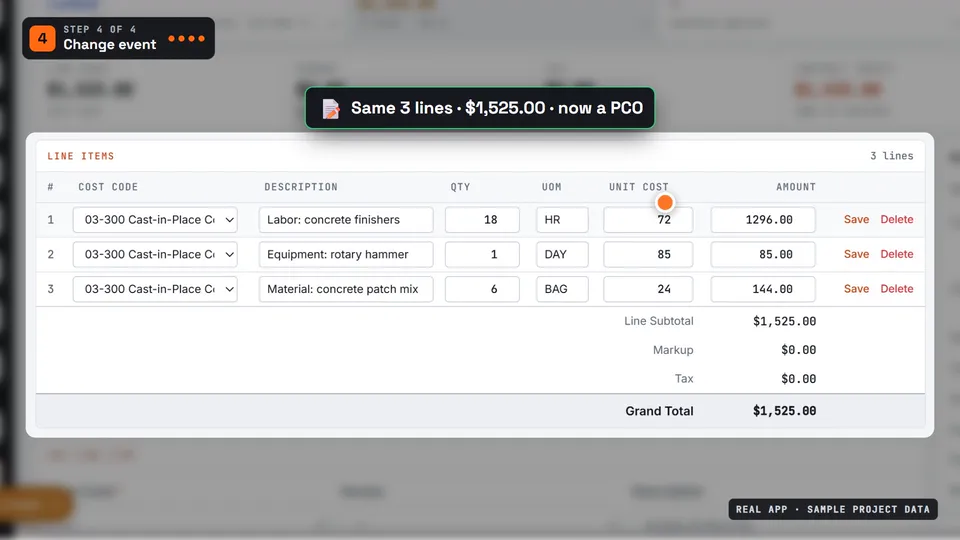
Add the lines on the same cost code as the ticket, with the same quantities and unit costs, so anyone can trace each dollar back to the field.
After you create it, add the approved ticket under Attachments: a name, and a link to the ticket. Now the backup travels with the change.
Then click Create PCO from Change Event. The lines copy onto a potential change order, and that's where pricing with markup, approval and the change order happen. Another walkthrough in this series follows it from there to the pay app.
A few honest limits, so nothing surprises you. A ticket has no PDF export today, attachments are links rather than uploaded files, and the sign-off is a typed name. The ticket's link to the change event is the one you add.
Now, five mistakes that cost money.
One: writing tickets at the end of the week. Every ticket needs a work date, and a phone browser is enough to write one. Write it the same day.
Two: a ticket that just says, extra work, six hours. Without a type, a quantity, a unit cost and a cost code on each line, the reviewer has nothing to check.
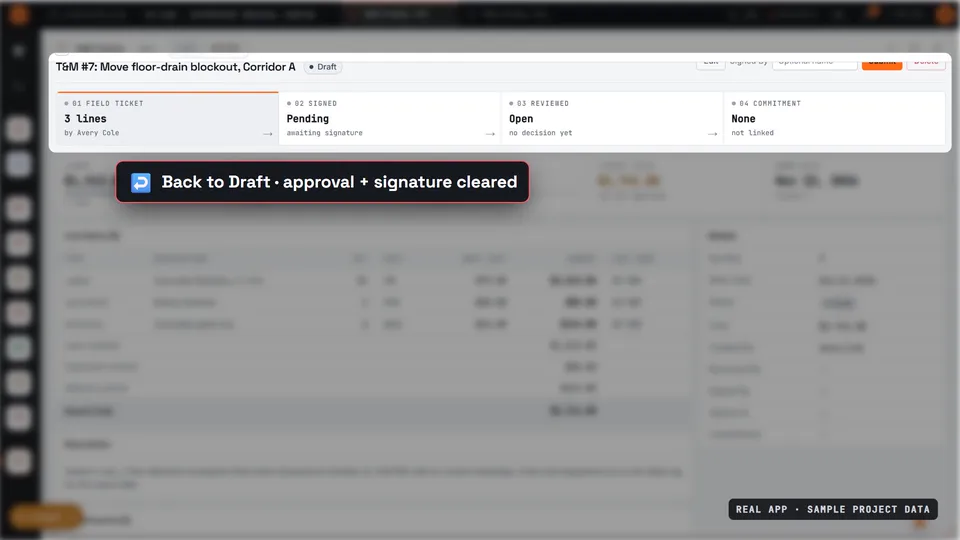
Three: changing an approved ticket. Watch what happens. Edit the labor hours from 18 to 21, and save. The ticket goes straight back to Draft, and the approval and signature are cleared. That's deliberate: an approved ticket always matches the lines that were approved. Title and description edits don't reset it.
Four: hiding markup in the unit costs. The ticket stops matching the field rates, and the cost can get marked up again when the change is priced. Keep the ticket at cost.
Five: a ticket that disagrees with the daily log. If the ticket says 21 hours and the log says 18, somebody has to explain the gap before anyone pays. Fix the record that's wrong, then submit it again.
One more illustrative example: a project manager at month-end. She filters T&M Tickets to Approved, then checks Change Events for each one. An approved ticket with no change event is cost that nobody has priced yet. That's the list to clear before billing.
Quick recap. Log the crew, the equipment and an observation the same day. Write the ticket with that work date, typed lines and cost codes, at cost. Submit it with the signer's name, and review it against the log. Then create the change event, attach the ticket, and create the PCO.
The free printable T&M ticket checklist is linked in the description, with the step-by-step guide at os dot construction. Try it on the sample project in a free trial workspace.
Four steps, one manual link
The daily log and the ticket are separate records that should agree. Between the approved ticket and the change event there is no stored link: that's the step you carry by hand. From the change event on, the links are stored.
- 01 Daily logManpower: Pacific Concrete Co., 3 workers × 6 h, 03-300, Corridor A. Equipment: rotary hammer, 6 h. A note with the time and who directed the work.18.0 man-hours
- 02 T&M ticketSame work date. Labor, equipment and material lines, each quantity × unit cost with a cost code. Starts as Draft.$1,525.00 at cost
- 03 Sign-off & reviewSubmit with the signer’s typed name, then an admin reviews it against the log and approves.Signed · Approved
- 04 Change event → PCOYou create the change event (no automatic link), copy the lines, attach the ticket, then Create PCO from Change Event.Same 3 lines on the PCO✋ Manual step
The ticket, line by line
| Type | Description | Qty | Unit | Unit cost | Amount |
|---|---|---|---|---|---|
| Labor | Concrete finishers, 3 × 6 h | 18 | HR | $72.00 | $1,296.00 |
| Equipment | Rotary hammer | 1 | DAY | $85.00 | $85.00 |
| Material | Concrete patch mix | 6 | BAG | $24.00 | $144.00 |
| Ticket total (cost, no markup) | $1,525.00 | ||||
The labor line matches the daily log: 3 finishers × 6 hours = 18 hours on the ticket and 18.0 man-hours logged for the same date. Every line carries cost code 03-300, so the change event and PCO use the same code.
Five ways extra work goes unpaid
- ❌ Writing tickets at the end of the week✅ Work Date is required on every ticket and a phone browser is enough. Write it the same day.
- ❌ “Extra work, 6 hours” as one lump✅ Type, quantity, unit cost and cost code on every line, so the reviewer can check it.
- ❌ Quietly changing an approved ticket✅ Changing line items sends it back to Draft and clears the approval and signature. Title or description edits don’t.
- ❌ Hiding markup in the unit costs✅ Keep the ticket at cost. Markup goes on the priced change, or it can be applied twice.
- ❌ A ticket that disagrees with the daily log✅ 21 hours on the ticket and 18 in the log needs an explanation before anyone pays. Fix the wrong record, then submit again.
Before the ticket leaves the field, and before billing
- Same day: crew, equipment and an observation in the daily log
- Ticket: same work date, typed lines and cost codes, at cost
- Submit with the signer’s name; review it against the log
- Create the change event, attach the ticket, create the PCO
- Month-end: every approved ticket has a change event
Keep exploring
Related across os.construction
- GlossaryTime and Materials Ticket (T&M Ticket)A daily field record of labor hours, materials and equipment used on extra work, signed by the other party as backup for payment.
- GlossaryDaily LogThe superintendent's dated record of each day on site: weather, manpower, work performed, deliveries, inspections, visitors, delays and issues.
- ExplainerT&M tickets: from the field to a priced changeWrite a T&M ticket in os.construction, get it signed and approved, then carry it by hand into a change event, a priced PCO and a change order.
- Free toolChange order markup calculatorPrice a change order with labor burden, overhead and profit markups.
- DocsT&M tickets: record extra work in the fieldRecord time-and-material work the day it happens. Labor, equipment and material lines with cost codes, a field sign-off name, and review to Approved.
- PlatformRole guide: SuperintendentA superintendent’s week in os.construction.
Sample project included
Try this workflow on the sample project
Every trial workspace includes a sample project with sample data, so you can follow these steps in the app before touching a live job.
Want this on live job data?
Daily log, T&M tickets, change events and PCOs are live in os.construction. A T&M ticket doesn't link to a change event automatically; you create the change event and attach the ticket.
14-day free trial. Pricing for paid plans isn't set yet. Talk to us. Already have an account? Sign in →
App figures are sample data from the Riverside Medical Center sample project, recorded in a local instance. The 3D scenes, the two vignettes and the 15% markup rate are illustrative, not measured results. Your contract decides how T&M work is priced and billed.