What is a schedule of values?
How an SOV splits the contract sum into billable lines, who prepares it, how each pay app bills against it, and why front-loading gets pushback.
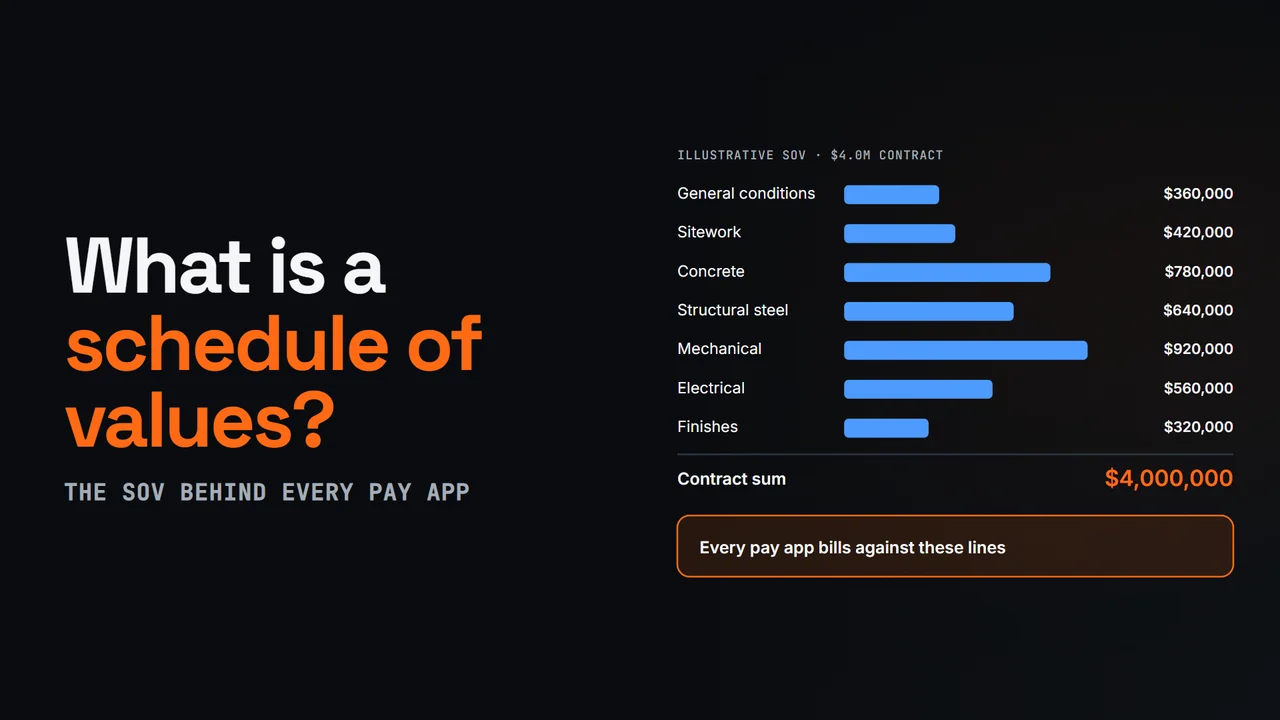
Diagram from this explainer
Chapters
- 0:00 The contract sum, line by line
- 0:18 Who prepares it
- 0:39 Billing against the lines
- 0:57 Change orders get their own lines
- 1:17 Front-loading
- 1:39 The SOV in os.construction
Video transcript
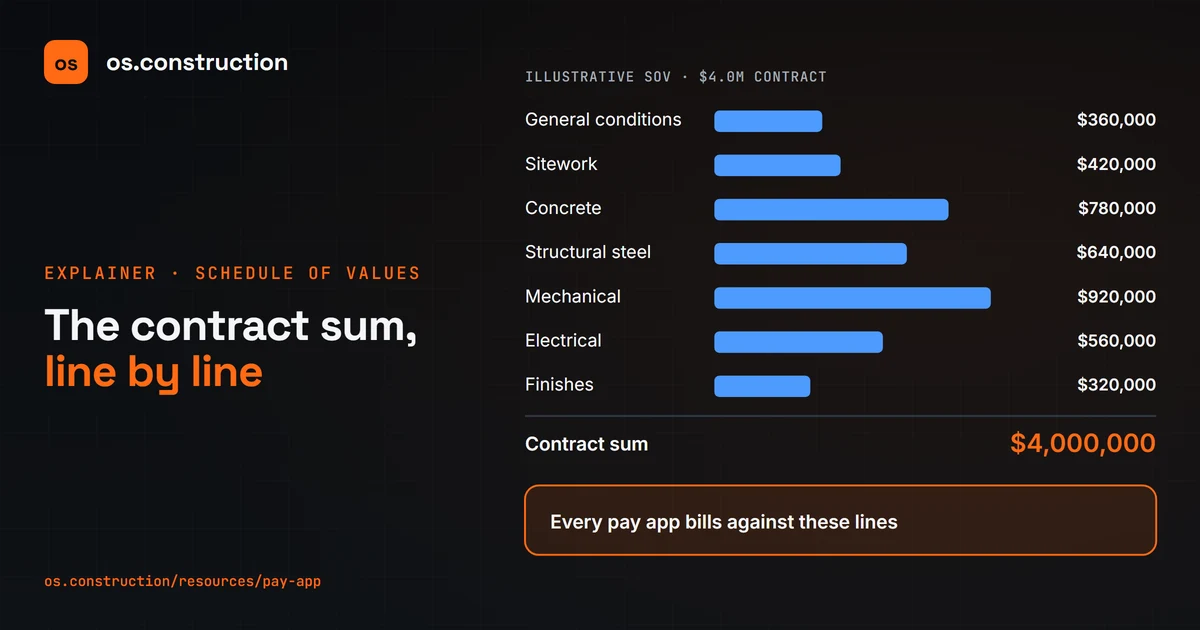
A schedule of values, or SOV, breaks the contract sum into line items, such as general conditions, sitework, concrete, steel, mechanical and electrical, each with a dollar value. The lines add up to the contract sum, and every pay app bills against them.
The contractor prepares it. Under AIA A201, section nine point two, on stipulated sum and GMP contracts, the contractor submits it before the first application for payment. The architect reviews the values and can ask for backup. Once it's accepted, it's the basis for reviewing every pay app.
Each month, the continuation sheet reports every line: work from previous applications, work this period, materials stored, total to date, percent complete, balance to finish and retainage. The summary page rolls those columns up into the current payment due.
Approved change orders change the contract sum, so each one is added, usually as its own line. On the sample Riverside job, change order fourteen, eighty-six thousand four hundred dollars for fire dampers, becomes its own line, and the SOV now totals forty-nine point three million. Pending changes stay off the bill.
Front-loading means putting more value on early lines, like mobilization or general conditions, than the work is worth, so more is billed early. It helps the contractor's cash flow, but leaves the owner paying ahead of the work, which is why architects look for it. A good SOV has lines you can measure progress on, each tied to cost codes.
In os.construction, prime contracts, subcontracts and purchase orders each hold a schedule of values. Payment applications fill the continuation sheet from the contract's SOV, add executed change orders and carry the previous column forward, so nobody retypes the SOV each month.
Your next step
See it on one project record.
Create an account and open the sample project to see contracts, costs, changes and billing on the same record.
Try it in the app