Earned revenue explained: accrual, cost-to-cost, WIP
Earned vs billed vs collected, accrual vs cash, a month-end accrual, cost-to-cost under ASC 606, one illustrative job and why earned revenue moves.
Diagrams from this explainer
Chapters
- 0:00 Earned, billed, collected
- 0:16 Accrual versus cash
- 0:41 A month-end accrual
- 1:06 Revenue over time under ASC 606
- 1:28 One illustrative job
- 1:52 This month's revenue versus billings
- 2:15 Why earned revenue moves
- 2:42 Earned revenue in os.construction
Video transcript
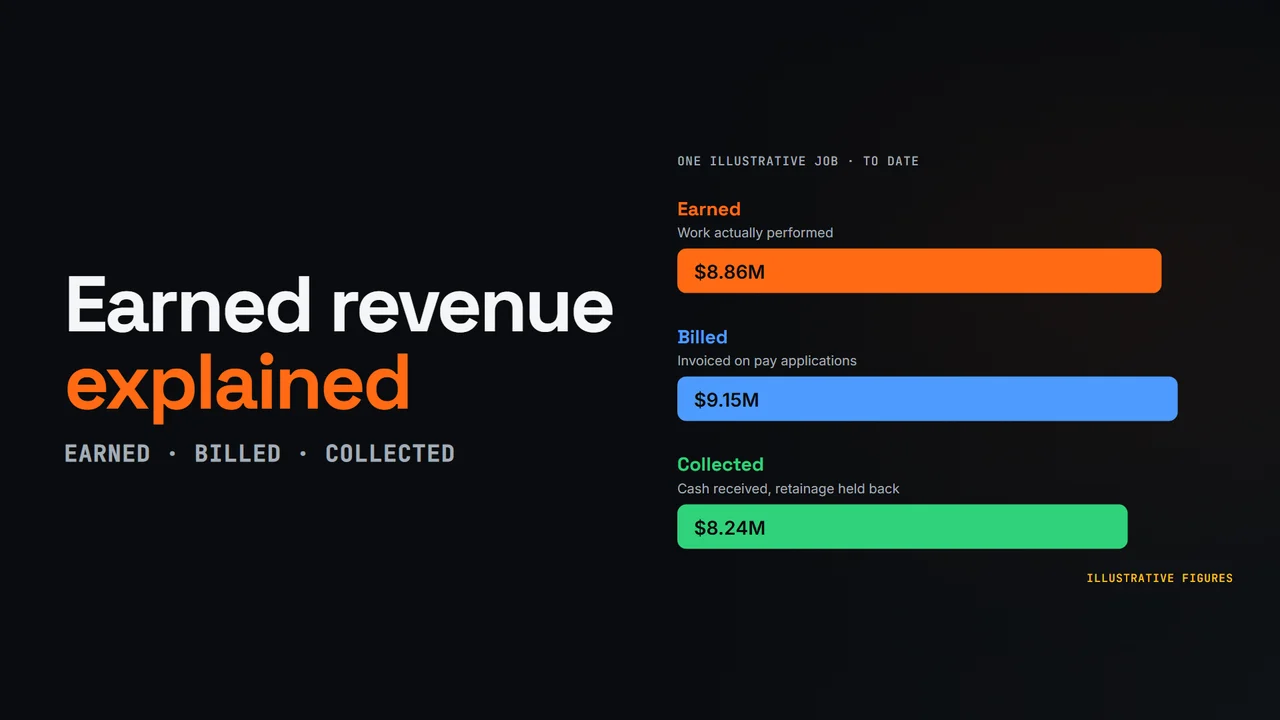
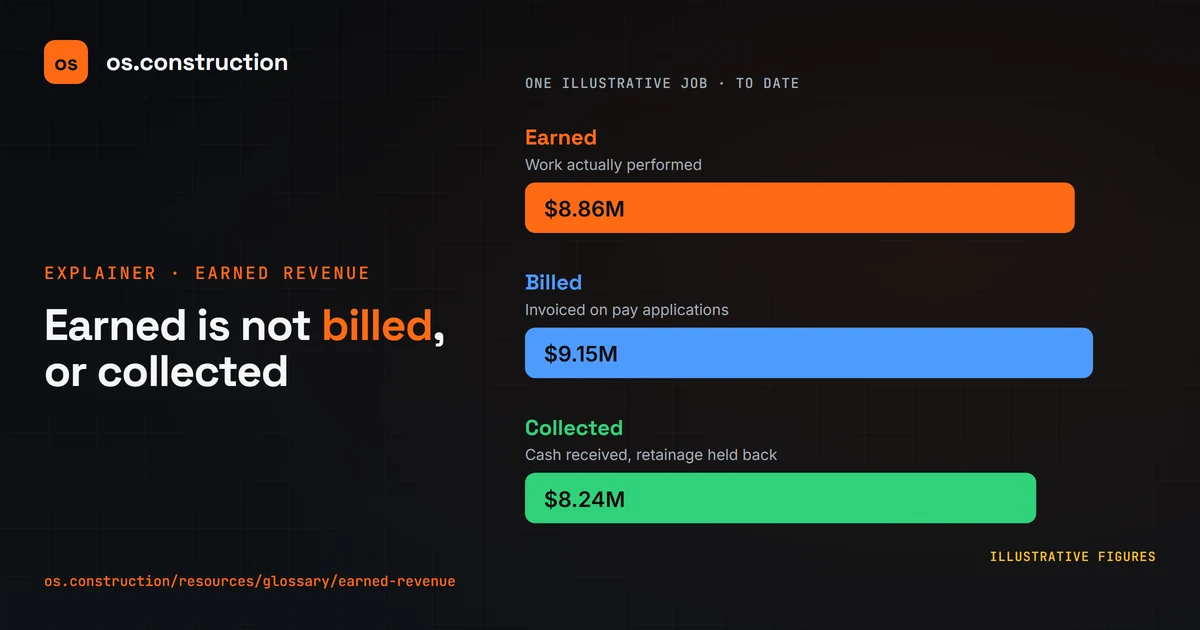
Earned revenue is the part of a contract a contractor has actually earned by doing the work. It is not what you have billed, and it is not what you have collected. Those are three different numbers, and in construction they almost never match in any given month.
Start with the basis. Cash accounting records revenue when the money arrives and costs when you pay them. Accrual accounting records them when they are earned or incurred. So if a drywall sub finishes work in September but invoices in October, that's a September cost on the accrual basis. Sureties and lenders usually ask contractors for accrual-basis, GAAP financial statements.
Here's how that looks at month-end. On September thirtieth, accrue one hundred eighty thousand dollars of sub work in place: debit job cost, credit accrued liabilities. On October first, the entry reverses. When the real pay app arrives on October eighth, it posts through payables. September carries the cost once, and October nets to zero.
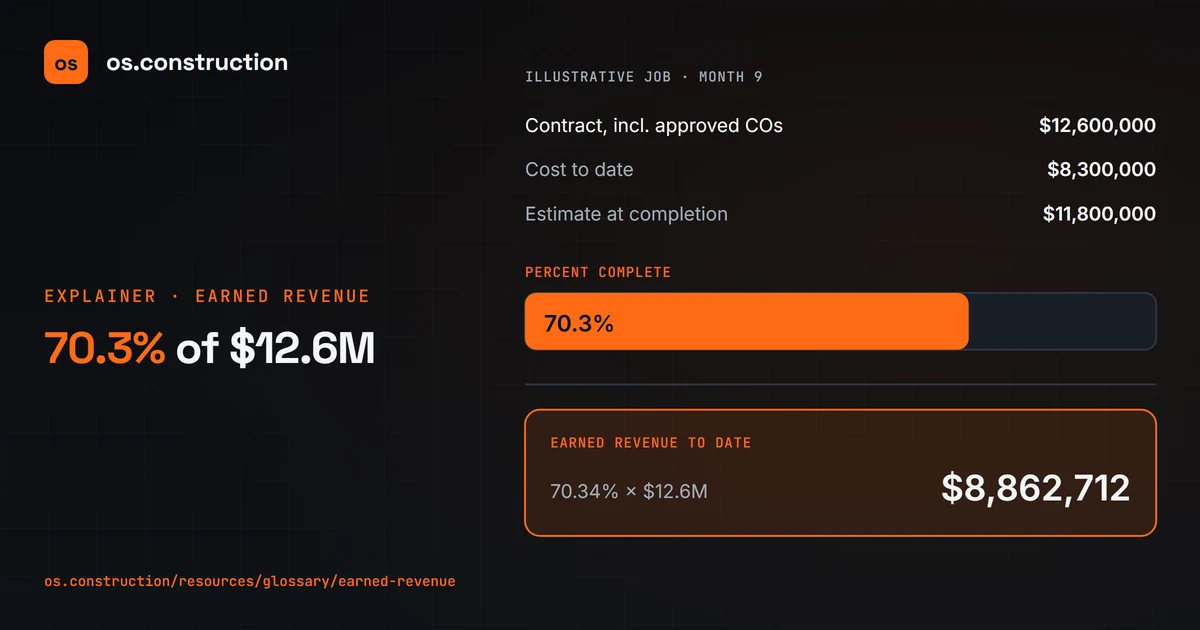
For revenue, most construction contracts are recognized over time under ASC 606, because the owner controls the work as it goes in. That means you need a measure of progress. The most common one is cost-to-cost: percent complete equals cost to date divided by the estimate at completion, which is the total cost you now expect for the job.
Here's an illustrative job at month nine. The contract, with approved change orders, is twelve point six million dollars. Cost to date is eight point three million, and the estimate at completion is eleven point eight million. That's seventy point three percent complete. And seventy point three percent of twelve point six million is about eight point eight six million of earned revenue to date.
Revenue for month nine is earned to date minus earned through month eight, seven point six nine million, so about one point one eight million. Meanwhile, the job has billed nine point one five million. Billings ahead of earned revenue is over billing, a liability of about two hundred eighty-seven thousand. Earned ahead of billings would be under billing, an asset.
Earned revenue is cumulative, so every change gets caught up in the current month. Raise the estimate at completion, and percent complete drops on the same cost, which can make a month's revenue small, or even negative. Unapproved change orders generally stay out of contract value until they meet the accounting criteria. And wasted materials, or materials not yet installed, shouldn't inflate progress.
In os.construction Accounting, the WIP app computes earned revenue from executed contracts and approved change orders, posted job cost and the approved forecast. You review exceptions, then post a snapshot. This is general information, not accounting or tax advice.
Your next step
See it on one project record.
Create an account and open the sample project to see contracts, costs, changes and billing on the same record.
Try it in the app