Stop payment notices explained (California)
How a stop payment notice freezes project funds, how it differs from a lien or bond claim, bonded vs unbonded, deadlines, and an illustrative draw.
Diagrams from this explainer
Chapters
- 0:00 Freezing the money, not the property
- 0:24 Lien vs bond claim vs stop notice
- 0:48 Who can serve one
- 1:11 Bonded vs unbonded
- 1:36 Public works
- 1:57 Deadlines to enforce
- 2:15 One illustrative draw
- 2:44 Stop-pays in os.construction
Video transcript
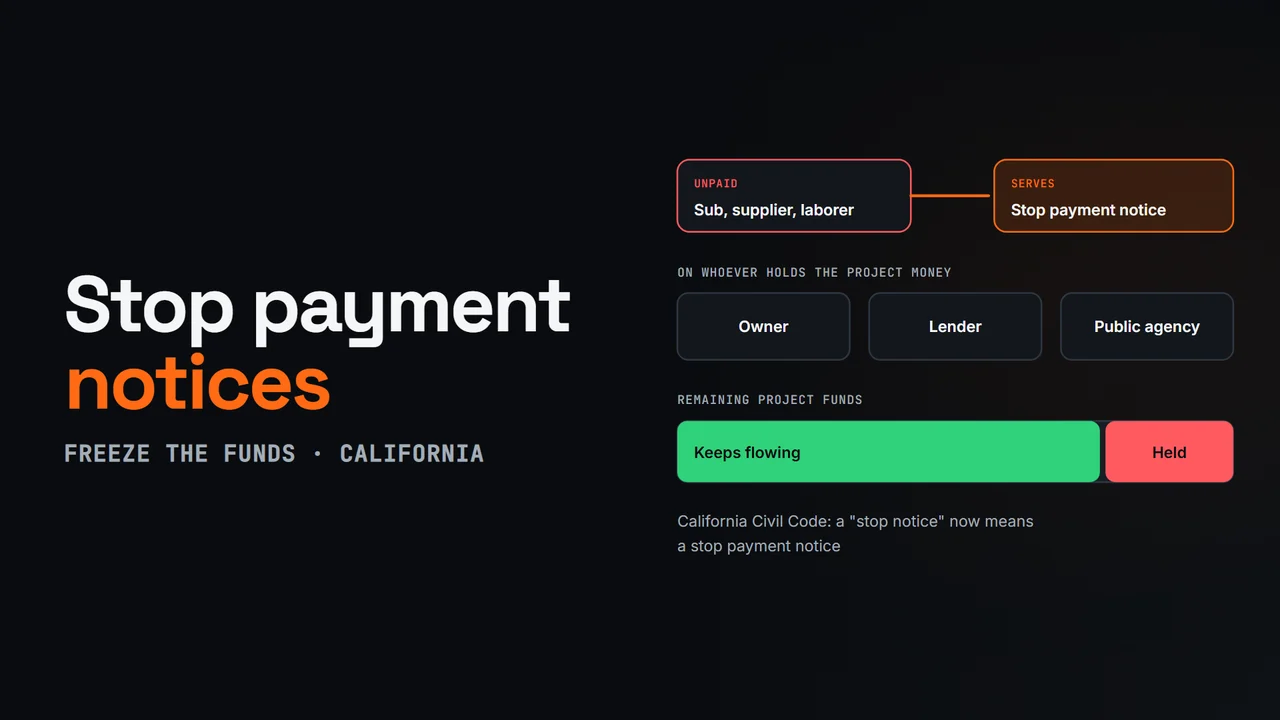
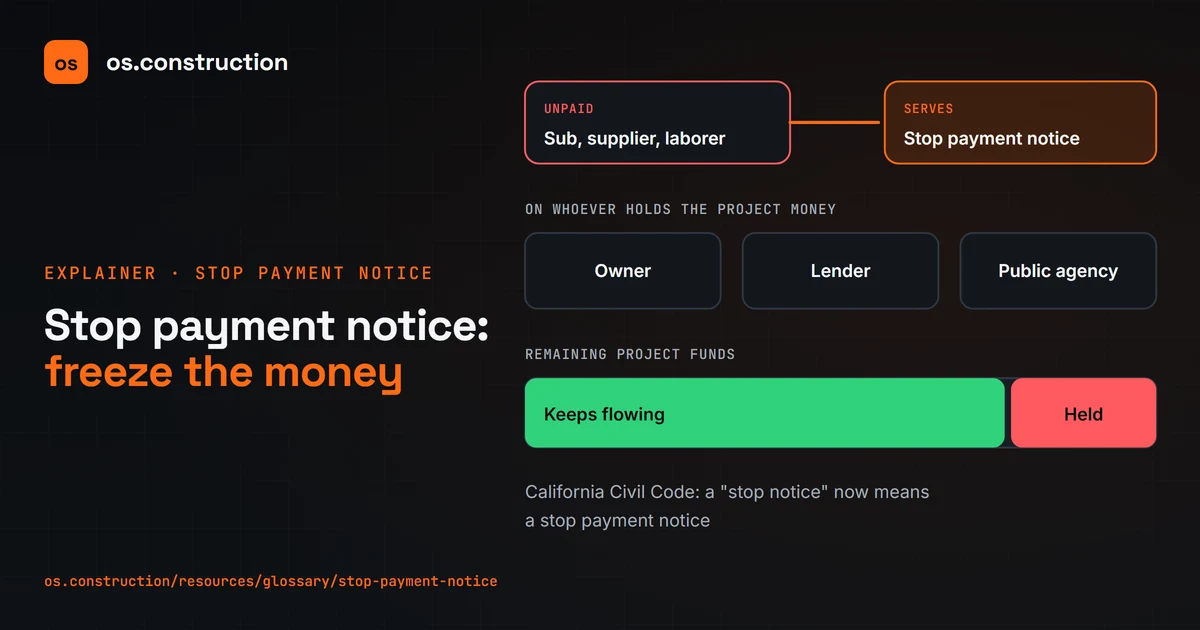
A stop payment notice is a claim an unpaid subcontractor, supplier or laborer serves on whoever still holds the project money: the owner, the construction lender or, on public work, the public agency. It requires them to hold back enough of the remaining funds to cover the claim. In California's Civil Code, the older term stop notice now means a stop payment notice.
A mechanics lien is recorded against the property itself. A payment bond claim goes after the surety's bond. A stop payment notice targets the undisbursed construction funds. On private work, a claimant may use all three. On public work, where liens on public property generally aren't allowed, the stop payment notice and the payment bond claim are the main remedies.
In California, these notices come from the lower tiers: subs, suppliers and laborers. The prime contractor can't give one on public work, or to a private owner. Most claimants must first have given a preliminary notice, often called the twenty-day notice, though laborers don't need one. The notice is signed and verified, and claims only work provided to date.
On private jobs with a construction loan, the bond matters. A bonded stop payment notice comes with the claimant's own bond for one hundred twenty-five percent of the claim, and the lender generally must withhold. With an unbonded notice, the lender may choose not to. A private owner who gets a notice generally must withhold too, unless it has recorded a payment bond.
On California public works, the notice goes to the public entity, which must withhold enough from the prime contractor to pay the claim, plus its reasonable litigation costs. The notice must be given within thirty days after a notice of completion, acceptance or cessation is recorded, or ninety days after completion or cessation if none is recorded.
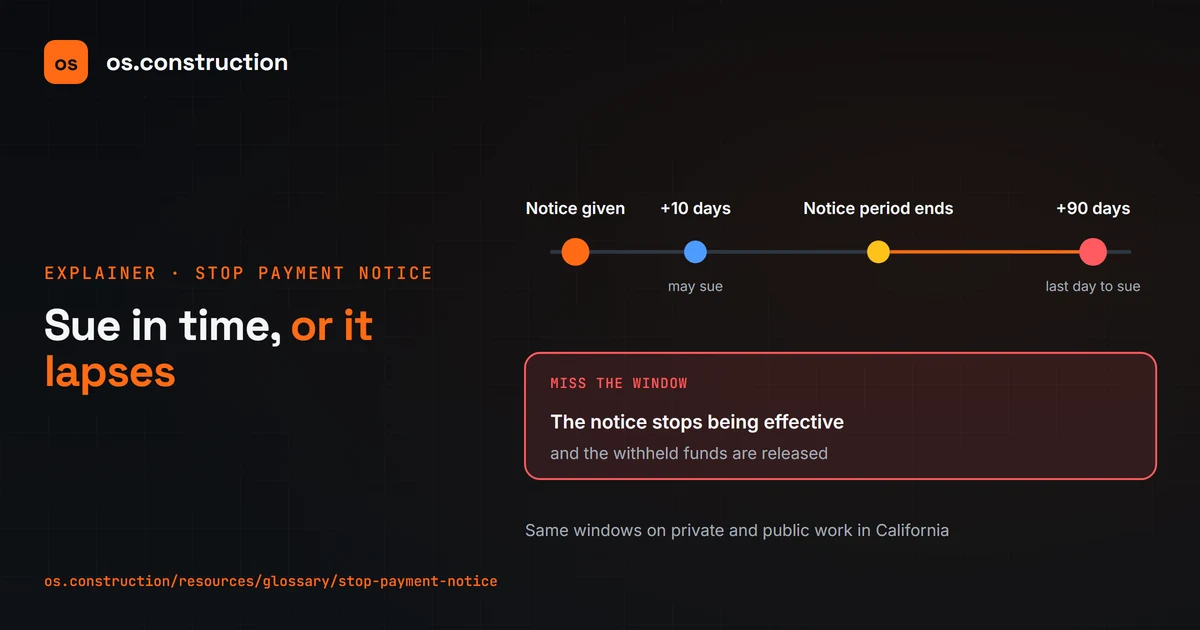
The claimant can't just sit on it. It may sue to enforce the claim any time after ten days from giving the notice, and must sue within ninety days after the period for giving notices expires. Miss that window, and the notice stops being effective, and the withheld funds must be released.
Here's an illustrative draw. A drywall supplier is owed sixty-two thousand dollars and serves a bonded notice on the lender. The GC's next draw is one point four five million, so the lender funds one point three eight eight million, holding back sixty-two thousand. To free it, the GC can pay the claim and get a written release, or dispute it and post a release bond at one hundred twenty-five percent: seventy-seven thousand five hundred dollars.
In os.construction Accounting, a stop-pay on file for a vendor puts a compliance hold on its bills, so they can't be paid until the hold is resolved. os.construction doesn't file statutory notices for you. This is general information, not legal advice, and the rules differ by state and between public and private work.
Your next step
See it on one project record.
Create an account and open the sample project to see contracts, costs, changes and billing on the same record.
Try it in the app