Joint checks explained: one check, two payees
How a joint check pays a sub and its supplier together, what the joint check agreement covers, one illustrative payment and the waivers to collect.
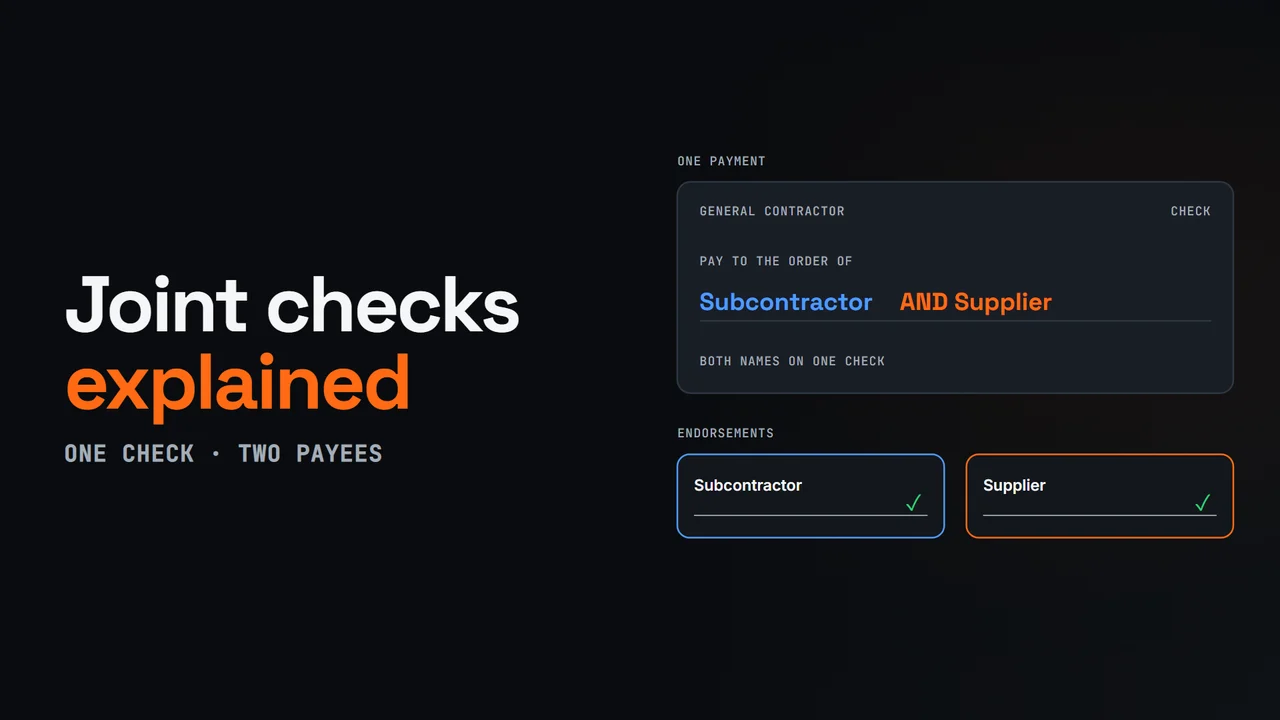
Diagram from this explainer
Chapters
- 0:00 One check, two payees
- 0:17 Why GCs use them
- 0:40 The joint check agreement
- 0:57 One illustrative payment
- 1:20 Waivers and the joint check rule
- 1:38 Joint checks in os.construction
Video transcript
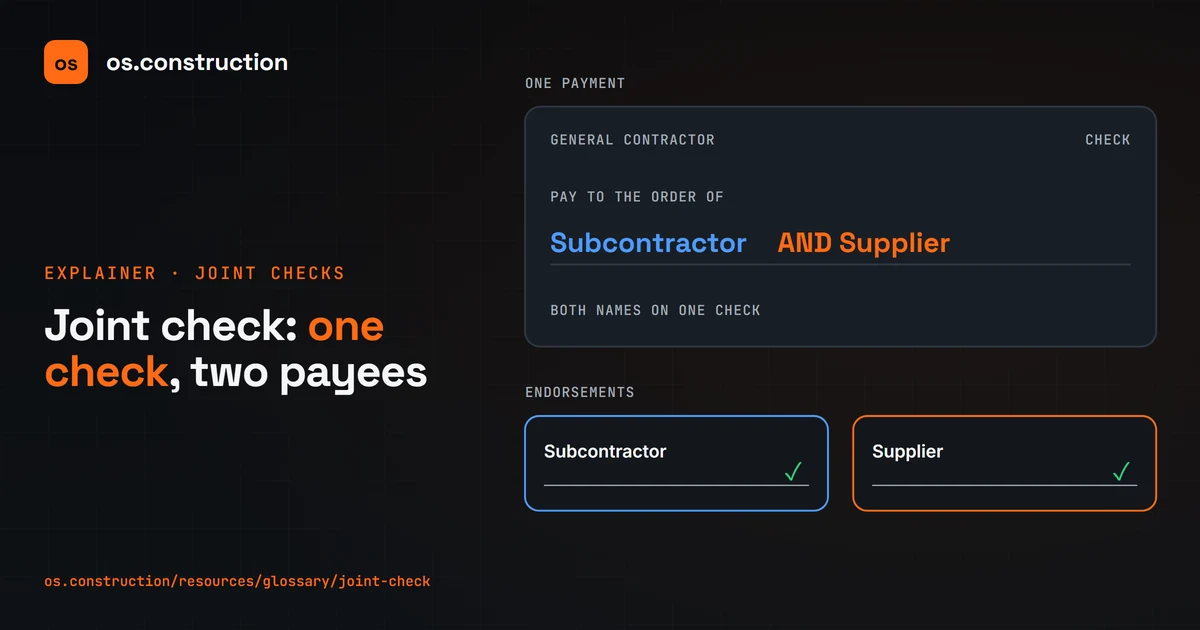
A joint check is a payment made out to two payees, usually a subcontractor and one of its suppliers. Both have to endorse it before it can be deposited, so the supplier knows it will be paid from the funds. General contractors use it to manage lien risk.
Why bother? A supplier to a sub can usually lien the project, or claim on a payment bond, even if the GC has already paid the sub. So when a supplier sends a preliminary notice, or a sub looks financially stretched, paying jointly helps make sure the money reaches the supplier, and nobody pays for the same materials twice.
Put it in writing. The GC, the sub and the supplier sign a joint check agreement. It names the invoices or materials it covers, how much of each payment goes jointly, how the funds are split after endorsement, and which lien waivers the supplier gives in return.
Here's an illustrative pay app. The sub's approved billing is three hundred ten thousand dollars, less ten percent retainage, so two hundred seventy-nine thousand is due. The GC pays one hundred twenty thousand by joint check to the sub and its switchgear supplier, and one hundred fifty-nine thousand to the sub alone. The sub's balance drops by the full two hundred seventy-nine thousand.
Collect a conditional lien waiver from the supplier with the check, and an unconditional one once it clears. Some states apply a joint check rule that treats an endorsing supplier as paid up to the check amount, but whether it applies varies by state. General information, not legal advice.
In os.construction Accounting, a payment run can pay a bill by check with up to five joint payees, and the bill stays matched to its commitment, retainage and lien waivers.
Your next step
See it on one project record.
Create an account and open the sample project to see contracts, costs, changes and billing on the same record.
Try it in the app