ASI vs field order vs CCD vs change order
Who issues each of the four change documents, who signs, and whether the contract price or time moves.
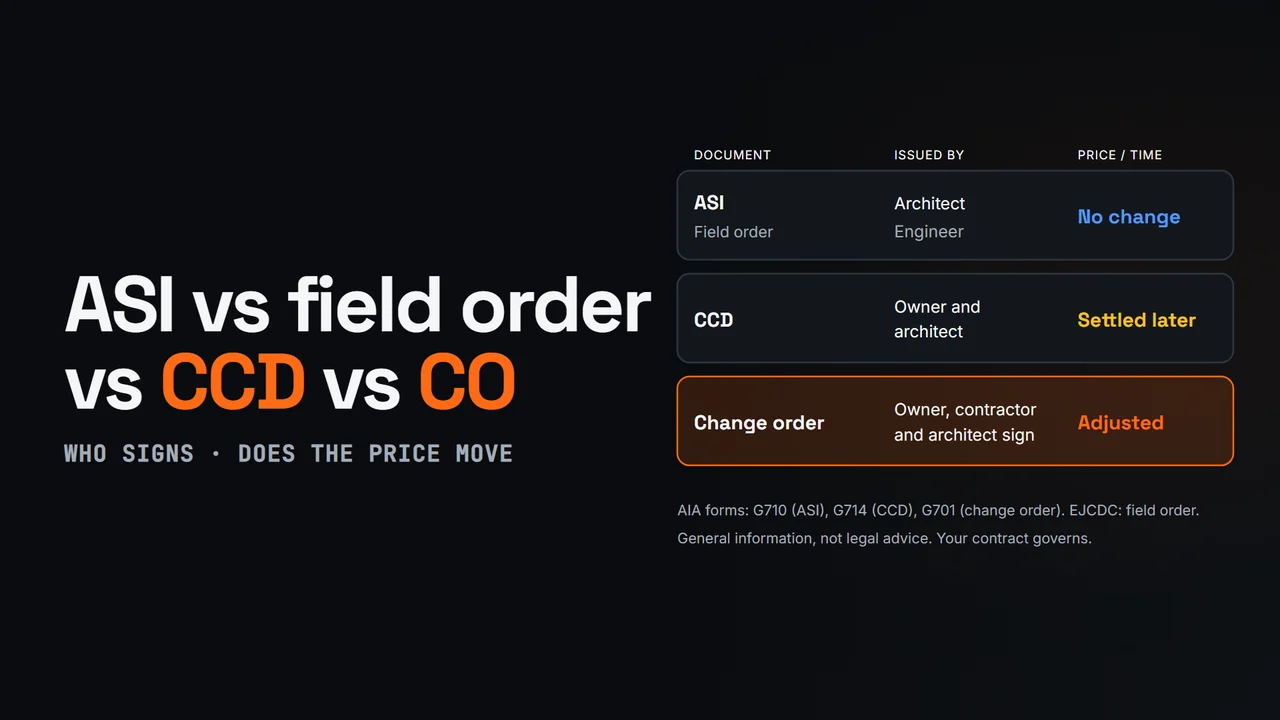
Diagram from this explainer
Chapters
- 0:00 Four change documents
- 0:14 ASI (AIA G710)
- 0:35 Field order (EJCDC)
- 0:53 CCD (AIA G714)
- 1:13 Change order (AIA G701)
- 1:30 Recap
- 1:41 One change chain
Video transcript
Four documents can change what gets built on a job: the ASI, the field order, the construction change directive and the change order. They differ in who issues them, and whether the price or the schedule moves.
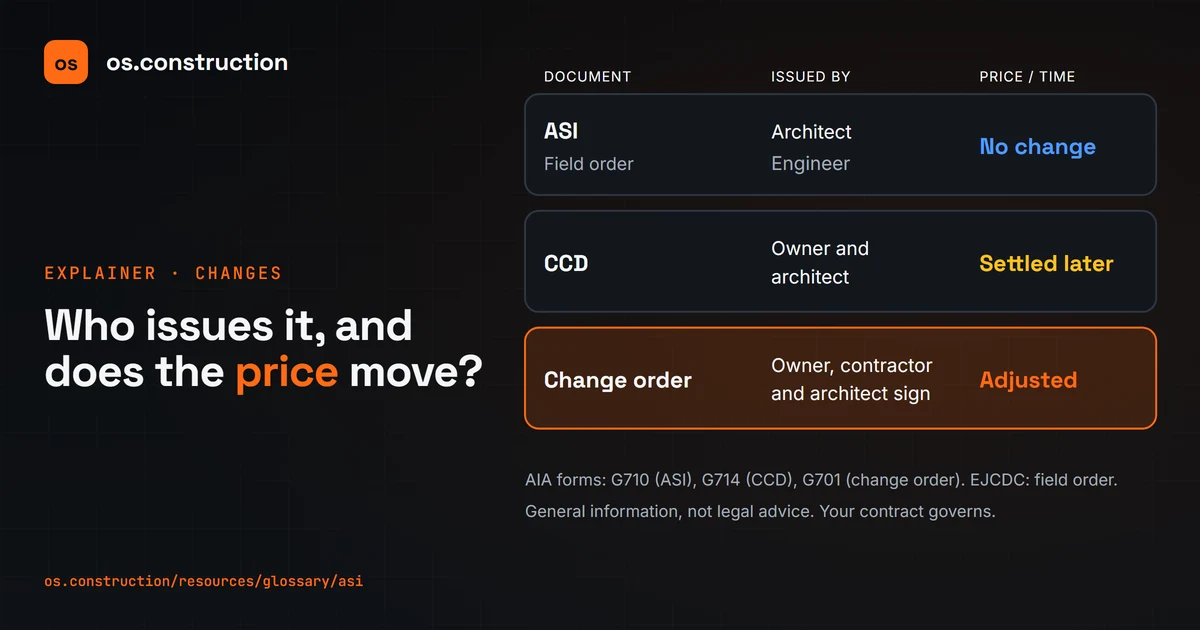
An architect's supplemental instruction, or ASI, comes from the architect. On AIA contracts it's form G710. It clarifies the documents or orders a minor change, with no change to the contract sum or time. If you think it does cost money or time, say so in writing before you proceed.
A field order plays the same role on many engineering contracts. Under EJCDC general conditions, the engineer issues it for a minor change with no change in price or times. Some owners use the term loosely, for work directed now and priced later, so read how your contract defines it.
A construction change directive, or CCD, is for real changes when the price isn't agreed yet. The owner and architect sign it, AIA form G714, and the contractor proceeds. The price is settled later, often from documented time and materials, so track that cost on its own code.
A change order is the agreement itself. The owner, contractor and architect sign it, AIA form G701, and it adjusts the contract sum, the contract time, or both. A CCD usually ends up as a change order once the price is settled.
So, ASI and field order: minor, with no price or time change. CCD: do the work now, settle the price later. Change order: the signed change to price or time.
In os.construction, a potential change starts as a change event, linked to the RFI behind it, gathers pricing and T&M tickets, and carries through to a change order on the same project record.
Your next step
See it on one project record.
Create an account and open the sample project to see contracts, costs, changes and billing on the same record.
Try it in the app