RFI response time: why answers stall and how ball in court fixes it
Most late RFIs aren't waiting on a hard question. They're waiting on someone who doesn't know it's their turn: the designer who never saw it, or the PM who got the answer and never closed it. Ball in court puts a name on every open RFI.
Answered in time isn't closed in time
Twelve closed RFIs against a 7-day contract response period. 8 of 12 were answered inside it; only 4 were closed inside it. The other 40 days were spent with the answer already in hand, waiting for the GC to review, distribute and close. Illustrative log. Run your own in the RFI response time calculator.
Every open RFI has a name on it
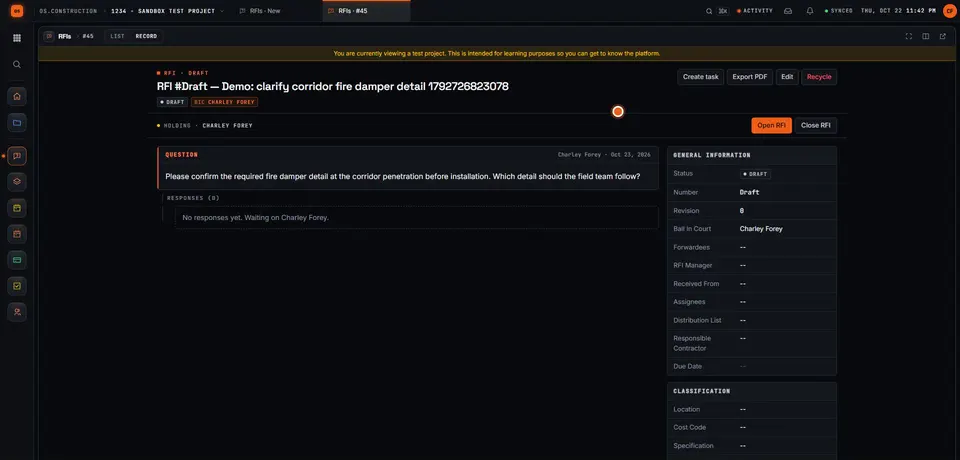
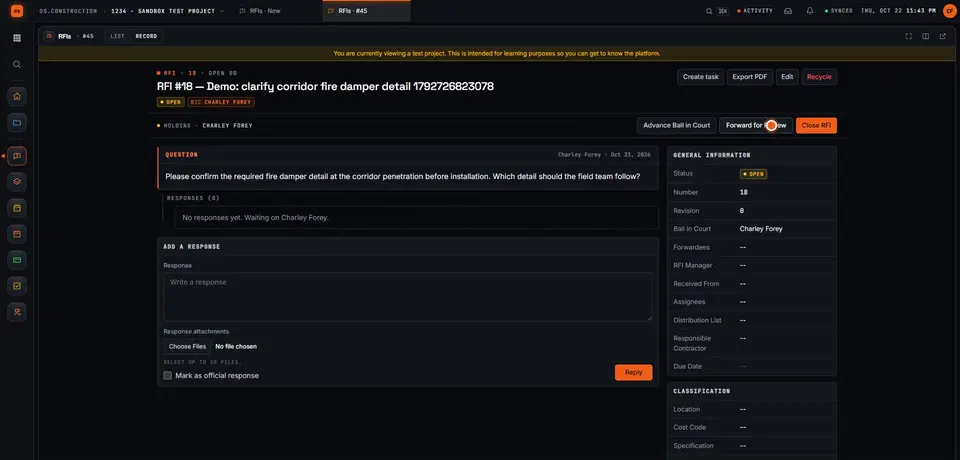
os.construction works out who holds each RFI from where it is. Nobody has to remember to reassign it, and the holder sees it in their open items.
Four habits that keep RFIs moving
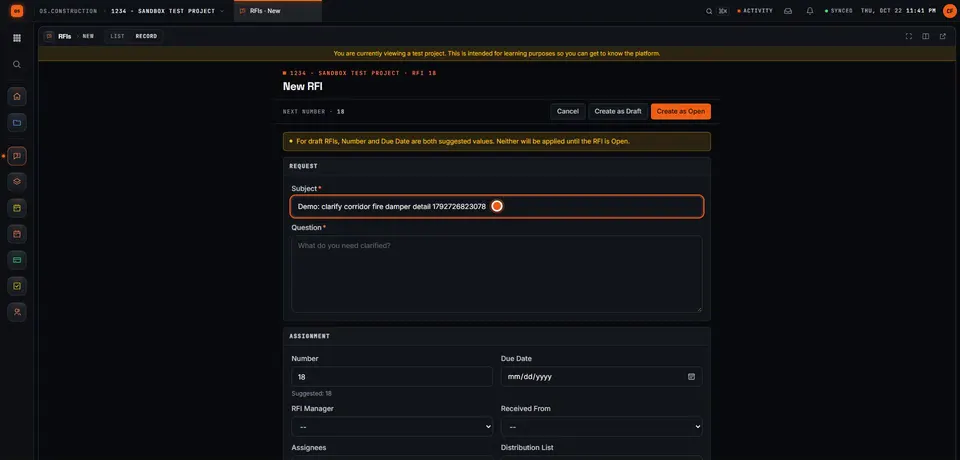
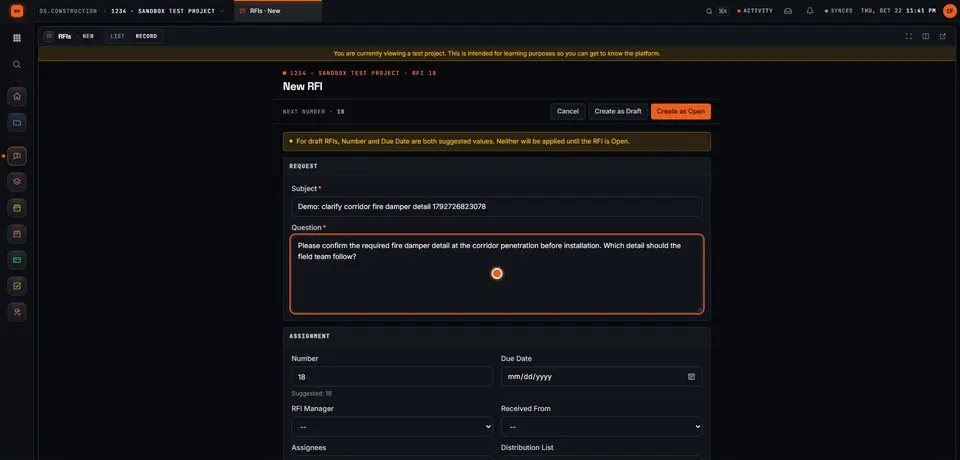
01 Ask one clear question, and review it as a draft
A vague question earns a vague answer and a second round trip. Name the decision in the subject, and say what the field needs to proceed. An RFI starts as a Draft, held by its creator, so someone can check it before it goes out. The number and due date take effect when you open it.
02 Give it a due date and the right assignees
Set the due date from your contract's response period: the app doesn't calculate it for you, and an RFI with no due date can never be late. Assignees are the people who must answer; the RFI manager is the person on your side who owns it. When the due date passes, the RFI shows "3d late" in red, counts on the list's Overdue card ("Past due — chase now"), and appears under the Overdue Only filter. Inside a week it shows the days left.
03 Open it, and the ball moves to the assignees
Open RFI gives it a number and hands the ball to the assignees. If they need someone else, Forward for Review sends it to that person and makes them the holder. Each move notifies the people it's moving to.
04 When the answer lands, it's your turn: close it
Every reply moves the ball to the RFI manager, because a reply needs reviewing. If it answers the question, Mark as official and Close RFI; a reply never closes the RFI by itself, which is where the waiting days in the chart come from. If it doesn't, Advance Ball in Court hands it back to the assignees with the notification that goes with it.
05 Watch the trend, not just the list
The project management analytics show Open RFIs and Late RFIs, a heatmap of open RFIs by ball in court and age, and Are RFIs answered faster?: RFIs raised each month against their average days to close. On Riverside, 23 RFIs are open and 4 are late; the heatmap shows whose desk they're on.
Not today: automatic reminders or escalation when an RFI goes overdue (notifications go out when someone acts on it), due dates calculated from the contract or in business days, and closing an RFI automatically on an official response. A past-due draft counts as overdue too, so open drafts or clear their dates.
Keep going
Keep exploring
Related across os.construction
- GlossaryBall in CourtWho has to act next on an RFI, submittal, punch item or other open record, so the item never waits without an owner.
- ExplainerFind anything: search, open items and ball in courtHow os.construction finds records across tools: Spotlight and the search page, My Open Items, and the ball in court rules for each tool.
- GlossaryMeeting MinutesThe written record of a project meeting: who attended, what was decided on each topic, who owns each open item and by when.
- DocsRFIsCreate, route, answer and close RFIs in the app. Ball in court, distribution, official responses, related items, private RFIs and PDF export.
- DocsSubmittalsBuild the submittal log, group submittals into packages, generate them from spec sections, and route each one through ordered approvers with ball in court.
- BlogHow to create and open a draft RFI in os.constructionWrite a clear question, save an RFI as a draft, review the record, and confirm it has opened in os.construction.
Sample project included
Try this workflow on the sample project
Every trial workspace includes a sample project with sample data, so you can follow these steps in the app before touching a live job.
Want this on live job data?
RFIs, ball in court and RFI analytics are live in os.construction. There are no automatic reminders when an RFI goes overdue, and due dates aren't calculated from your contract.
14-day free trial. Pricing for paid plans isn't set yet. Talk to us. Already have an account? Sign in →
All figures are illustrative sample data, not a real project. Contract terms and state law decide how retainage, stored materials and change orders work on your job. Check both.